

Key Takeaways
Minimum Viable Habitat
A minimum viable habitat is the smallest living space that genuinely meets a small pet's physical, behavioral, and psychological needs. It's not just about fitting inside the cage - it's about having enough room to move, explore, burrow, and express natural behaviors without chronic stress. For most small pets, this threshold is significantly higher than what typical pet-store cages offer.
Animal welfare science uses the concept of 'behavioral needs' - species-specific actions an animal is strongly motivated to perform regardless of environment. Space deprivation that prevents these behaviors is recognized as a welfare problem, not merely a comfort issue.
The Gap Between 'Fits' and 'Thrives'
Walk into almost any pet store and you'll find small cages marketed for hamsters, gerbils, or rabbits - colorful, compact, and priced to sell. The problem isn't that these enclosures look bad. It's that many of them are genuinely too small to support healthy animal behavior, regardless of how they're labeled or displayed.
The confusion comes from a common misunderstanding: people assume that because an animal is small, it needs very little space. In reality, many small pets are highly active animals with complex behavioral needs. Hamsters in the wild travel several miles in a single night. Rabbits are built to sprint and leap. Guinea pigs thrive when they can roam and socialize. A cage that simply contains an animal is not the same as one where that animal can actually live well.
For a deeper look at what science says about small pet behavior, our article on small pet myths separates fact from common assumption across several popular species.
775 sq in
Recommended minimum floor space for a Syrian hamster
Widely cited by European animal welfare bodies and increasingly referenced by US exotic animal veterinarians as a baseline standard.
7.5 sq ft
Minimum space suggested for a pair of guinea pigs
Recommended by the Humane Society of the United States; larger groups require proportionally more floor area.
Several miles
Distance wild hamsters travel nightly
Field research on Syrian and European hamsters documents extensive nightly foraging ranges, underscoring why exercise and space matter even in captivity.
What Each Species Actually Needs
Space requirements aren't one-size-fits-all - they depend on species, activity level, and social structure. Here's a practical breakdown:
- Hamsters: Syrian hamsters require substantial floor space - many welfare organizations recommend a minimum of around 775 square inches. Just as important is bedding depth: hamsters are burrowing animals and need at least 6-8 inches of substrate to dig tunnels. Without it, they often show signs of frustration. The common hamster owner mistakes guide covers this in more detail.
- Gerbils: Social animals that do best in pairs, gerbils need horizontal space to run and tunnel. A gerbilarium - a tank-style enclosure with deep bedding - typically serves them better than a standard wire cage. See how gerbils and hamsters differ to understand why their needs diverge.
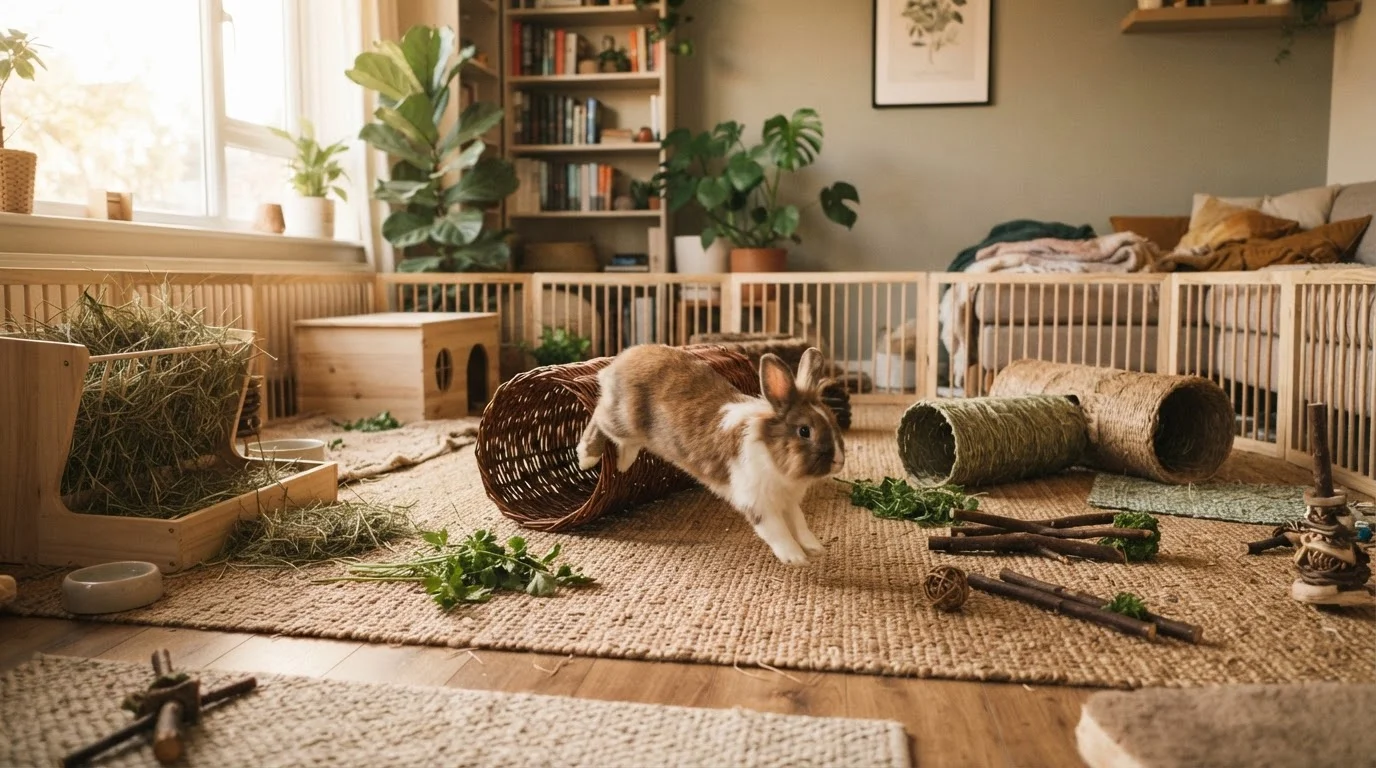
- Rabbits: Among the most space-hungry of popular small pets, rabbits need room to perform their full range of locomotion - binkying (a joyful leap-and-twist), stretching, and foraging. Most welfare guidance calls for an enclosure significantly larger than the standard hutch, paired with regular supervised free-roaming time.
- Guinea pigs: These highly social animals do best in pairs or groups and need open floor space rather than vertical height. The Humane Society suggests a minimum of 7.5 square feet for a pair, with more recommended.
Check Cage Size Before You Buy
Look up the specific floor space and bedding depth requirements for your intended pet before purchasing any enclosure. Pet store cage labels don't always reflect current welfare guidance. Consulting an exotic animal vet or a reputable rescue organization for housing recommendations is a reliable extra step.
Signs Your Pet's Space Isn't Working
Animals can't tell you they're uncomfortable - but their behavior often does. Knowing what to watch for helps you respond before chronic stress affects long-term health.
Stereotypies - repetitive behaviors with no clear function - are one of the most recognized welfare indicators in captive animals. In small pets, these often look like:
- Bar-chewing or rattling the cage walls repeatedly
- Pacing the same route in a tight loop
- Persistent digging in corners where there's nothing to dig
- Excessive, frantic wheel running that doesn't slow down even when the animal seems tired
These behaviors don't mean the pet is defective or poorly trained. They typically signal that the environment isn't meeting the animal's behavioral needs. If you notice them, expanding the enclosure and increasing enrichment is a reasonable first step - and consulting an exotic animal veterinarian is worthwhile if the behavior persists. Our guide to when small pets need a vet explains when behavioral changes warrant professional attention.
Making Space Work in a Real Home
Upgrading your pet's habitat doesn't always require a dramatic overhaul. Some practical approaches include:
- Repurpose larger containers: Large storage bins, glass aquariums, or custom wooden enclosures can often provide more space than commercial cages at similar or lower cost.
- Add supervised free-roaming time: For rabbits especially, a rabbit-proofed room or pen where they can roam safely each day significantly supplements their enclosure.
- Layer enrichment, not just floor space: Tunnels, hides, foraging opportunities, and appropriate bedding depth make a space feel larger and more stimulating. Small pet enrichment ideas offers species-specific suggestions.
- Plan before you bring a pet home: Space needs are easiest to meet when you've set up the habitat in advance. Our preparation checklist for new small pets walks through everything to have ready ahead of time.
If you're still deciding which small pet suits your home, comparing guinea pigs, hamsters, gerbils, and rabbits can help you match a species to your actual living situation - space included.