

Key Takeaways
Option A
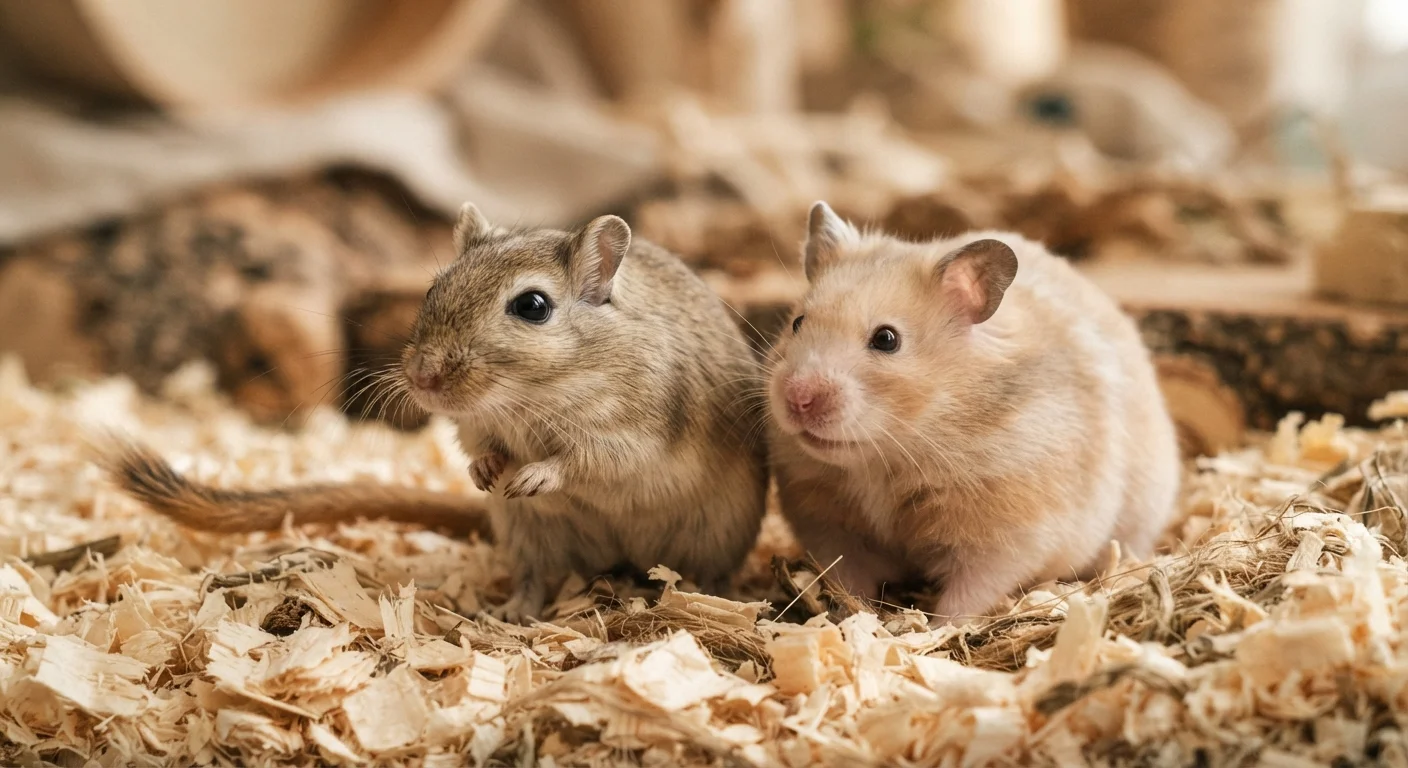
Gerbil
The social, curious daytime explorer.
Best for: Owners who want an active pet they can watch interact with a companion throughout the day.
Option B
Hamster
The independent, low-maintenance solitary pet.
Best for: Owners with evening schedules who prefer a single pet with predictable, contained care routines.
If you want to watch entertaining social interactions between pets
Gerbil
Gerbils live happily in bonded pairs and engage in grooming, play, and exploration together, giving owners far more visible activity to enjoy.
If your household is busiest in the evenings and quieter during the day
Hamster
Hamsters are nocturnal and naturally come alive after dark, fitting well with owners who are home and awake during evening hours.
If you are looking for a longer-term small pet commitment
Gerbil
With a typical lifespan of 3-5 years compared to a hamster's 2-3, gerbils offer a somewhat longer relationship for dedicated owners.
If you want a single pet that is straightforward to house and feed
Hamster
Hamsters are naturally solitary, so there is no need to source or bond a pair, and their care routine is well-documented and manageable solo.
If you are choosing a first small pet for a calm, older child
Hamster
A well-handled Syrian hamster tends to be more tolerant of being held than the faster, more skittish gerbil - though adult supervision remains essential.
Activity Patterns: When Will You Actually See Your Pet?
One of the most practical differences between gerbils and hamsters is when they are awake. Hamsters are nocturnal - they sleep through much of the day and become active after sunset. This means daytime handling can stress a hamster; waking them mid-sleep is a common mistake that can lead to biting or lethargy. For more on this, see common hamster owner missteps.
Gerbils, by contrast, follow a polyphasic pattern - meaning they cycle through short bursts of activity and rest throughout the full 24-hour day. You are likely to see your gerbils digging, running, and exploring at various points during daylight hours, which many owners find more rewarding. Neither animal should be forced awake during its natural rest period.
3-5 yrs
Typical gerbil lifespan
Gerbils generally outlive hamsters by one to two years, according to veterinary reference ranges used in small animal practice.
6-8 in
Minimum recommended bedding depth
Animal welfare organizations commonly recommend at least 6 to 8 inches of substrate to allow natural burrowing behavior in both species.
Solitary
Syrian hamster housing preference
Syrian hamsters are territorial by nature and should not be housed with other hamsters, a fact confirmed by multiple small animal welfare guidelines.
Social Needs: One Pet or Two?
This is arguably the most important difference between the two species. Gerbils are inherently social animals. In the wild, they live in family groups, and keeping a single gerbil alone can cause chronic stress and boredom. Most animal welfare organizations recommend housing gerbils in same-sex pairs or small same-sex groups. Introducing unfamiliar adult gerbils carries a risk of fighting, so ideally you would adopt a pre-bonded pair from the same litter.
Hamsters, with the exception of some dwarf species, are solitary. The Syrian hamster - the most common pet variety - is territorial and will fight aggressively if housed with another hamster. Even dwarf species sometimes do not tolerate cage-mates. Housing two Syrians together is a welfare problem, not a solution to loneliness. For a broader look at small-pet social myths, our article on small pet loneliness myths covers this topic in depth.
| Criterion | Gerbil | Hamster |
|---|---|---|
| Activity pattern | Active in bursts, day and night | Primarily nocturnal |
| Social needs | Needs a companion (pair recommended) | Solitary (Syrians especially) |
| Typical lifespan | 3-5 years | 2-3 years |
| Handling temperament | Curious but quick and hard to hold | Calmer when well-socialized |
| Bedding depth needed | 6+ inches for burrowing | 6-8+ inches recommended |
| Biting risk | Low; may nip if startled | Low; higher if woken during day |
| Best enclosure type | Tank/gerbilarium with mesh lid | Deep tank or bin cage |
Handling and Temperament
Both gerbils and hamsters can become comfortable with gentle, regular handling - but their baseline temperaments differ. Gerbils are naturally curious and will often approach your hand, but they are also fast and agile, making them harder to hold securely without practice. They rarely bite unprovoked, though startled gerbils can nip.
Hamsters, when properly socialized from a young age, can become quite calm in human hands. Syrian hamsters in particular tend to sit still and explore at a slower pace compared to gerbils. However, a hamster that is handled during the day - while it would naturally be sleeping - is more likely to bite out of disorientation. Patience and a consistent handling schedule matter for both species.
Neither animal is suitable for rough handling or for very young children without close adult supervision. Their small bones make them vulnerable to accidental injury.
Space, Habitat, and Enrichment
Pet store cage sizes are frequently too small for either species. Both gerbils and hamsters need far more room to thrive than a typical starter kit provides. If you are setting up a habitat, our guide on space requirements for small pets explains what animal welfare research actually recommends.
Gerbils need deep substrate - at least 6 inches - for burrowing, which is a core natural behavior. A tank-style enclosure (often called an aquarium or gerbilarium) with a secure mesh top works well. They are prolific diggers and chewers, so enrichment like cardboard tubes and wooden toys helps prevent boredom.
Hamsters also require deep bedding - a minimum of 6-8 inches is widely recommended by welfare organizations - along with a wheel large enough for their body size. A wheel that is too small forces an unnatural curved spine posture and can cause injury over time. Both animals benefit from hiding areas, foraging opportunities, and regular cage cleaning on a consistent schedule.
If you are weighing other small pet options alongside these two, the overview in choosing between guinea pigs, hamsters, gerbils, and rabbits is a useful starting point.
A Note on Dwarf Hamster Species
Not all hamsters are the same. Roborovski and Campbell's dwarf hamsters are sometimes kept in pairs, unlike the Syrian hamster. However, even dwarf species can become aggressive toward cage-mates, and introductions should be done carefully. If you are considering a dwarf variety, speak with a knowledgeable exotic animal veterinarian or a reputable small animal rescue for species-specific guidance.