

Key Takeaways
Option A
Caulk
The permanent, flexible sealant for stationary gaps.
Best for: Sealing fixed cracks and gaps where two surfaces meet but don't move - such as around window frames, baseboards, and wall penetrations.
Option B
Weatherstripping
The compressible seal for moving parts.
Best for: Creating an airtight seal on doors, operable windows, and any gap that opens and closes repeatedly with use.
If you're sealing a visible crack between a window frame and your interior wall
Caulk
This is a fixed joint that never moves. Caulk bonds permanently to both surfaces and creates a smooth, paintable seal that weatherstripping can't replicate here.
If cold air is seeping under or around an exterior door
Weatherstripping
Door edges open and close constantly. Weatherstripping is designed to compress and recover with each use, while caulk would crack and fail quickly in this location.
If you're sealing around a pipe, wire, or duct passing through an exterior wall
Caulk
Penetrations through walls are static gaps. Caulk fills irregular shapes and hardens into a durable, airtight seal that weatherstripping cannot conform to.
If you have a sliding or double-hung window that rattles or lets in drafts
Weatherstripping
Sliding window sashes move along tracks and need a compressible material that can maintain a seal through repeated motion without tearing.
If you want to address both a drafty door and its surrounding frame
Caulk
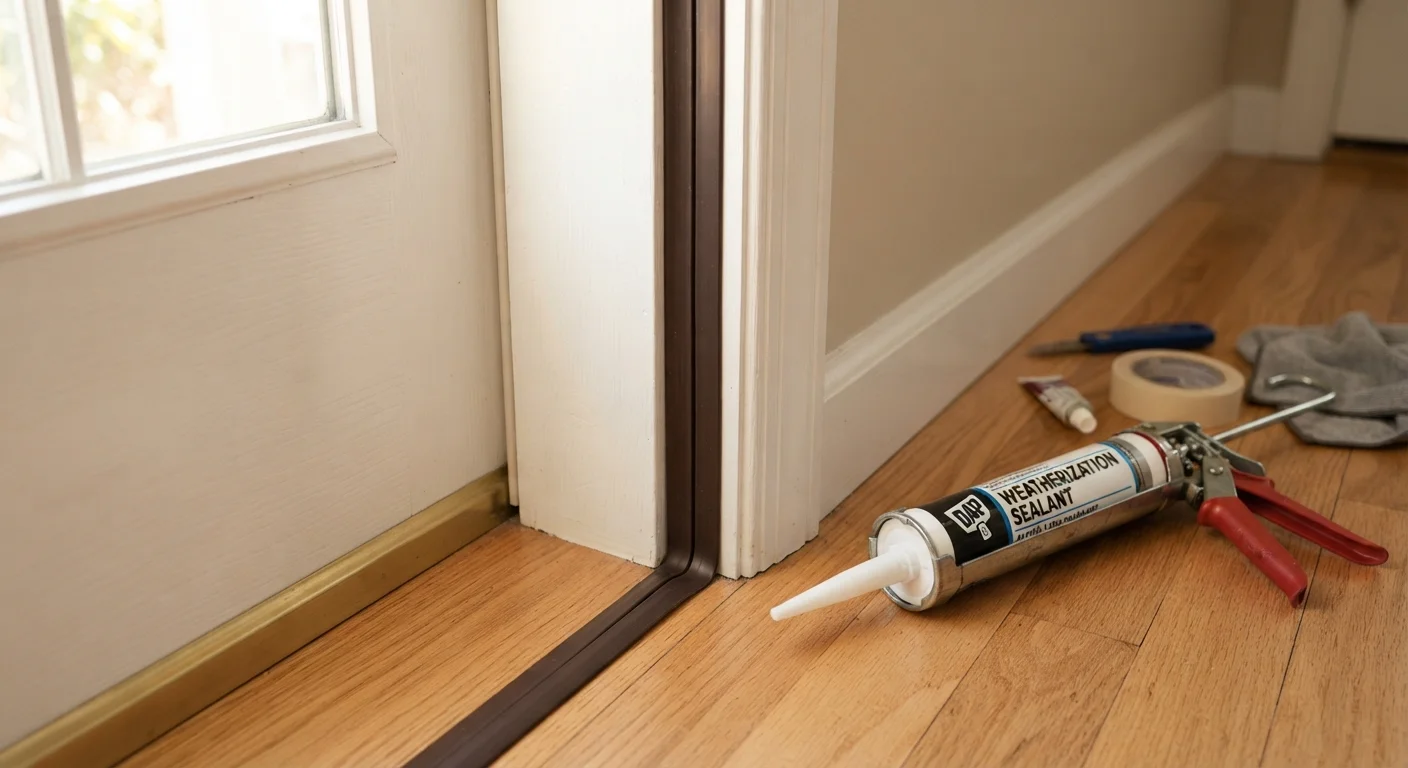
Use weatherstripping on the door sash itself, but caulk the fixed joint between the door frame and the wall - both materials work together in this common scenario.
Why the Distinction Matters
A drafty home is one of the most common complaints among homeowners and renters alike. The fix sounds simple - seal the gaps. But reaching for the wrong material is one of the most frequent beginner mistakes in home improvement. Caulk applied to a moving door gap will crack within weeks. Weatherstripping stuck across a static crack in drywall won't bond properly and will peel away.
The key question to ask before you start is simple: Does this gap ever move? If the answer is no, caulk is almost always your tool. If the answer is yes - even occasionally - weatherstripping is the right choice. Understanding this single rule will save you from redoing the job a month later.
| Criterion | Caulk | Weatherstripping |
|---|---|---|
| Best location | Fixed, stationary gaps | Moving parts (doors, windows) |
| Application method | Caulk gun, smoothed by hand | Self-adhesive tape or nails |
| Durability | 5-20 years (varies by type) | 1-5 years with regular use |
| Handles movement? | No - cracks under repeated flex | Yes - designed to compress and recover |
| Paintable? | Yes (latex/acrylic types) | Generally no |
| Tools required | Caulk gun, putty knife | Scissors or utility knife |
| Cost | Low | Low |
Where Caulk Belongs
Caulk is a flexible sealant that cures (hardens) after application to form a durable, airtight bond. It comes in tubes and is applied using a caulk gun - a simple, inexpensive tool. Common types include silicone caulk (water-resistant and long-lasting, ideal for exterior use) and latex or acrylic caulk (easier to clean up and paintable, better for interior trim work).
Apply caulk to these areas:
- Around window frames - the joint between the fixed frame and the interior or exterior wall surface
- Along baseboards and door casings - where trim meets the wall or floor
- Around exterior penetrations - pipes, wires, vents, and ducts passing through walls
- At the sill plate - the bottom edge of the wall where it meets the foundation
For a deeper look at where caulk tends to wear out first, see our guide to the spots where caulk fails fastest. Also note that caulk has specific rules in tile work - not every joint should be caulked. Our article on grout vs. caulk in tile joints explains the difference.
30%
Heat loss from air leaks in a typical home
The U.S. Department of Energy estimates that air leaks through gaps, cracks, and openings can account for up to 30% of a home's heating and cooling energy use.
$0.50
Approximate cost per linear foot of foam weatherstripping
Foam tape weatherstripping is one of the most affordable home improvement materials available at hardware and home improvement stores across the US.
Where Weatherstripping Belongs
Weatherstripping refers to a family of compressible materials - foam tape, V-strip (tension seal), door sweeps, and rubber gaskets - designed to fill the gap between a moving part and its frame each time that part closes. Unlike caulk, weatherstripping must survive thousands of compression and release cycles without cracking or losing its shape.
Apply weatherstripping to these areas:
- Exterior door edges - along the top and sides of the door where it meets the door stop (the small strip of wood the door closes against)
- Door bottoms - a door sweep attached to the door base seals the gap between the door and the threshold
- Operable windows - sliding, double-hung, and casement windows all have moving sashes that benefit from foam tape or V-strip along their tracks
- Garage doors - perimeter seals and bottom seals are forms of weatherstripping
When shopping for weatherstripping, check the gap size you're filling. Foam tape is best for small, even gaps; V-strip metal or plastic works well for uneven gaps along door edges. Most weatherstripping is self-adhesive or attached with small nails and can be replaced without special tools.
When to Use Both at the Same Door
A standard exterior door typically needs both materials working together. Weatherstripping seals the door sash against the door stop on the top and sides. A door sweep handles the bottom gap. Caulk then seals the static joint between the door frame (casing) and the surrounding wall. Treating these as separate tasks - each with the right material - gives you the most complete seal.
Applying Both Materials: Quick-Start Tips
Both caulk and weatherstripping work best on clean, dry surfaces. Before applying either, wipe down the area with a damp cloth and let it dry fully. Remove any old, cracked caulk with a putty knife or caulk removal tool. Pull off peeling weatherstripping completely before laying new material.
For caulk: cut the tube tip at a 45-degree angle for a smooth bead. Apply in a single, steady motion and smooth the bead with a damp finger or a caulk tool immediately. Most interior latex caulks are paintable within a few hours; check the product label for cure time before painting.
For weatherstripping: measure twice before cutting. It's better to cut slightly long and trim down than to come up short. Press foam tape firmly along its entire length and close the door or window to test the seal - you should feel light resistance but be able to open and close without forcing.
In many spots around a door, you'll use both: weatherstripping on the door edges and a door sweep at the bottom, plus caulk around the fixed door frame where it meets the wall. They work as a team, not competitors.