

Key Takeaways
Start With Your Bag, Not Your Clothes
Most first-time travelers make the same mistake: they pull out every item they might want and then try to find a bag big enough to hold it all. That approach almost always leads to an overloaded, unwieldy bag. Flip the process - choose your bag first, and let it define your limits.
There are three common bag formats to understand:
- Carry-on suitcase: Wheeled, usually around 22"×14"×9", fits most airline overhead bins. Good for urban travel with smooth surfaces.
- Travel backpack: Frameless bags ranging from 30 to 50 liters. Hands-free and maneuverable - ideal for mixed terrain, transit-heavy trips, or budget airlines with strict size rules.
- Personal item bag: A smaller daypack or tote that fits under the seat in front of you. Used as a supplement, not a standalone bag for multi-day travel.
A 40-liter backpack or a standard carry-on suitcase is sufficient for most trips up to two weeks when you pack intentionally. Going checked-baggage means added fees on many airlines and waiting at carousels - not worth it for most beginner trips.
Let Your Bag Set the Packing Limit
When you choose a carry-on or a 40-liter backpack first, you give yourself a physical constraint that does the editing work for you. If it doesn't fit, it doesn't go - no willpower required. This simple rule is one of the most effective packing habits you can adopt as a first-timer.
If you're still working through the bigger picture of trip planning, see our complete trip planning walkthrough for context on how packing fits into the full process.
Build Your Packing List Before You Pack
A packing list is not just a memory aid - it's a decision-making tool. Writing one forces you to think through each day of your trip rather than defaulting to "I might need this."
Start by answering these questions:
- How many days is the trip?
- What is the expected weather range?
- What activities are planned - hiking, swimming, formal dinners, city walking?
- Will laundry be available? If yes, you can repeat outfits and pack fewer clothes.
- Are there any airline restrictions on liquids or bag dimensions?
Once you have those answers, write a category-by-category list before touching your closet. This separates the planning from the physical packing and prevents the "I'll just throw it in" impulse that causes overpacking.
~50%
Items packed but never used on a trip
Travel surveys and packing studies consistently find that roughly half of packed items go untouched, suggesting most travelers chronically overpack.
3.4 oz
TSA liquid limit per container (carry-on)
The U.S. Transportation Security Administration requires all carry-on liquids to be in containers of 3.4 ounces (100ml) or less, all fitting in one quart-sized clear bag.
40 L
Bag volume sufficient for most 1-2 week trips
Many experienced travelers and travel writers cite a 40-liter bag as the practical ceiling for comfortable carry-on travel lasting up to two weeks.
After each trip, update your list with notes on what you used and what stayed in the bag untouched. Over time, this becomes a personalized master list you can adapt to any destination. For a deeper look at how experienced travelers approach this, see our guide on smart packing habits.
The Core Categories Every Traveler Needs
Regardless of destination, most trips require packing across the same broad categories. Here's a practical breakdown:
- Clothing
- Plan outfits, not individual items. Aim for pieces that mix and match across at least two or three combinations. Neutral colors make this easier. Include one layer for cold, one for rain if the forecast calls for it.
- Toiletries
- Travel-size containers of your essentials. If flying, liquids must be 3.4 oz (100ml) or under and fit in a single quart-sized clear bag for carry-on. Solid alternatives - shampoo bars, solid sunscreen - sidestep the liquid rule entirely.
- Medications and health items
- Any prescription medication in its original labeled container, plus a small supply of over-the-counter basics (pain reliever, antacids, blister treatment). Carry medications in your personal item, not checked luggage.
- Electronics
- Phone, charger, any adapters required for your destination's outlets, and a portable battery bank for long travel days. Most destinations outside North America use different plug types - verify before you go.
- Documents
- Passport, ID, any required visas or travel authorizations, insurance card, and printed or downloaded copies of bookings. Covered in more detail in the next section.
Do a dress rehearsal pack two days before departure, then leave the bag untouched for 24 hours. When you return to it, you'll immediately spot what you were second-guessing - remove those items.
The act of stepping away removes the anxiety-driven impulse to add "just in case" items. Distance gives clarity that packing in the moment rarely does.
Lay every item from your list on your bed before putting anything in the bag. If you can't see it all at once, your list is already too long.
Visual auditing surfaces excess before it enters the bag, making it easier to edit rather than trying to remove things once they're packed and justified.
How to Pack Efficiently (Without Overstuffing)
Once your list is finalized, the physical packing process matters. These methods help you fit more without forcing a zipper:
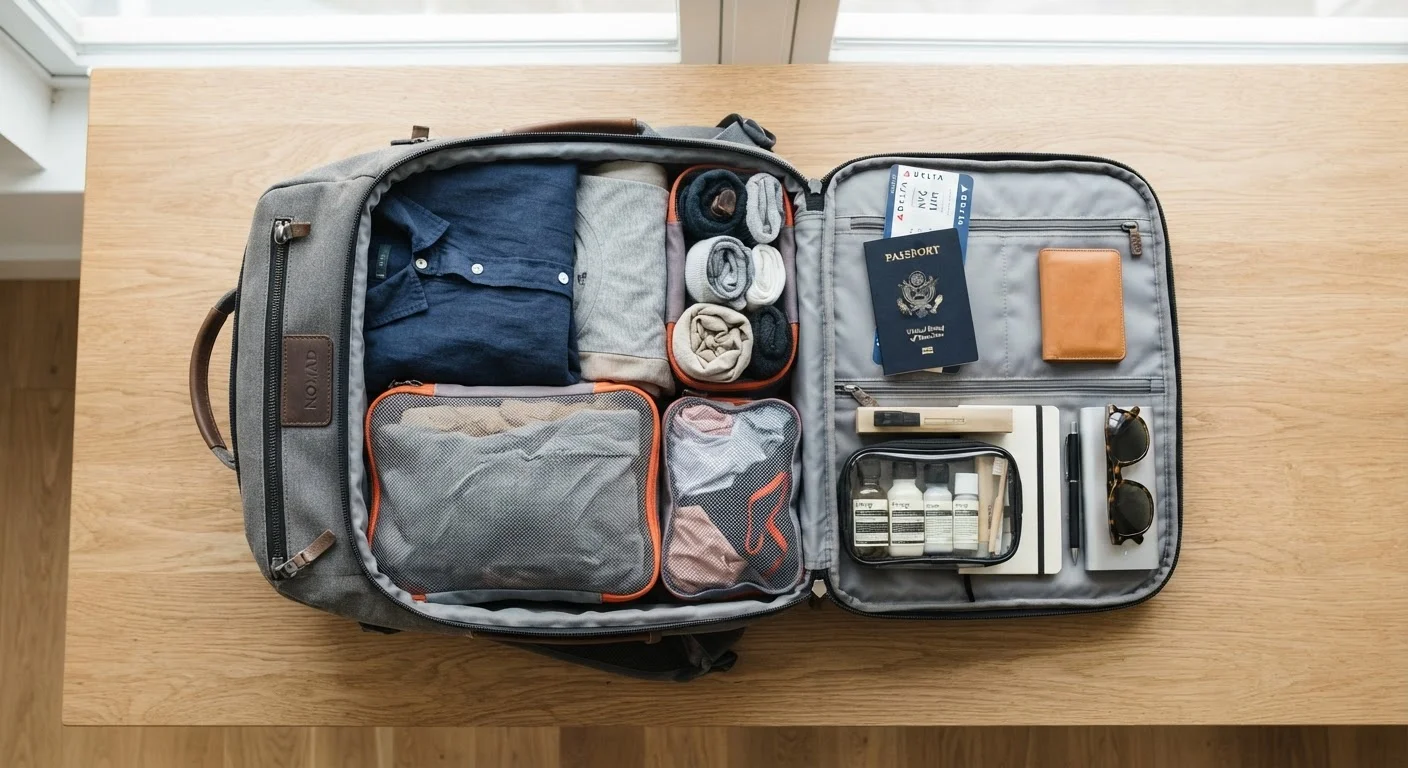
- Rolling clothes reduces wrinkles in casual garments and compresses volume more efficiently than flat folding for most items like t-shirts, jeans, and workout clothes.
- Packing cubes are fabric organizers that compress clothing and keep categories separated. They're not required, but many travelers find them transformative for staying organized mid-trip.
- Heaviest items go closest to your back (for backpacks) or at the bottom near wheels (for suitcases). This balances the load and reduces strain.
- Shoes go in last if using a suitcase, or in the base of a backpack. Stuff socks inside shoes to use the dead space.
- Leave 20% of space unfilled. You will almost certainly acquire something during your trip - a souvenir, a layer bought on arrival, items from a pharmacy. A jam-packed bag at departure means an impossible bag on the way home.
Never Pack Your Bag to Its Absolute Limit
A bag that's completely full at departure is a problem waiting to happen. You'll almost certainly accumulate items on any trip - purchases, freebies, an extra layer bought when the weather surprised you. Pack to about 80% capacity so you have room to return home without stress or forced decisions at airport security.
Documents, Tech, and Last-Minute Checks
Your documents are the one category where losing something has serious consequences. Treat them accordingly.
Keep originals in your personal item bag - the one that stays with you at all times, not in the overhead bin. Store digital copies in a secure cloud folder you can access from your phone even without cell service. Email copies to yourself as a backup.
Before your departure day, verify:
- Passport expiry - many countries require 6 months of validity beyond your travel dates. Check each destination's specific rules through official government sources.
- Any required visas or travel authorizations, which vary by destination and your citizenship. Check requirements directly through official embassy or government websites; rules change and third-party information may be outdated.
- Travel insurance documentation. If you purchased a policy, know where your policy number is and how to contact your insurer from abroad.
For a full breakdown of every document type you might need and how to organize them, see our travel document organization guide. And don't overlook the non-packing prep tasks covered in our article on pre-departure tasks most travelers skip.
Entry requirements, visa rules, and travel advisories change. Always verify current requirements with your country's official government travel portal and the destination country's embassy or immigration authority before traveling.
Common Packing Mistakes to Avoid
Even with a list, first-timers fall into predictable traps. Being aware of them in advance is the simplest way to sidestep them.
Overpacking Is the Most Common First-Timer Error
The single most universal packing mistake is bringing too much. When in doubt, remove two items from your pile before zipping up. Most travelers who have been doing this for years report that they pack significantly less than they did on their first few trips - and travel more comfortably as a result. More stuff does not mean more prepared; it means more to carry, more to lose, and more to manage.
Beyond the big ones, watch out for:
- Packing for unlikely scenarios. "What if there's a formal event?" is a classic packing trap. Pack for what you've actually planned, not every possible situation.
- Bringing full-size toiletries. A full bottle of shampoo adds weight and takes up space. Travel sizes or decanted containers are sufficient for most trips.
- Forgetting to weigh your bag. If you're checking a bag, weigh it at home on a luggage scale or bathroom scale before going to the airport. Overweight bag fees can be expensive and are entirely avoidable.
- Packing items you can easily buy at your destination. Sunscreen, basic toiletries, and over-the-counter medicine are available almost everywhere. You don't need to carry a supply for the full trip.
For a deeper look at the thinking behind common packing errors, our article on packing myths first-timers still believe unpacks the reasoning - and how to correct it. If you're still building your foundational approach, the beginner's introduction to packing strategy is a helpful companion read.