

Key Takeaways
Option A
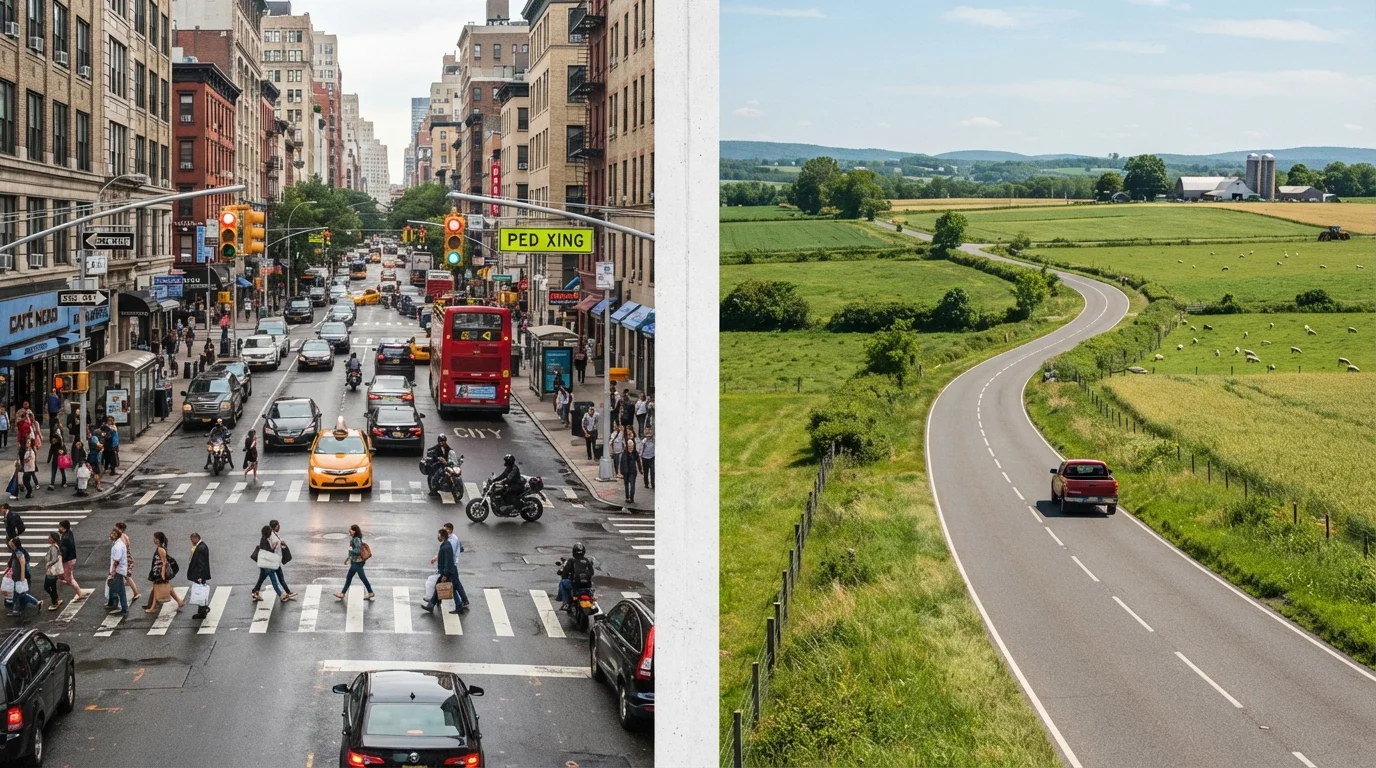
City Driving
High-stimulus, low-speed driving that demands constant split-second decisions.
Best for: Drivers navigating dense traffic, frequent stops, pedestrians, cyclists, and tight intersections.
Option B
Rural Driving
Open-road driving where speed, fatigue, and isolation create a different set of risks.
Best for: Drivers covering long distances on two-lane highways, farm roads, or low-traffic country routes.
If you drive primarily in urban areas
City Driving
Master intersection rules, pedestrian right-of-way, and tight-space maneuvering first. These skills compound quickly in dense environments.
If you frequently travel long distances on rural routes
Rural Driving
Focus on speed management, fatigue awareness, and scanning for wildlife and unmarked crossings - hazards that don't appear in city driving practice.
If you regularly transition between city and rural roads on the same trip
City Driving
Build your urban habits first; they transfer more readily to rural roads than the reverse, since rural driving tends to develop a false sense of low-risk comfort.
Why Environment Changes Everything
Most new drivers learn in one type of environment and assume the skills transfer everywhere. They mostly do - but the emphasis shifts dramatically depending on where you're driving. The hazards are different, the timing of decisions is different, and even the way you should be scanning the road changes.
City driving floods you with information: signals, signs, pedestrians, cyclists, double-parked cars, buses pulling in and out. Rural driving strips much of that away - but replaces it with higher speeds, poor lighting, limited road markings, and far fewer nearby services if something goes wrong.
Understanding those differences isn't just academic. It directly affects how you position your vehicle, how far ahead you look, and how you manage your own attention. For a deeper look at the foundational skill underlying both environments, see our guide on systematic road scanning.
City Driving: Managing Information Overload
The defining challenge of urban driving is volume - not speed. You're processing more inputs per mile than almost any other driving scenario. Here's what that requires in practice:
- Shorter following distances: Stops happen fast. The standard three-second following gap often needs to compress in slow urban traffic, but don't go below one to two seconds - you still need reaction time.
- Constant mirror cycling: Check your mirrors every five to eight seconds. City environments have vehicles, cyclists, and pedestrians approaching from multiple angles simultaneously.
- Intersection discipline: Even on a green light, pause a beat before entering. Red-light running is most common in urban areas. Our right-of-way reference guide covers the intersection scenarios that trip up even experienced drivers.
- Pedestrian zones: Watch for people stepping off curbs between parked cars - not just at crosswalks. Delivery vehicles and ride-share drop-offs create unpredictable foot traffic.
| Criterion | City Driving | Rural Driving |
|---|---|---|
| Primary hazards | Pedestrians, cyclists, intersections | Speed, wildlife, fatigue |
| Typical speed range | 15-45 mph | 45-70+ mph |
| Decision frequency | Very high - constant inputs | Lower but higher-stakes |
| Following distance | 1-3 seconds in traffic | 3-4+ seconds at speed |
| Fatigue risk | Lower - stimulation keeps you alert | Higher - monotony dulls attention |
| Emergency services proximity | Close - minutes away | Distant - can be 30+ minutes |
| Road marking clarity | Generally well-marked | Often minimal or absent |
If you're driving in an unfamiliar city, GPS helps - but it can also narrow your attention to the screen. Our article on staying oriented without over-relying on GPS explains how to keep situational awareness sharp.
Rural Driving: When Open Roads Become Deceptive
Rural roads feel easier. Fewer cars, lower stress, clearer sight lines. But crash data consistently shows that rural roads account for a disproportionate share of fatal accidents in the US - largely because of higher speeds, less forgiving roadsides, and longer emergency response times.
~50%
Share of US traffic fatalities on rural roads
Rural roads account for roughly half of all US traffic deaths despite carrying far less than half of total vehicle miles traveled, according to NHTSA data.
2x
Higher fatality rate per mile in rural vs. urban areas
The fatality rate per 100 million vehicle miles traveled is approximately twice as high on rural roads as on urban roads, per Federal Highway Administration figures.
The key hazards to stay ahead of:
- Speed creep: Without visual anchors like buildings and other vehicles, drivers often accelerate beyond safe limits without noticing. Check your speedometer more frequently on open roads.
- Wildlife crossings: Deer, livestock, and other animals appear with almost no warning, especially at dawn and dusk. Scan the road edges actively, not just the lane ahead.
- Unmarked intersections and driveways: Rural roads often have farm entrances and side roads with no signage. Reduce speed when visibility is limited by curves or vegetation.
- Fatigue: Monotonous roads reduce alertness faster than busy urban routes. If you feel drowsy, pull over safely - don't push through it. This risk overlaps with the hazards covered in our night driving guide.
Rural driving also demands more from your vehicle. Low fuel stations, no cell coverage, and limited breakdown services mean basic preparedness - spare tire, emergency kit, charged phone - matters more here than in the city.
Making the Mental Switch Mid-Trip
Many drivers transition between city and rural roads in a single journey - leaving a suburb, hitting a two-lane highway, then re-entering an urban area at the other end. That transition is where habits built in one environment can create problems in the other.
The Speed Adjustment Problem
Drivers who spend long stretches on rural roads often experience speed adaptation - the sensation that 45 mph feels slow after driving at 65 mph for an extended period. This is a known perceptual effect, not a character flaw. When re-entering urban areas, give yourself a few minutes to recalibrate and check your speedometer more frequently than usual. Don't rely on feel alone.
Drivers moving from rural to city roads often underestimate how quickly pedestrians and cyclists will appear. Conversely, drivers moving from city to rural roads may carry urban caution into open roads and drive too slowly for safe flow, or they may overcorrect and speed once the open road feels familiar.
The practical fix: treat each environment change as a deliberate reset. When the road type changes, consciously adjust your following distance, check your speed, and recalibrate how far ahead you're looking. A complete overview of driving skills can help you see how these environmental adjustments fit into your broader development as a driver.