

Key Takeaways
Night Driving Risk
Night driving risk refers to the combination of factors that make operating a vehicle after dark more dangerous than driving in daylight. Reduced visibility, impaired depth perception, driver fatigue, and glare from oncoming headlights all contribute to a significantly higher chance of a crash. These risks are real and measurable, but they can be managed with the right habits.
The human eye's ability to detect contrast and judge distance degrades substantially in low-light conditions, a limitation that cannot be fully offset by artificial lighting alone.
Why Nighttime Roads Are Genuinely More Dangerous
Most drivers treat night driving as a minor inconvenience rather than a meaningfully different risk environment. That assumption is worth examining. Traffic volume drops after dark, but crash rates - particularly fatal ones - rise sharply relative to the miles driven. The National Safety Council reports that roughly half of all traffic fatalities occur at night despite nighttime accounting for a much smaller share of total vehicle miles traveled.
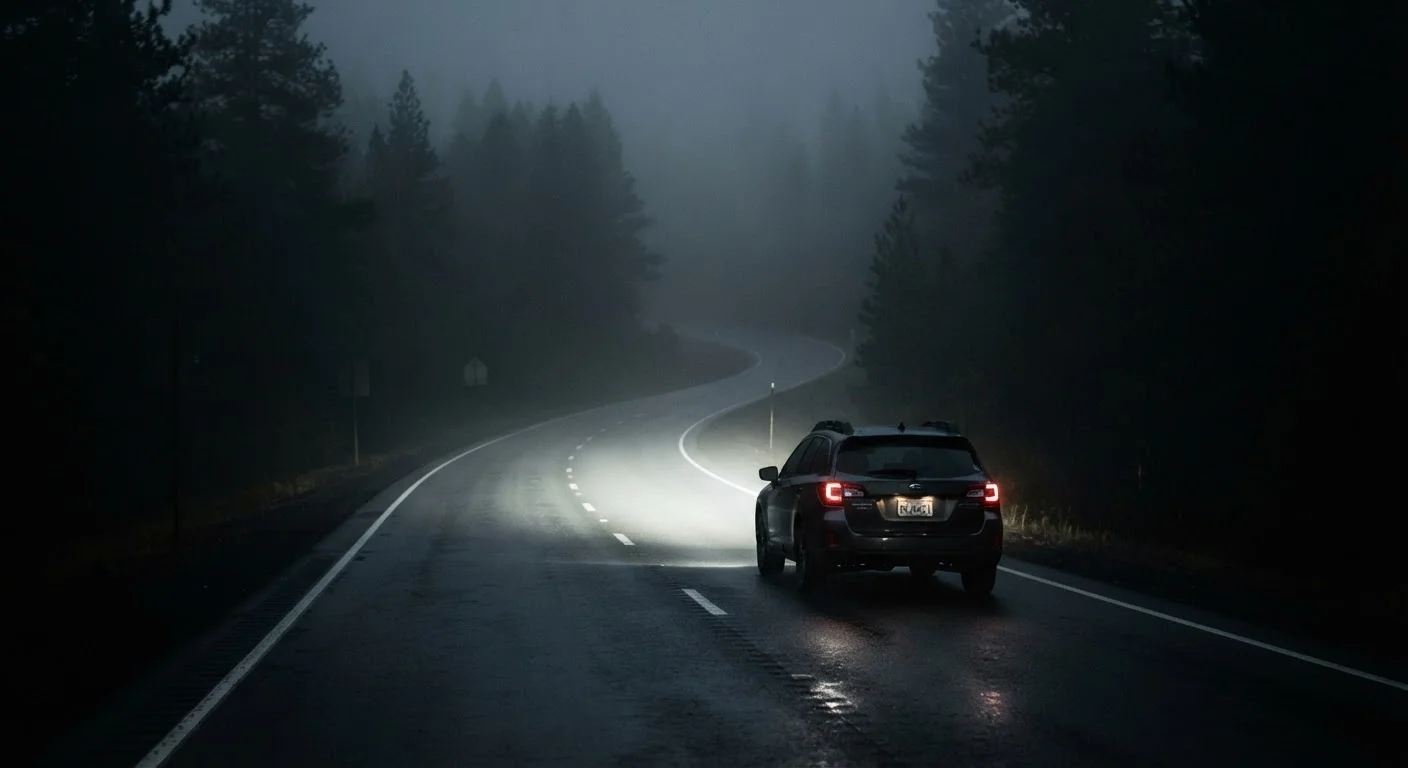
The core problem is visibility. Human eyes are not well-designed for low-light driving. Peripheral vision narrows, depth perception becomes less reliable, and the ability to detect color and contrast drops. Your headlights compensate only partially - they cast a fixed cone of light that may not cover everything your speed demands you be able to see and respond to in time.
Pair that visibility gap with higher rates of impaired and fatigued driving after dark, and the risk picture becomes clearer. Night driving is not inherently unmanageable, but it requires deliberate adjustments that most drivers skip. See our complete overview of driving skills for context on how environment affects every aspect of your performance behind the wheel.
~50%
Of fatal crashes occur at night
According to the National Safety Council, roughly half of all traffic fatalities happen after dark despite significantly lower nighttime traffic volume.
~160 ft
Typical low-beam headlight range
Most passenger vehicle low-beam headlights illuminate approximately 160 feet of road ahead, which is less than the stopping distance at highway speeds.
3x
Higher fatality rate per mile at night
The NHTSA has noted that nighttime driving produces fatality rates roughly three times higher per mile traveled compared to daytime driving.
The Hidden Problem: Overdriving Your Headlights
One of the most common - and least discussed - night driving errors is overdriving your headlights. This happens when you travel fast enough that you cannot stop within the distance your headlights actually illuminate. Standard low-beam headlights on most passenger vehicles light roughly 160 feet of road ahead. At 60 mph, a typical stopping distance is well over 200 feet. The math does not work in your favor.
Slowing down at night is not timid driving - it is the correct physical response to a changed visual environment. This is especially true on unlit rural roads where animals, debris, or stopped vehicles can appear with almost no warning. For more on how driving environment should shape your approach, see how your approach should shift between city and rural roads.
A Simple Speed Check for Night Driving
On an unlit road, try a quick mental check: if something appeared at the edge of your headlights right now, could you stop in time? If the honest answer is no, you are overdriving your headlights. Backing off your speed by 10-15 mph on dark rural roads is often enough to bring stopping distance back within your visible range.
Fatigue, Glare, and What Your Eyes Are Actually Doing
Driver fatigue is more dangerous at night for two reasons. First, the body's circadian rhythm naturally promotes drowsiness between roughly midnight and 6 a.m. Second, low-light driving is cognitively taxing - your brain works harder to process less information, which accelerates mental fatigue even on shorter trips.
Glare from oncoming headlights adds another layer. When a bright light hits your eyes in the dark, it temporarily overwhelms the photoreceptors you depend on for low-light vision. Recovery can take several seconds - enough time to miss a hazard entirely. The practical fix is straightforward: shift your gaze to the right edge of your lane when oncoming headlights approach, rather than looking directly at them.
Your scanning habits also need adjustment after dark. The systematic scanning techniques used in driver training work in daylight partly because contrast is high and hazards are easy to detect. At night, you need to rely more on the edges of your headlight beams and watch for reflections, eye-shine from animals, and the outlines of pedestrians and cyclists who may not be wearing reflective gear.
Eye Adaptation Takes Time
Moving from a brightly lit interior (a gas station, parking garage, or restaurant) to a dark road means your eyes need several minutes to fully adapt to low light. Avoid looking at bright screens or lights just before driving at night when possible, and give yourself a moment to let your vision adjust before pulling back into traffic.
Practical Adjustments That Make a Real Difference
A few straightforward habits reliably improve night driving safety:
- Clean your windshield inside and out. Interior film from outgassing plastics scatters light severely. A clean windshield dramatically reduces glare from oncoming headlights.
- Dim your dashboard and instrument lights. Bright interior lighting reduces your eyes' ability to adapt to the dark outside - most vehicles have a dashboard dimmer for exactly this reason.
- Use high beams strategically. On unlit roads with no oncoming traffic, high beams extend your visibility significantly. Switch back to low beams promptly when another vehicle approaches.
- Increase your following distance. Stopping distances don't change at night, but your ability to detect hazards early does. Extra space gives you more time to react.
- Pull over if you're tired. No technique compensates for genuine drowsiness. A short stop is far safer than pushing through fatigue.
Night driving is also one context where distraction carries extra cost. The cognitive load of low-light driving leaves less mental bandwidth for secondary tasks - a point reinforced by research covered in our article on distracted driving and cognitive load. Similarly, conditions like rain or fog compound night driving risks considerably - see how weather conditions change the rules for guidance on combined-condition driving.