

Key Takeaways
Why Weather Changes Everything Behind the Wheel
Clear, dry roads are what most driving tests are designed around. But the majority of weather-related crashes happen because drivers keep using dry-road habits when conditions have fundamentally changed beneath their tires. Rain reduces traction. Snow and ice can cut it almost entirely. Fog strips away the seconds of advance warning you normally rely on to react. Each condition calls for a specific set of adjustments - not just general caution.
Before diving into the steps, it helps to understand one key concept: stopping distance. At 60 mph on dry pavement, a typical car needs roughly 180 feet to stop after the driver reacts. On wet pavement, that can stretch to 270 feet or more. On ice, it can multiply several times over. This is why speed and following distance are the two most critical variables in adverse weather.
For a broader look at how driving context shapes your decisions, see our complete overview of the skills that make a competent driver. And if you want to prepare your vehicle before bad weather arrives, seasonal car care guidance walks through exactly what to check.
What you will need
Driving in Rain, Snow, and Fog: Step-by-Step
The steps below cover all three conditions. Some apply across the board; others are specific to one type of weather. Work through them in order before and during any challenging drive.
Turn on your headlights before you start moving
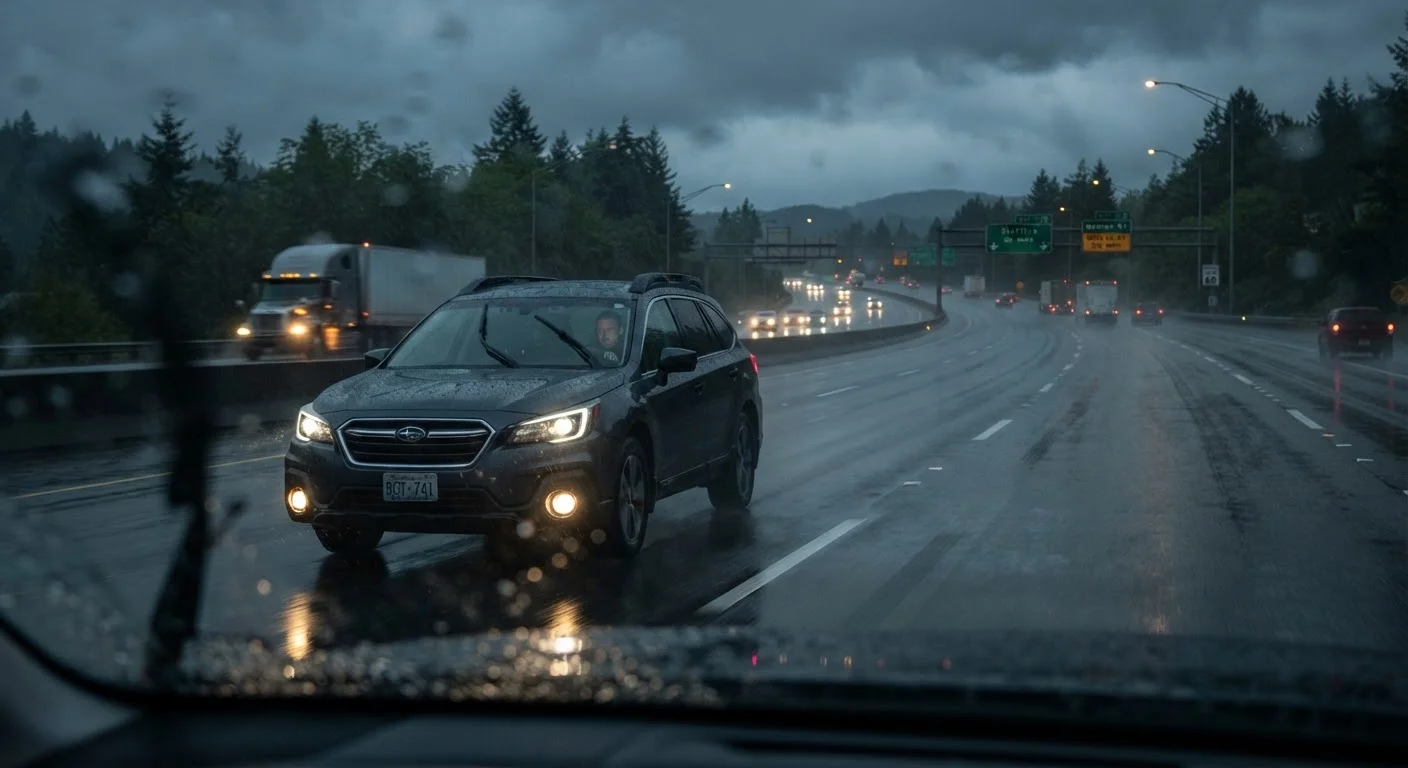
In rain, snow, or fog, turn on your headlights - not just your daytime running lights. Many states require headlights whenever your wipers are running. More importantly, lights make you visible to other drivers, not just help you see. Check that all lights are working before you leave, including taillights.
Reduce your speed well below the posted limit
Speed limits are set for ideal conditions. In rain, dropping 5-10 mph below the limit is a reasonable starting point. In heavy snow or ice, speeds of 20-35 mph on roads that might normally allow 55 mph are not uncommon for safe travel. Adjust based on what you can actually see and how the road feels under your tires.
Expand your following distance significantly
The standard three-second following distance is for dry conditions. In rain, use at least four seconds. In snow or ice, extend that to eight seconds or more. To measure: pick a fixed landmark, watch when the car ahead passes it, then count seconds until you reach the same point. If you arrive too soon, back off further.
Turn off cruise control
Cruise control is designed for steady-speed highway driving in good conditions. On wet or icy roads, it can delay your reaction to a skid or a change in traction. Disable it any time the road surface is slippery or wet, even if the weather seems moderate.
Brake, steer, and accelerate smoothly and gradually
Jerky inputs - sudden braking, sharp steering, or hard acceleration - are the fastest way to break traction on a slippery surface. Apply the brake pedal with steady, firm pressure rather than stabbing at it. Modern vehicles with anti-lock brakes (ABS) are designed to be pressed firmly and held; you may feel a vibration - that is normal, keep pressing. Steer with small, deliberate inputs. Accelerate slowly from stops to avoid wheel spin.
In fog: slow down and use your hazard lights if moving very slowly
Dense fog can reduce visibility to under 100 feet. At highway speeds, that is not enough distance to stop. Drop your speed until you can see clearly ahead to a distance that allows comfortable stopping. If fog forces you to travel well below the normal traffic speed, turn on your hazard lights to alert drivers behind you. Pull well off the road - onto a driveway or parking lot, away from the travel lane - if visibility drops to near zero.
Never Use Cruise Control on Wet or Icy Roads
This is one of the most underappreciated risks in adverse weather driving. Cruise control keeps your speed constant, which can maintain or increase wheel spin on ice and delay your response time during a skid. Disable it the moment conditions deteriorate. The few seconds of convenience are not worth the risk.
Common Mistakes and When to Pull Over
Even experienced drivers fall into predictable traps in bad weather. One of the most common is overconfidence in all-wheel drive (AWD). AWD helps your vehicle accelerate on slippery surfaces, but it does not improve braking or cornering - the physics of stopping remain the same regardless of how many wheels are driven.
Another frequent mistake is using high beams in fog. It feels intuitive to want more light, but the beam hits suspended water droplets and reflects back, creating a bright white wall that actually reduces how far you can see. Use low beams and dedicated fog lights if your vehicle has them.
Low-visibility driving shares some of the same risks as nighttime driving. Our article on night driving risks most people underestimate covers the overlap in detail.
Finally, know when to stop altogether. If you cannot see the lines on the road, if the car ahead is a faint blur, or if your vehicle is sliding despite slow speeds - pulling over to a safe, well-lit spot (away from the travel lane) and waiting is a completely valid decision. No destination is worth a crash.
Practice in a Safe, Empty Space First
If you've never driven on ice or in heavy rain, an empty parking lot after a snowfall is one of the best places to learn how your vehicle responds to gentle braking and steering on a slick surface. Understanding what a loss of traction feels like - at low speed, in a controlled environment - prepares you to manage it calmly on a real road. Check out how experienced drivers shift their mindset for different environments for more on reading road conditions in context.