

| Who yields at a roundabout | Entering traffic yields to circulating traffic (Federal Highway Administration guidance) |
| Four-way stop tiebreaker | Vehicle on the right goes first when two arrive simultaneously (Uniform Vehicle Code, standard US traffic law) |
| Yield sign meaning | Slow down, be prepared to stop, give way to crossing or merging traffic (MUTCD (Manual on Uniform Traffic Control Devices)) |
| Roundabout traffic direction | Counterclockwise in the United States |
| Pedestrian priority at crosswalks | Drivers must yield to pedestrians in marked or unmarked crosswalks (Most US state traffic codes) |
| Emergency vehicle rule | Pull to the right and stop; yield to any emergency vehicle with lights or siren active (Standard US traffic law, all states) |
Roundabouts: Who Goes First and Why
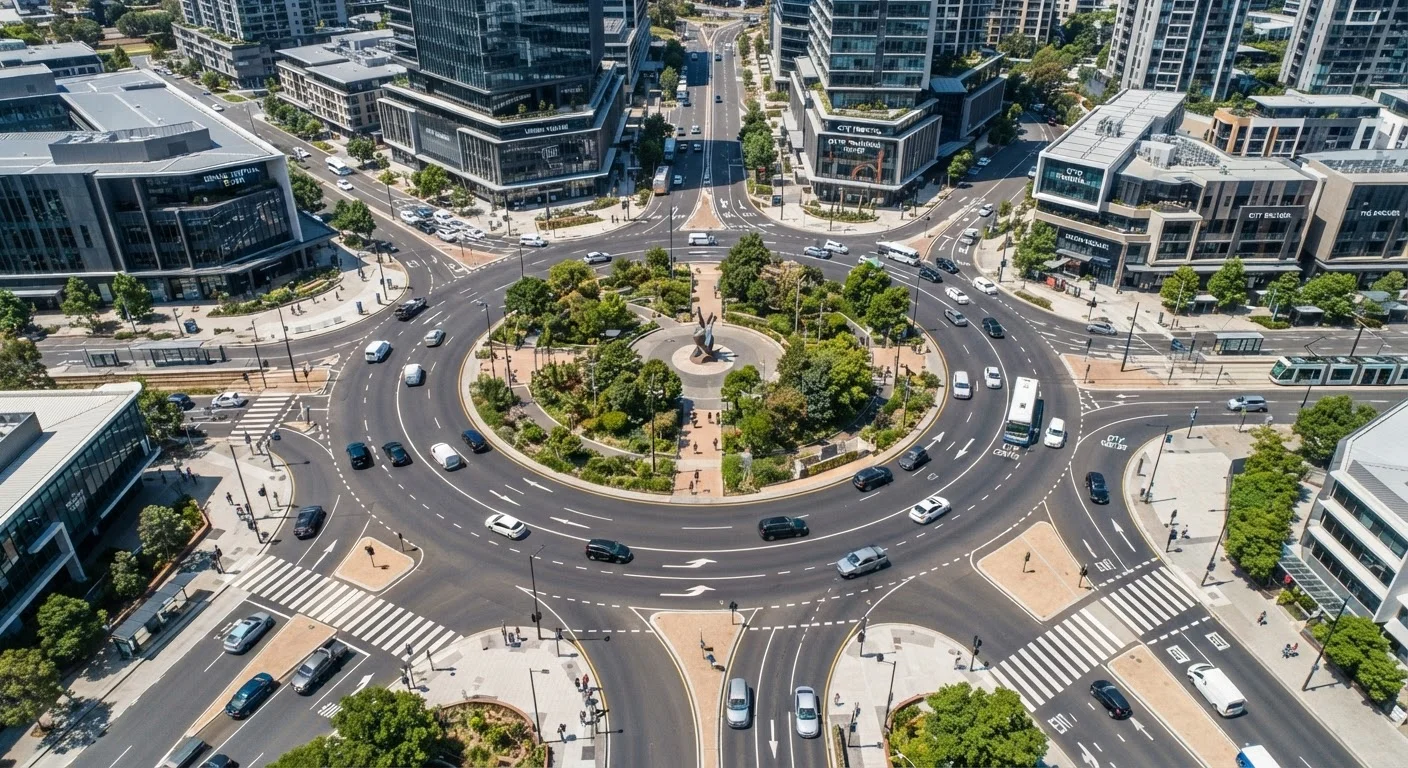
Roundabouts confuse drivers partly because they look different from traditional intersections. The core rule is straightforward: vehicles already inside the roundabout have the right of way. If you're entering, you yield - always - regardless of how many cars are waiting at your entrance.
| Who yields at a roundabout | Entering traffic yields to circulating traffic (Federal Highway Administration guidance) |
| Four-way stop tiebreaker | Vehicle on the right goes first when two arrive simultaneously (Uniform Vehicle Code, standard US traffic law) |
| Yield sign meaning | Slow down, be prepared to stop, give way to crossing or merging traffic (MUTCD (Manual on Uniform Traffic Control Devices)) |
| Roundabout traffic direction | Counterclockwise in the United States |
| Pedestrian priority at crosswalks | Drivers must yield to pedestrians in marked or unmarked crosswalks (Most US state traffic codes) |
| Emergency vehicle rule | Pull to the right and stop; yield to any emergency vehicle with lights or siren active (Standard US traffic law, all states) |
Here's how to navigate one step by step:
- Slow down as you approach and look for the yield sign.
- Check for circulating traffic to your left - that's the direction vehicles will come from.
- Enter only when there's a safe gap. Do not stop inside the roundabout unless traffic forces you to.
- Signal your exit as you pass the entrance before yours, then exit in your lane.
Multi-lane roundabouts follow the same priority rule but require lane discipline. Choose your lane before you enter - left lanes are typically for left turns or U-turns, right lanes for right turns or going straight - and stay in your lane through the circle.
One thing roundabouts handle well: pedestrians. Look for crosswalks just before the entrance and exit points, and yield to any pedestrians crossing there. For more on reading complex road environments, see how systematic scanning habits help you anticipate these moments earlier.
Four-Way Stops: The Order of Priority
At a four-way stop, every vehicle must come to a complete stop before the intersection. "Rolling" through doesn't count legally or safely. Once stopped, the order of priority works like this:
Right of Way Can't Be "Taken"
A common misconception is that you can demand the right of way. In reality, right-of-way rules only describe who should yield - they can't force another driver to act correctly. Always be prepared to wait, even when you technically have priority. Safe driving means accounting for what other drivers actually do, not just what they're supposed to do.
- First to arrive, first to go. If one vehicle stopped before the others, it goes first.
- Simultaneous arrival: yield to the right. If two vehicles arrive at the same time, the driver on the left yields to the driver on the right.
- Facing traffic goes before crossing traffic. If two vehicles arrive simultaneously and are directly across from each other, the one going straight or turning right has priority over the one turning left - because a left turn crosses oncoming lanes.
When three or four vehicles arrive at once, apply the yield-to-the-right rule in sequence. In practice, drivers often use eye contact and small gestures to work it out - but knowing the legal rule keeps you from freezing up or taking a turn that isn't yours.
City streets with lots of four-way stops call for particular alertness. Urban and rural driving each demand a different mindset - understanding where four-way stops are most common helps you adapt your approach.
Yield Signs, Merges, and Other Right-of-Way Situations
A yield sign doesn't mean stop - it means slow down, assess, and only stop if necessary. You must give the right of way to any vehicles or pedestrians that would be affected by your entry. Common places you'll see yield signs:
~40%
Of all traffic crashes occur at intersections
According to the Federal Highway Administration, intersection-related crashes account for roughly 40% of all US traffic crashes annually.
75%
Reduction in serious injury crashes at roundabouts
The Insurance Institute for Highway Safety (IIHS) reports that converting traditional intersections to roundabouts reduces serious injury crashes by approximately 75%.
- Roundabout entrances - as described above.
- Highway on-ramps - merging traffic yields to vehicles already in the travel lane. Don't expect others to make room, though many will.
- T-intersections - the driver on the terminating road typically yields to cross traffic.
- Shared-use paths crossing roads - drivers yield to cyclists and pedestrians at designated crossings.
At merges specifically: match the speed of traffic in the lane you're entering, signal early, and merge smoothly when a gap opens. Slowing dramatically on an on-ramp is a common and dangerous mistake. For a full breakdown of highway merging, see our guide to highway driving for new drivers.
Emergency vehicles always have the right of way. When you see or hear an approaching emergency vehicle with lights or siren active, pull to the right edge of the road and stop until it passes - even if you're in the middle of an intersection.
Right-of-way is one layer of a broader set of driving skills. For a wider view, explore the full range of competencies that shape how you drive.
Right of way
The legal or conventional priority given to one driver, pedestrian, or cyclist to proceed before another. Having the right of way does not remove your obligation to drive safely - it only establishes who goes first.
Yield
To slow down or stop and let other traffic or pedestrians go first before you enter a lane or intersection. Yielding is required even when no stop sign is present.
Traffic control device
Any sign, signal, or road marking used to regulate the flow of traffic. Stop signs, yield signs, lane markings, and traffic lights are all traffic control devices.
Roundabout
A circular intersection where traffic flows in one direction around a central island. Drivers entering the roundabout must yield to vehicles already inside it.
Four-way stop
An intersection where all approaches have a stop sign. All vehicles must come to a complete stop before proceeding, following a defined order of priority.
Merge
The process of moving from one lane into an adjacent lane of moving traffic. The merging driver generally must yield to vehicles already in the target lane.