

Key Takeaways
Why Cage Setup Matters More Than You Might Expect
A cage isn't just a container - it's your bird's entire living environment for most of each day. Getting it right from the start sets the foundation for a bird that's physically healthy, mentally engaged, and behaviorally balanced. Most common mistakes aren't about neglect; they're simply about not knowing what these small animals actually need.
For a deeper look at how space requirements affect small animals' wellbeing, see our article on why small pets need more space than you think. If you're still in the planning stage, our preparation checklist for bringing a small pet home covers what to have ready before your bird arrives.
This guide focuses on the practical setup steps - what to place inside the cage, where to put it in your home, and the details that often get overlooked.
What you will need
Choosing the Right Cage Before You Set Anything Up
Before arranging the interior, confirm the cage itself is appropriate. Two measurements matter most:
- Bar spacing: For budgies and small parakeets, bars should be no more than ½ inch apart. For cockatiels and similar mid-sized birds, ⅝ inch is the upper limit. Wider gaps risk head entrapment or escape.
- Dimensions: Prioritize width over height. Birds fly horizontally, not vertically. A budgie needs a cage at least 18-24 inches wide; larger parrots need substantially more room. The bird should be able to fully extend both wings without touching the sides.
Avoid cages with decorative rounded tops - that vertical column of space is unusable and wastes money better spent on floor space. Also check that bar coatings are non-toxic and that there are no sharp interior welds or edges.
Natural wood perches (varied diameters)
Mimic branches found in the wild; varying thickness exercises foot muscles and prevents pressure sores.
Rope or cotton perch
Provides a soft, flexible surface that adds textural variety and encourages grip strength.
Foraging toys
Encourage natural food-seeking behavior, reducing boredom and feather-destructive habits.
Stainless steel food and water dishes
Durable, non-porous, and easy to sanitize - important for preventing bacterial buildup.
Unscented paper cage liner
Lines the floor tray for easy waste removal and daily monitoring of droppings.
Bird-safe cage cleaner or diluted white vinegar
Used to disinfect cage surfaces without exposing birds to toxic chemical fumes.
Step-by-Step: Setting Up the Cage Interior
Once you have the right enclosure, follow these steps to create a genuinely enriching environment.
Line the tray with unscented paper
Cut plain, unscented paper - newsprint without colored ink or paper towels - to fit the floor tray. Avoid cedar or pine shavings, which release aromatic oils that can irritate a bird's respiratory system. A flat paper liner lets you check droppings daily, which is one of the easiest ways to spot early illness.
Install perches at varied heights and in varied materials
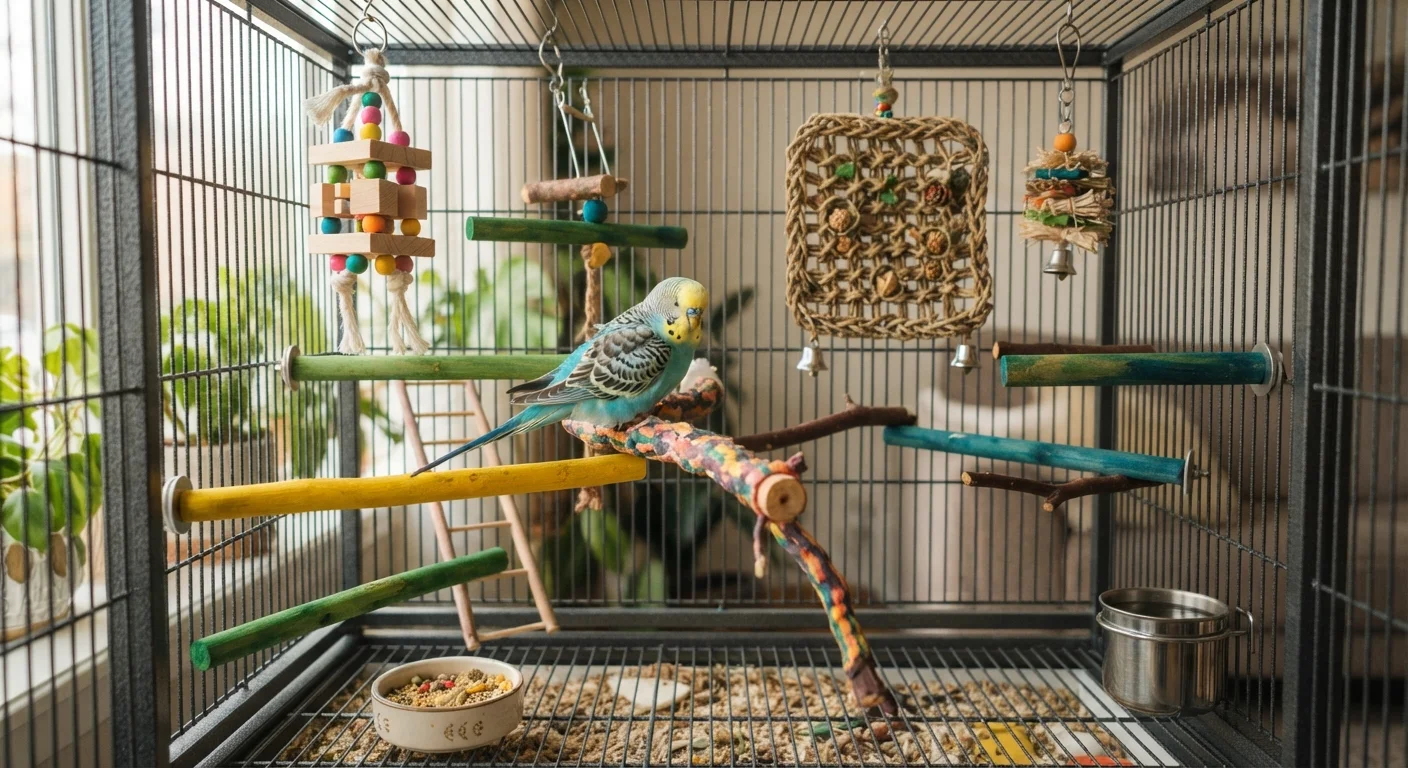
Place at least two perches at different heights - but never directly above each other, which causes the lower perch to become soiled. Use a mix of materials: one natural wood branch-style perch, one rope or cotton perch, and ideally one mineral or concrete perch near a food dish to help keep nails trimmed naturally. Vary the diameter so the bird's toes grip differently on each surface.
Position food and water dishes away from perches above them
Attach stainless steel or ceramic dishes firmly to the cage bars, not balanced on the floor where they can be contaminated by droppings. Position them so no perch sits directly overhead. Fresh water should be changed daily; food dishes should be cleaned at each refill to prevent bacterial growth.
Add toys - but don't overcrowd
Introduce two or three toys appropriate for your bird's size: a foraging toy that hides a small treat, a chewable wooden toy, and something with varied textures to explore. Rotate toys every week or two to maintain novelty. Overcrowding the cage reduces flying room and can stress birds rather than stimulate them.
Leave the highest perch for sleeping
Birds prefer to sleep at the highest point they feel is safe. Ensure the topmost perch has clearance so the bird's head and tail don't touch the cage ceiling or sides. Cover three sides of the cage loosely with a breathable cloth at night to reduce light and drafts and help the bird get the 10-12 hours of darkness recommended for most species.
Do a final safety check before introducing your bird
Before your bird enters the cage, run through this checklist:
- All doors and latches close securely - parrots especially are skilled at opening simple catches
- No exposed wire ends or sharp welds inside the cage
- No toys with openings large enough to trap a head or foot
- No synthetic rope fraying into long strands that can wrap around toes
- No wood treated with pesticides or toxic finishes
Kitchen Fumes Can Be Fatal to Birds
Polytetrafluoroethylene (PTFE), the coating used in many non-stick pans, releases fumes when overheated that are highly toxic to birds and can cause rapid death. This is not an exaggeration - avian veterinarians consistently flag this as a leading cause of accidental bird death in homes. Never place a bird cage in or near a kitchen, and consider replacing non-stick cookware if your bird has access to adjacent areas.
Placement, Routine, and Enrichment Beyond the Cage
Where you put the cage matters as much as what's inside it. Birds are social and perceptive - placement shapes their daily experience significantly.
- Avoid the kitchen: Fumes from non-stick cookware heated at high temperatures can be fatal to birds. This is a firm safety rule, not a preference.
- Avoid drafts and direct sun: Place the cage against a wall so the bird has a sense of security on at least one side. Direct afternoon sunlight can cause dangerous overheating.
- Eye-level placement: Cages placed too low create anxiety; birds feel safer at approximately human eye level.
Daily out-of-cage time in a bird-proofed room is important for birds that are tame enough for it. Enrichment doesn't stop at the cage door - for ideas that translate well to birds, our guide on small pet enrichment and mental stimulation offers a useful framework. For a broader picture of life with a pet bird, including social needs and health signs to watch for, see everything you need to know about caring for a pet bird.
Rotate Toys to Maintain Curiosity
Birds, particularly parrots, habituate quickly to familiar objects and may ignore toys after a short time. Keeping a small rotation of four to six toys - swapping two out each week - maintains novelty without requiring a large collection. Even returning a previous toy after a few weeks can renew interest.
This article is for general informational purposes only. For health concerns or species-specific guidance, consult an avian veterinarian.