

Key Takeaways
Why Dog Food Labels Are Worth Understanding
Dog food packaging can feel overwhelming - dense text, unfamiliar terms, and marketing language competing for your attention. But the label is actually structured in a predictable way, and once you know the four key sections to look for, reading it becomes straightforward.
Understanding what's in your dog's food matters because nutrition affects energy, coat health, digestion, weight, and long-term wellbeing. The information you need is already on the bag - you just need a map to navigate it. This guide walks you through each section in order, so you can evaluate any dog food with confidence.
If you're also weighing the format of food - dry versus wet - our comparison of kibble and wet food covers how those choices interact with nutrition. And to understand how your dog's nutritional needs shift over time, see our article on dog nutrition across life stages.
Labels Don't Replace Veterinary Guidance
This article is general educational information, not veterinary or dietary advice for your specific dog. Nutritional needs vary by breed, age, health status, and activity level. If your dog has a medical condition or you are considering a significant diet change, consult your veterinarian first.
What to Look For - and Where to Find It
Dog food labels in the United States are regulated primarily by the Association of American Feed Control Officials (AAFCO) and, in some states, state feed control officials. Labels must include specific sections by law. Here are the four you should always review:
1. The Product Name
The name itself carries regulatory meaning. A food called "Chicken Dog Food" must contain at least 95% chicken (excluding water). One called "Chicken Dinner" or "Chicken Formula" only needs 25%. A food "with Chicken" needs just 3%, and "Chicken Flavor" may contain even less. These naming rules are standardized, so the product name is a quick first filter.
2. The Ingredient List
Ingredients are listed in descending order by weight before cooking. This means a high-moisture ingredient like fresh chicken can appear first even if a dry ingredient like rice is present in greater dry amounts after processing. Named protein sources ("deboned turkey," "salmon") are more specific than vague terms ("poultry," "meat meal"). Neither phrasing is automatically unsafe, but specificity lets you know exactly what you're feeding. Be aware that ingredients can be "split" - for example, listing "ground corn," "corn gluten meal," and "corn syrup" separately, which collectively may outweigh the first listed protein source.
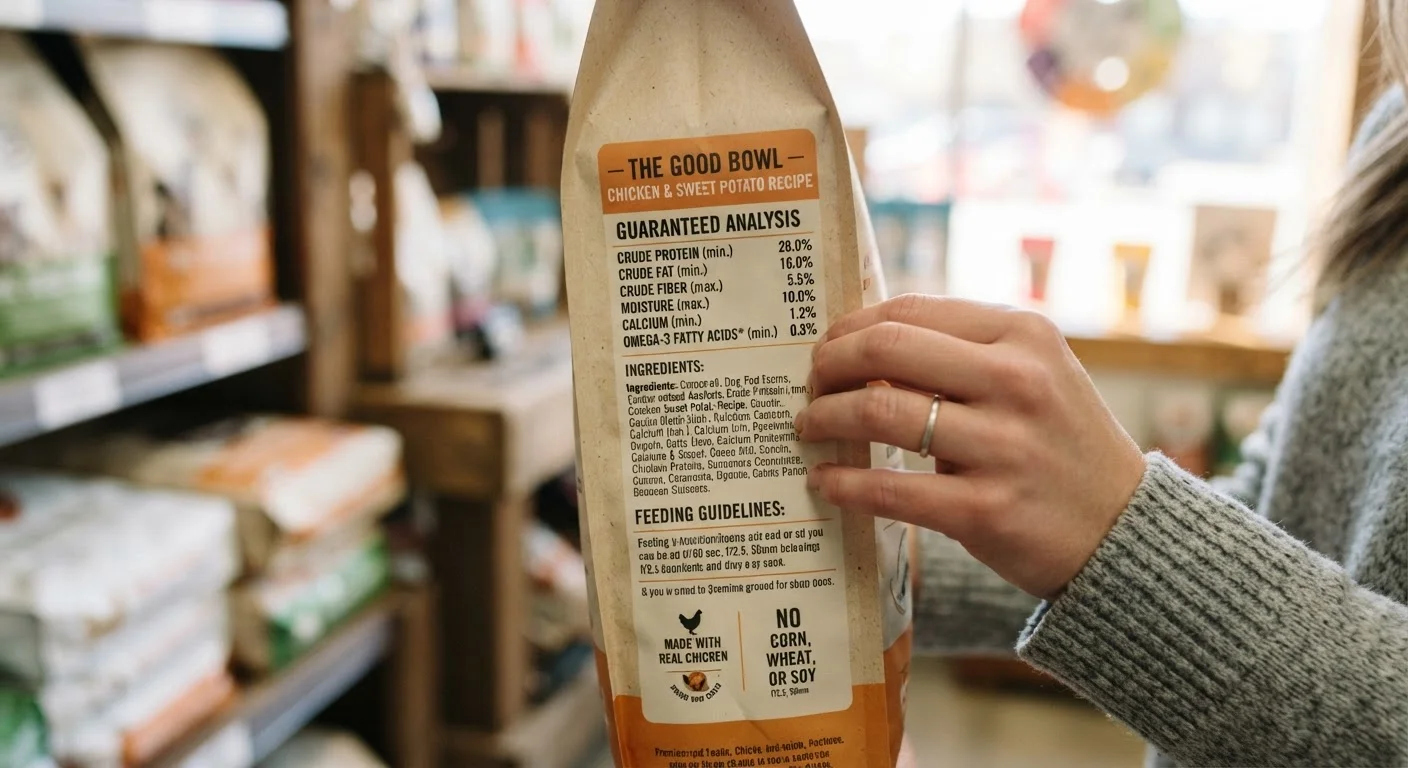
3. The Guaranteed Analysis Panel
This panel lists minimum percentages of crude protein and crude fat, and maximum percentages of crude fiber and moisture. "Crude" refers to the measurement method, not quality. These are not exact amounts - they are guarantees that the food contains at least (or at most) the stated percentage. You cannot compare a wet food and a dry food directly using this panel without adjusting for moisture content.
Compare Foods on a Dry-Matter Basis
Wet and dry foods contain very different amounts of moisture, which distorts direct nutrient comparisons. To compare them fairly, use the 'dry-matter basis' calculation: subtract the moisture percentage from 100, then divide each nutrient percentage by that number. Your veterinarian or a veterinary nutritionist can walk you through this if needed.
4. The AAFCO Nutritional Adequacy Statement
This is arguably the most important line on the label. It tells you two things: whether the food is "complete and balanced" (meaning it provides all nutrients your dog needs without supplementation), and which life stage it is formulated for - growth (puppies), adult maintenance, or all life stages. A food labeled for "all life stages" meets the more demanding puppy standards and is appropriate for dogs of any age. A food labeled "for supplemental feeding only" or "intermittent use" is not a complete diet on its own.
Watch for Misleading Front-of-Bag Claims
Words like 'natural,' 'holistic,' or 'premium' on the front of a package have no standardized regulatory definition in dog food labeling. These terms are marketing language, not quality guarantees. Always flip the bag and read the ingredient list and AAFCO statement before drawing conclusions.
Step-by-Step: How to Read a Label
What you will need
Read the product name critically
Before looking at anything else, parse the product name using the percentage rules described above. If the name includes a qualifier like "dinner," "formula," "platter," or "entrée," the named ingredient only needs to make up 25% of the food. Use this as a quick orientation before you open the ingredient list.
Scan the first five ingredients
The first five ingredients make up the largest portion of the food by pre-cooking weight. Look for a named protein source (such as "chicken," "beef," or "salmon") ideally in the first one or two positions. Whole grains, vegetables, and legumes are common filler ingredients and are not inherently harmful, but their placement tells you how much of the food is protein-forward.
Check the guaranteed analysis
Note the crude protein minimum, crude fat minimum, crude fiber maximum, and moisture maximum. For most healthy adult dogs, a minimum of around 18-25% crude protein on a dry-matter basis is a reasonable general range, but your veterinarian can advise on what is appropriate for your individual dog. Higher fat content supports energy; lower fiber levels generally indicate fewer plant fillers.
Locate and read the AAFCO statement
Find the AAFCO nutritional adequacy statement - it is usually a single sentence near the guaranteed analysis or feeding guidelines. Confirm it says "complete and balanced" and note the life stage. If you have a puppy, look for "growth" or "all life stages." If you have a senior dog, "adult maintenance" or "all life stages" are both appropriate.
Cross-check front-of-bag claims against what you found
Now return to the front of the package. If it claims high protein content, does the ingredient list back that up? If it says "grain-free," check whether grains have simply been replaced with legumes or potatoes - which may or may not be relevant to your dog's needs. Use the front of the bag as a prompt for questions, not as a source of answers.
When to Dig Deeper
Most healthy adult dogs do well on any complete and balanced food matched to their life stage. But some situations call for more scrutiny. Dogs with allergies, chronic digestive issues, kidney disease, or other health conditions may need foods formulated to specific parameters - and those needs should be identified with a veterinarian, not by label-reading alone.
It is also worth being cautious about foods that have not been formulated using AAFCO feeding trials. Both "formulated to meet" and "feeding trial" language on the AAFCO statement are acceptable, but feeding trials involve real animals eating the food over time, which some consider a stronger form of validation.
For a closer look at ingredients that can genuinely harm dogs - not just low-quality ones, but toxic ones - our guide to foods toxic to dogs is a useful companion reference. And if you are curious how human nutrition labels compare, the same structured reading approach applies - see how to read a human nutrition label.
This article is for general informational and educational purposes only and does not constitute veterinary or dietary advice. Always consult a licensed veterinarian for guidance specific to your dog's health, breed, age, and nutritional needs.