

Key Takeaways
Our Verdict
Each organizing method has genuine strengths, and the right choice depends on your home's layout, how overwhelmed you feel, and how you naturally think about your belongings. Beginners prone to burnout do well starting room by room; those frustrated by clutter migrating across rooms benefit from a category approach; and open-plan or multi-use spaces are best handled with defined zones.
| Best for | Recommended |
|---|---|
| First-time organizers who want quick, visible wins | Room-by-Room |
| Homes where one type of item (clothes, books, paperwork) has spread everywhere | Category-Based |
| Open-plan apartments, studios, or multi-use spaces | Zone Organizing |
| Households with multiple people and different habits | Zone Organizing |
Why the Method You Choose Actually Matters
Most organizing advice skips straight to storage bins and labels - but the more important decision is which framework you use before you touch a single item. Starting with the wrong method for your situation is one of the main reasons people stall halfway through a declutter and give up.
If you've ever felt paralyzed staring at a messy room, you're not alone. The good news: there's no single correct system. The three most common approaches - organizing by room, by category, or by zone - each solve a different problem. Understanding how they work helps you pick one that fits your actual life, not an idealized version of it. For a foundational walkthrough before you decide, see our first-timer's guide to organizing any room.
Room-by-Room: The Beginner's Default
The room-by-room method means you complete one room entirely before moving to the next. It's the most intuitive approach for beginners because it creates clear start and finish lines, and results are immediately visible.
How it works
- Pick one room - ideally a smaller one like a bathroom or bedroom to build confidence.
- Remove everything that doesn't belong in that room.
- Sort what remains: keep, donate, discard.
- Organize what's left using storage solutions that fit the space.
- Only then move to the next room.
When it works well
This approach suits homes with clearly defined rooms and people who need motivating wins to stay on track. Finishing a room gives a tangible sense of progress. It's also helpful when you're working alone and can only dedicate a few hours at a time.
Its limitations
The room method struggles when items don't have a clear home. Books spread across three rooms, seasonal clothes stashed everywhere, or paperwork piled in multiple spots will get reorganized piecemeal - you may tidy the living room only to discover the real problem is a home-wide paper clutter issue. If that sounds familiar, the category approach below may serve you better.
Start Small to Build Momentum
If you're using the room-by-room method, resist the urge to start with the most chaotic room. Tackling a bathroom or a single closet first gives you a quick, satisfying win that builds the confidence to keep going. Once you have one completed space to point to, the rest of the project feels far less daunting.
Category-Based Organizing: The Whole-Home Sweep
Instead of working room by room, this method has you gather every item in one category from across the entire home before making a single decision. Popularized by the KonMari method (developed by organizing consultant Marie Kondo), it typically follows a sequence like: clothing → books → papers → miscellaneous items → sentimental items.
How it works
- Choose a category - say, all clothing in the home.
- Pull every single item in that category into one pile, regardless of where it was stored.
- Decide what to keep, donate, or discard before putting anything away.
- Assign a permanent home for everything you're keeping.
- Repeat with the next category.
When it works well
This approach is powerful when one type of item is your primary source of clutter, or when the same category is scattered across multiple rooms. It also forces you to confront the true quantity of what you own - seeing 80 items of clothing in one pile is far more clarifying than encountering them room by room. For specific help applying this to your wardrobe storage, our closet organization guide walks you through the full process.
Its limitations
The whole-home sweep can feel overwhelming, especially for large households. It also requires uninterrupted time - leaving a pile of pulled-out belongings half-sorted is stressful. If you tend to freeze when faced with large decisions, consider the one-box method as a gentler starting point.
| Room-by-Room | Category-Based | Zone Organizing | |
|---|---|---|---|
| Best for | Beginners, traditional layouts | Scattered clutter by item type | Open-plan or multi-use spaces |
| Effort level | Low to moderate | Moderate to high | Moderate |
| Time commitment per session | Flexible, 1-3 hours | Longer blocks required | Flexible, depends on zone size |
| Motivation style | Visible room-by-room wins | Whole-home transformation | Functional clarity day-to-day |
| Works for shared homes? | Moderately | Less naturally | Very well |
| Risk of burnout | Lower | Higher if unprepared | Lower with planning |
Zone Organizing: Mapping Function Onto Space
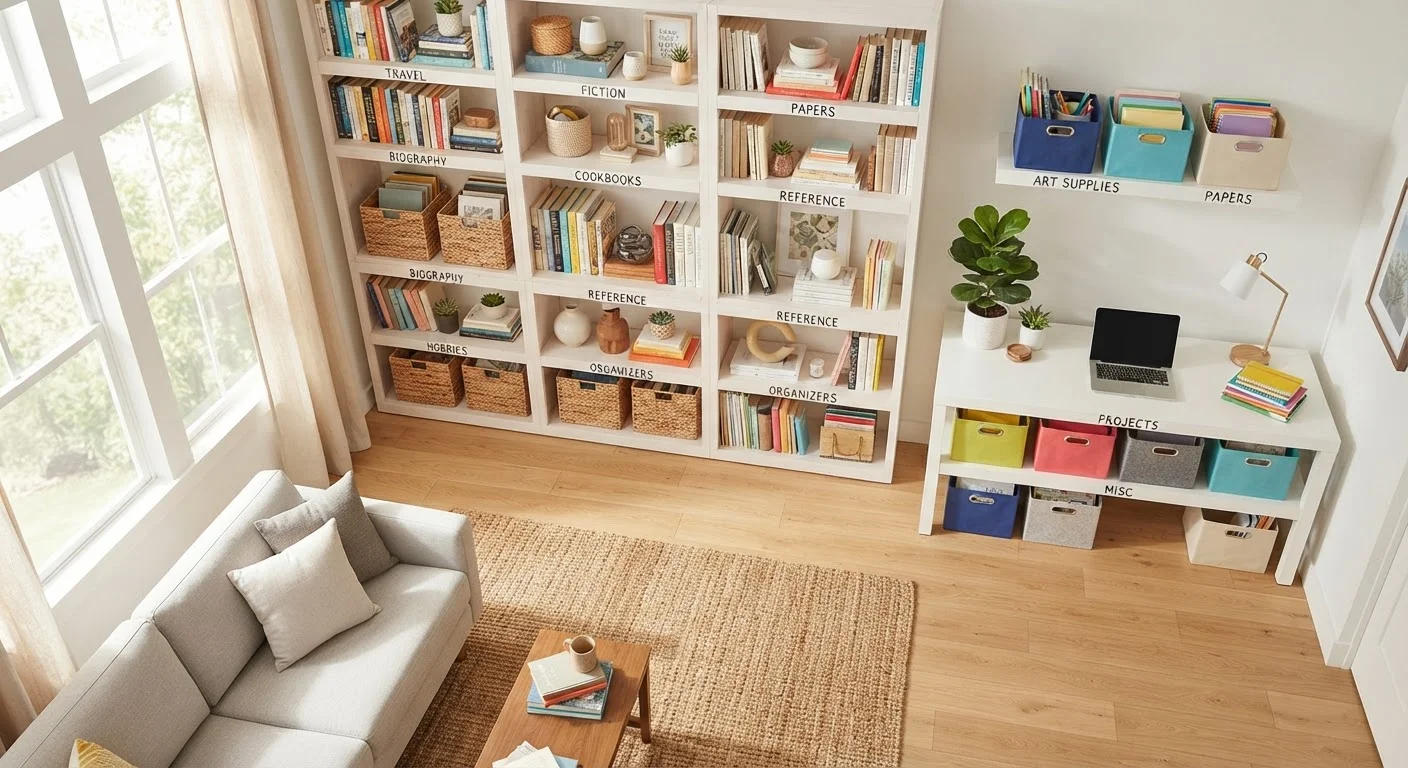
Zone organizing means dividing your home - or individual rooms - into functional areas based on what activities happen there, then organizing each zone to support those activities. A living room might have a reading zone, a media zone, and a kids' activity zone. A kitchen might have a prep zone, a coffee zone, and a baking zone.
How it works
- Walk through your home and list every activity that regularly happens in each area.
- Draw rough boundaries around where each activity naturally clusters.
- Ensure everything needed for that activity lives within or very near its zone.
- Remove anything stored in a zone that belongs elsewhere.
When it works well
Zone organizing is particularly well-suited to open-plan apartments and studios where rooms don't have defined walls. It also helps households where multiple people use the same space for different purposes - a dining table that doubles as a homework station, for instance. For small-space dwellers, combining zones with room-by-room strategies can be especially effective; our article on organizing a small apartment covers this overlap in detail. Zone systems also work well in shared homes - see organizing shared spaces for strategies when not everyone agrees on tidiness standards.
Its limitations
Zones require upfront thinking and a reasonable degree of commitment from everyone in the household. Without buy-in, zones collapse quickly. They also work best as a maintenance system rather than a first-pass declutter - you'll likely want to do a room or category pass first, then formalize zones once the volume of stuff is manageable.
Avoid Setting Up Zones Before Decluttering
A common mistake with zone organizing is buying storage and labeling zones before reducing the overall volume of items. Organizing clutter into neat zones just makes clutter easier to ignore. Always declutter first - remove what you don't need before deciding where things should live. Buying bins before you know what you're keeping is one of the fastest ways to waste money and re-create the same mess in a tidier container.
Choosing the Right Approach for Your Home
If you're still unsure which method to start with, use these simple decision points:
- Overwhelmed and don't know where to start? Begin room by room with the smallest room first.
- One type of item is out of control everywhere? Use the category method for that item only.
- Living in a studio or open-plan space? Map your zones first, then organize within each one.
- Sharing space with others? Zone organizing provides natural boundaries and shared accountability.
It's also completely valid to mix methods. Many people do a first-pass declutter room by room, then use category thinking to fine-tune, and finally establish zones to keep things functional long-term. The seasonal declutter checklist can help you maintain whichever system you land on. The method is a tool, not a rule - adapt it until it works for the way you actually live.