

Key Takeaways
Why Small Spaces Demand a Smarter System
Living in a small apartment isn't just about having less room - it's about every square foot pulling double duty. When space is tight, clutter accumulates faster, feels more oppressive, and is harder to ignore. The good news: you don't need a bigger place to feel organized. You need a better system.
Before diving into specific rooms, one principle applies everywhere: declutter first, organize second. No storage solution works well when it's filled with items you rarely use or don't need. Take a single afternoon to go through your belongings and remove anything broken, duplicate, or untouched for more than a year. From that leaner starting point, organizing becomes dramatically easier.
If you're unsure which overall approach fits your personality - tackling one room at a time versus sorting by category - our guide on organizing approaches that work for different home types can help you decide before you start.
Entryway: Create a Landing Zone
The entryway sets the tone for your entire apartment. Without a defined system, it becomes a dumping ground for shoes, bags, keys, and mail within minutes of arriving home.
- Mount hooks at eye level for bags, jackets, and umbrellas - a row of hooks on a wall or the back of the front door keeps things off the floor instantly.
- Use a small bench or shoe rack directly inside the door. Limit yourself to two or three pairs of current-season shoes here; store the rest in your closet.
- Add a single small tray or bowl for keys, transit cards, and pocket items. One designated spot eliminates the daily search.
Even a narrow hallway can fit a slim console table with a basket underneath for shoes and a tray on top for daily essentials.
A single designated tray for daily essentials eliminates the frantic morning key search.
Kitchen: Think Vertical and Zoned
Small kitchens force you to be deliberate. Counter space is precious, so the goal is to keep surfaces as clear as possible while storing everything within easy reach.
- Group items by task zone: coffee supplies near the coffee maker, cooking oils near the stove, cutting tools near the prep area. Zones reduce the time you spend searching mid-cook.
- Use vertical space inside cabinets with stackable shelf risers, which effectively double shelf capacity for plates and mugs without adding furniture.
- Mount a magnetic knife strip or a small pegboard on a spare wall section for utensils, freeing up an entire drawer.
- Store rarely used appliances - a waffle maker, a slow cooker - in a higher cabinet or on a closet shelf. Only everyday-use items earn counter space.
Only everyday-use appliances earn counter space - store the rest out of sight.
Living Room: Furniture That Works Twice as Hard
In a small apartment, the living room often serves as a lounge, home office, reading nook, and guest room simultaneously. Multifunctional furniture is the key to keeping it from feeling chaotic.
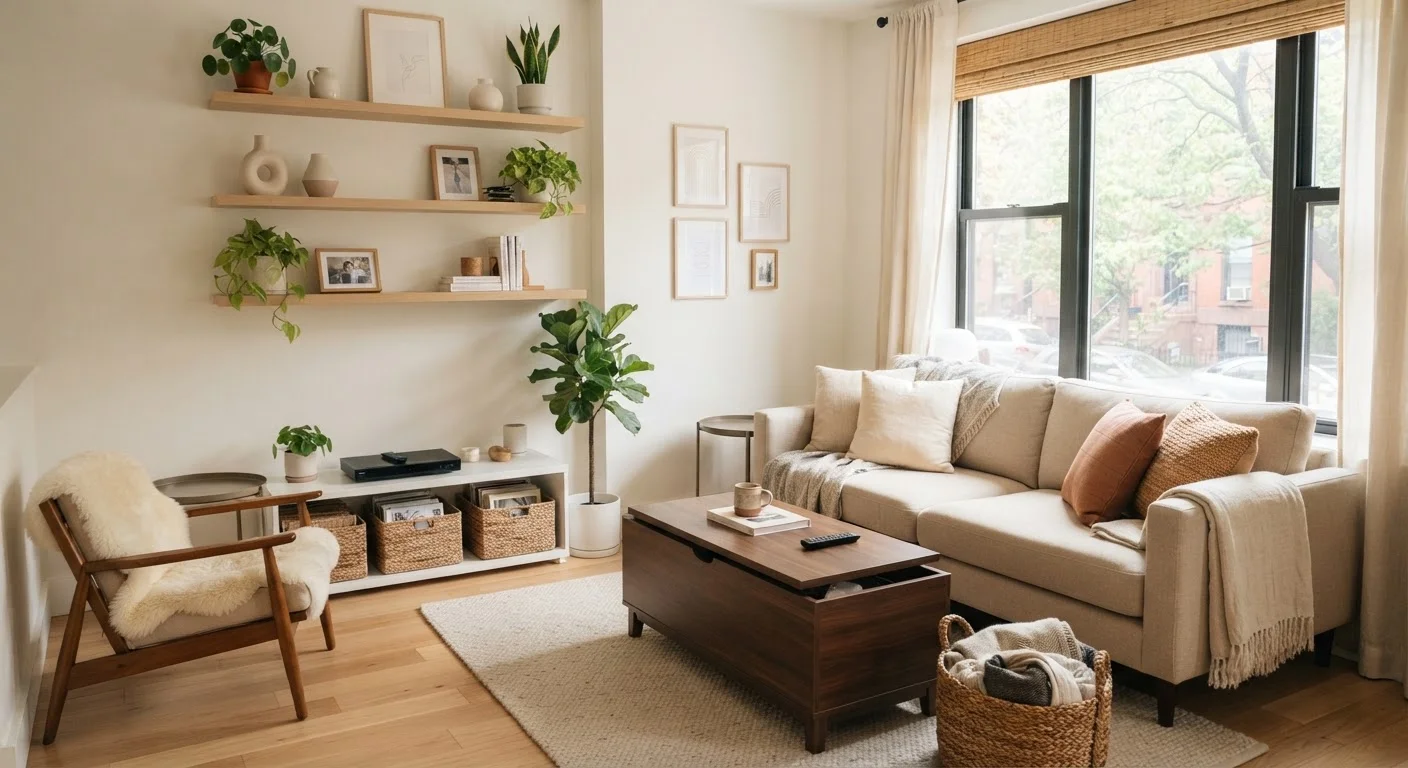
- Choose a storage ottoman instead of a traditional coffee table - it provides surface space, seating, and hidden storage for blankets, remotes, and board games in one footprint.
- Install floating wall shelves above seating areas or along an empty wall. These hold books, plants, and décor without occupying floor space.
- Use baskets as catch-alls within shelves or under console tables - they corral loose items visually while keeping the room looking intentional rather than cluttered.
- Limit décor to meaningful pieces. In a small room, every surface-level item competes for visual attention. Fewer, more purposeful objects make the space feel larger and calmer.
A storage ottoman replaces a coffee table while adding hidden space for blankets and remotes.
Bedroom: Maximize Under-Bed and Closet Space
The bedroom is where storage potential is most frequently wasted. The two biggest opportunities are directly under your bed and inside your closet.
- Use flat, lidded storage bins under the bed for off-season clothing, extra bedding, or shoes. If your bed sits too low, bed risers (simple plastic or wood blocks placed under each leg) create clearance without replacing the frame.
- Double your closet rod by adding a second hanging bar below the first for shorter garments like shirts and folded pants - this is one of the highest-impact, lowest-cost closet upgrades available.
- Add an over-the-door organizer on the closet or bedroom door for accessories, shoes, or small folded items. This turns dead space into usable storage immediately.
- Fold vertically in dresser drawers (a method sometimes called file folding) so you can see every item at a glance rather than digging through stacked layers.
Doubling your closet rod for short garments is one of the highest-impact, lowest-cost upgrades available.
Bathroom: Go Vertical, Minimize the Counter
Bathrooms in small apartments tend to have almost no storage built in. A few targeted additions change everything.
- Install a simple over-toilet shelving unit - a freestanding or wall-mounted shelf above the toilet uses completely unused vertical space for toiletries, towels, and extra supplies.
- Use a shower caddy or tension-rod shelf inside the shower or tub to keep bottles off the ledge and within easy reach.
- Add a small magnetic or adhesive strip inside a cabinet door for bobby pins, tweezers, and nail clippers - small items that routinely get lost on countertops.
- Audit your toiletry supply regularly. Expired products and duplicates accumulate quickly in bathroom cabinets. A quarterly sweep keeps the space manageable without requiring a major reorganization each time.
An over-toilet shelf turns completely unused vertical space into practical, accessible storage.
Building Habits That Keep Small Spaces Tidy
Organization systems only work if they're maintained. The most effective habit for small-apartment dwellers is a daily five-minute reset - a quick scan of each room to return items to their designated spots before clutter builds momentum. Done consistently, this prevents the overwhelming pile-ups that require a full weekend to address.
Start With One Drawer, Not the Whole Apartment
If the idea of organizing your entire apartment feels overwhelming, shrink your starting point to a single drawer or shelf. Complete that one area fully - declutter, assign every item a spot, and tidy it - before moving on. Small wins build momentum and make the larger project feel achievable rather than paralyzing.
If you share your space with a roommate or partner who has different organizational standards, sustainable systems require compromise. Our article on organizing a home when not everyone is on board offers practical frameworks for creating shared rules that actually stick.
Finally, remember that organizing a small apartment is a gradual process. Start with one room, get that space working well, then move to the next. Progress - not perfection - is what makes a small home livable.