

Key Takeaways
Start here
Why Rooms Get Cluttered (And Why That's Normal)
Core method
The Four-Step Framework for Any Room
Build on it
Choosing the Right Storage Solutions
Make it stick
How to Keep a Room Organized Long-Term
Why Rooms Get Cluttered (And Why That's Normal)
Clutter isn't a character flaw - it's a systems problem. When a room lacks a clear home for each category of item, things pile up by default. Mail lands on the counter because there's no designated inbox. Clothes drape over chairs because the closet is full. Understanding this removes the guilt and points you toward a real fix: building a simple system, not just tidying up.
Most first-timers make the mistake of straightening rather than organizing - moving clutter around rather than giving items permanent, logical homes. The result looks better for a day or two, then drifts back. This guide shows you how to break that cycle for good.
Zone
A single, defined area within a room - such as one shelf, drawer, or countertop - that you organize as a discrete unit before moving to the next.
Purge
The step in which you decide which items to keep, donate, discard, or move to another room. It's the most time-consuming part but creates the most immediate impact.
Assign a home
Giving each category of item a specific, consistent location so that everyone in the household knows exactly where to find it and return it.
Contain
Using physical storage tools - bins, baskets, dividers - to group items within their assigned home so the space stays neat between uses.
Daily reset
A short, regular routine (typically 5-10 minutes) of returning displaced items to their assigned homes to prevent clutter from accumulating.
One in, one out rule
A guideline where every new item brought into a space is matched by removing one existing item, keeping the total volume of belongings stable.
The Four-Step Framework for Any Room
This method works whether you're tackling a bedroom, a home office, or a packed garage. Work through it one zone at a time - a zone being one surface, drawer, or shelf - rather than trying to process the whole room at once.
- Sort: Pull everything out of the zone and group like items together on a clear floor or bed. Seeing all similar items in one pile makes decisions much easier.
- Purge: For each group, ask: Do I use this? Do I love it? Does it belong in this room? Items that don't pass get sorted into three boxes - Donate, Trash, and Relocate (belongs elsewhere in the home).
- Assign a home: Decide exactly where each remaining category will live. The guiding principle is frequency of use: things you reach for daily should be the easiest to access, while rarely used items can go higher up or further back.
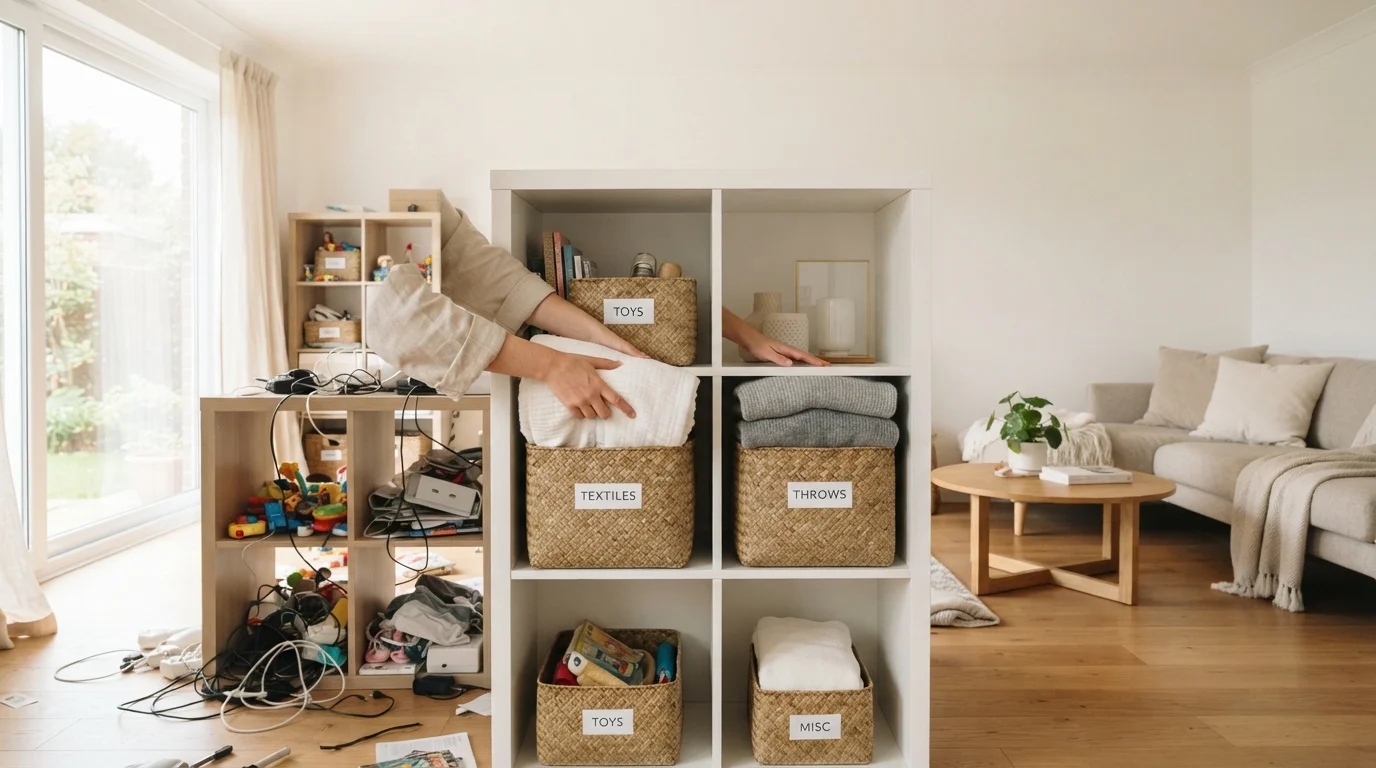
- Contain: Now - and only now - measure your space and choose containers to hold each category. Label every container, even if it seems obvious. Labels are the single biggest factor in whether a system gets maintained.
Work in Short Bursts to Avoid Burnout
Set a timer for 30-45 minutes and stop when it goes off, even if you're not finished. Decision fatigue is real - the quality of your choices drops noticeably after an hour of sorting. Taking breaks and returning fresh will produce better results than pushing through exhaustion.
Once you've organized one zone successfully, move to the next. The closet organization guide applies this same process in depth if your wardrobe space is the biggest challenge.
Choosing the Right Storage Solutions
Storage shopping is where many beginners overspend and underplan. The rule is simple: measure first, shop second. Before you buy anything, know the exact dimensions of your shelves, drawers, and cabinets, and know which categories of items you need to contain.
Common storage formats and where they work best:
- Open baskets: Good for items you grab frequently - blankets, kids' toys, rolled towels. Easy to access, but contents stay visible, so they look tidy only if not overfilled.
- Drawer dividers: Essential for small-item categories like socks, utensils, or office supplies. They prevent items from migrating and jumbling together.
- Clear bins with lids: Ideal for pantry goods, craft supplies, or seasonal items. Clear sides let you see contents without opening; lids keep dust out.
- Over-door organizers: A useful option in small spaces where floor and shelf real estate is limited - works well in bathrooms, closets, and pantries.
Containers Don't Have to Be Expensive
Effective storage doesn't require a large budget. Shoeboxes, repurposed glass jars, and cardboard magazine holders all work well as temporary or permanent solutions. Focus first on getting your system right; upgrade containers gradually over time if you choose to.
If you're working with limited square footage throughout your home, the room-by-room strategies in our small apartment organization guide offer targeted solutions for tight spaces.
How to Keep a Room Organized Long-Term
Organizing a room once is far easier than keeping it organized. The maintenance phase is where most people stumble, but two simple habits prevent the vast majority of drift:
- The daily reset (5 minutes): At the end of each day, do a quick pass through the room returning stray items to their assigned homes. This prevents small messes from compounding into overwhelming clutter.
- One in, one out: Every time a new item enters the room - a purchase, a gift, a hand-me-down - one existing item leaves. This keeps the total volume of belongings stable over time.
About once a season, do a brief reassessment: are the systems still working, or have categories shifted? Life changes, and a good organization system should adapt with it. A 20-minute seasonal check is far less work than starting from zero again.
Building organizational habits has a lot in common with building any other personal system. If you find the process of creating structured routines useful, our guide to building a personal study system explores a similar framework applied to learning habits.
Don't Skip the Purge Step
It's tempting to go straight to buying pretty bins and arranging things neatly, but organizing clutter just hides the problem. If you skip purging, you'll run out of storage space quickly and the system will collapse within weeks. Take the time to reduce volume before you contain what remains.