

Key Takeaways
Start here
What a Personal Study System Actually Is
Next
Laying the Foundation: Goals and Schedule
Build skills
Core Study Techniques for Beginners
Refine
Tracking Progress and Adjusting Your System
Stay on track
Common Pitfalls and How to Avoid Them
What a Personal Study System Actually Is
Most beginners approach learning the same way: read something, hope it sticks, repeat. That approach works occasionally, but it is unreliable - and exhausting. A personal study system replaces guesswork with a repeatable process you can trust.
Think of it as a set of decisions you make once and then follow consistently: when you study, how long each session lasts, which techniques you use, and how you track what you have covered. The system does the planning so your mental energy goes toward actual learning.
Active recall
A study technique where you deliberately retrieve information from memory rather than simply re-reading it. This effortful retrieval strengthens long-term retention.
Spaced repetition
A method of reviewing material at gradually increasing time intervals, targeting the moments just before you are likely to forget it, which makes memories more durable.
Study system
A consistent, repeatable set of decisions - covering when, how, and what you study - that removes guesswork and makes learning more predictable.
Retrieval practice
Any activity that requires you to pull information out of your memory without looking at your source material, such as self-quizzing or writing summaries from scratch.
Self-directed learning
A style of learning where the individual takes responsibility for setting goals, choosing resources, and monitoring their own progress, rather than relying on an instructor.
A good system is not rigid. It is designed to be adjusted as you discover what works for your particular learning style and the subject at hand. For a broader look at how self-directed learners build these frameworks end to end, see the complete self-directed learning framework.
Laying the Foundation: Goals and Schedule
Before picking any techniques, you need two things: a clear goal and a realistic schedule. Without these, even the best study methods drift.
Setting Useful Goals
Vague goals - "learn Spanish" or "understand investing" - are hard to act on. Break them into smaller, measurable targets: "Read and summarize one chapter per week" or "Complete five practice problems per session." Smaller targets give you something concrete to check off and make it easier to notice when you are falling behind.
Building a Sustainable Schedule
Identify two or three consistent time slots in your week - even 30 minutes each - and protect them. Consistency beats intensity: short daily sessions generally produce better retention than marathon sessions once a week. Before each session, use a quick readiness routine to reduce friction. The pre-session readiness checklist is a practical tool for this.
Start with what you already have
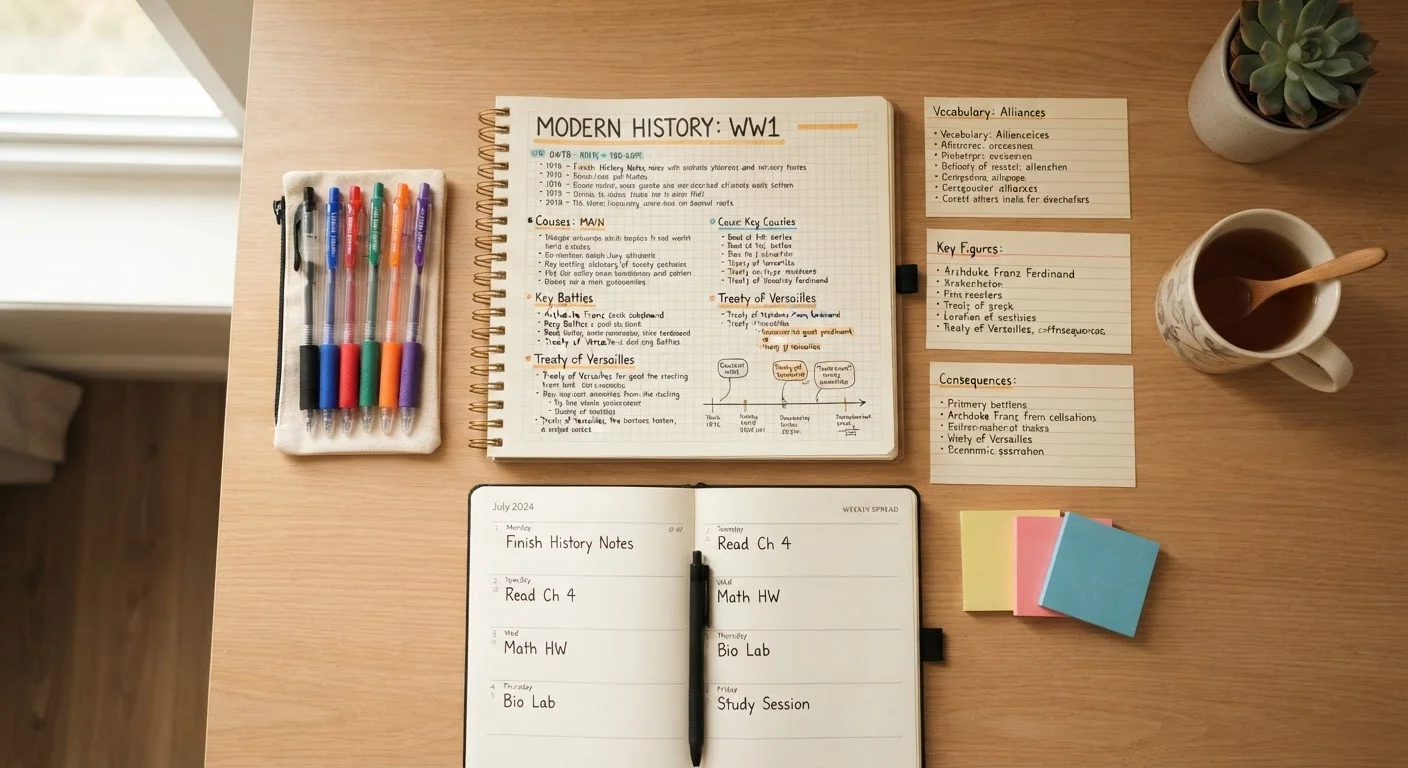
You do not need a new planner or app to launch your study system. A notebook divided into sections for goals, session notes, and review dates is enough. Building the habit of studying consistently matters far more than the tools you use to organize it.
Core Study Techniques for Beginners
The technique you use during a study session determines how well you retain the material. Two approaches have the strongest track record for beginners.
Active Recall
Instead of re-reading notes, close them and try to retrieve what you have learned from memory. Write a summary without looking, answer questions you wrote yourself, or explain the concept aloud as if teaching someone else. This retrieval effort - even when it feels difficult - strengthens memory far more effectively than passive review.
Spaced Repetition
Rather than reviewing a topic exhaustively in one sitting, spread reviews over time: study it today, revisit it in two days, then again in a week. This spacing forces repeated retrieval at the point when memory is beginning to fade, which is exactly when review has the most impact.
You do not need a sophisticated app to apply these methods. Index cards for self-quizzing and a simple calendar for scheduling review sessions are sufficient starting points.
Active recall takes practice
If you try active recall for the first time and feel like you have forgotten everything, that is normal - and it is actually part of the process. The mental effort of attempting to retrieve information, even when it is difficult, is what builds stronger memory. Feeling uncertain during recall does not mean the method is failing; it means it is working.
Tracking Progress and Adjusting Your System
A system without feedback loops is just a schedule. Tracking turns your sessions into data you can act on.
At the end of each week, spend five minutes answering three questions:
- What did I plan to study, and what did I actually cover?
- Can I recall and explain the key points without notes?
- What felt hard, and why?
This brief review exposes gaps before they accumulate. If you consistently fall short of your plan, your schedule may be over-ambitious. If recall is weak despite covering the material, your technique likely needs adjustment - more active recall, more spaced review, or smaller chunks per session.
Track your sessions in a simple log: date, topic, duration, and one sentence on what you will review next time. Over several weeks, patterns emerge that would otherwise stay invisible.
Common Pitfalls and How to Avoid Them
Certain habits feel like studying but produce little lasting learning. Recognizing them early saves significant time.
- Passive re-reading: Highlighting and re-reading notes feels productive but rarely builds durable memory. Replace it with self-quizzing.
- Session cramming: Long, infrequent sessions are harder to sustain and less effective for retention than shorter, regular ones.
- Skipping review: Without spaced review, new material fades quickly. Build review sessions into your schedule from the start, not as an afterthought.
- Perfectionism: Waiting for the perfect conditions - the right notebook, the perfect app, a free weekend - delays progress. An imperfect system you actually use beats a perfect one you never start.
For a deeper look at why beginners plateau and what breaks the pattern, the article Why New Learners Stall Out is a useful companion read. Building any skill-based habit - whether learning, fitness, or home organization - shares the same underlying principle: small, consistent actions compound over time.
Pre-Session Readiness Checklist
A structured checklist to run through before each study session, covering goal-setting, distraction reduction, and session planning. Helps you start every session with clear intent.
Self-Directed Learning Framework
An end-to-end guide covering goal setting, resource selection, practice design, and progress tracking for learners who want to teach themselves any subject independently.
Simple Session Log Template
A bare-bones one-page template for tracking study sessions - date, topic, duration, and next-review note. Effective for spotting patterns and staying accountable over weeks.