

Key Takeaways
Releases nutrients slowly, reducing burn risk
Because microbes must break down organic material first, nutrient release is gradual and gentler on roots, making over-application far less likely for beginners.
Improves long-term soil health
Organic matter feeds beneficial soil organisms, which over time improve soil structure, drainage, and the overall growing environment.
Lower environmental runoff risk
Slow-release nutrients are less likely to wash out of soil during rain events, reducing the chance of waterway contamination compared to fast-dissolving synthetics.
Builds soil biology with repeated use
Consistent organic applications support a living soil ecosystem that can reduce the need for added nutrients over multiple growing seasons.
Results take weeks, not days
If a plant is visibly deficient, organic fertilizers may not correct the problem fast enough to prevent damage during the current growing season.
Higher risk of plant burn from salts
Synthetic fertilizers are concentrated mineral salts, and applying too much - or applying to dry soil - can damage roots and foliage relatively quickly.
Does not improve soil biology
Synthetic formulations feed plants directly but provide nothing for soil microbes, meaning repeated use alone doesn't build long-term soil health.
Nutrient leaching is more likely
Water-soluble synthetic nutrients can wash through soil rapidly, especially in sandy or heavily irrigated beds, which means nutrients may not reach roots and can enter local waterways.
NPK ratios can vary and be hard to predict
Organic sources like compost have inconsistent nutrient concentrations, making it harder to know exactly how much of each nutrient you're applying.
Our Verdict
Organic fertilizers are a strong default for most new gardeners: they're forgiving, support soil health, and carry a low risk of plant burn. Synthetic fertilizers have their place when fast results or precise nutrient correction are needed, but they require more careful application. Many experienced gardeners use both depending on the situation.
Beginners building their first garden bed who want a low-risk, soil-friendly approach will generally do well starting with organic options, while those troubleshooting a specific nutrient deficiency may benefit from a targeted synthetic product.
What Fertilizer Actually Does
Plants make their own food through photosynthesis, but they also draw three key nutrients from soil: nitrogen (N), which drives leafy green growth; phosphorus (P), which supports root development and flowering; and potassium (K), which helps overall plant resilience. Together, these are called macronutrients, and you'll see them listed as an NPK ratio on any fertilizer bag (for example, 10-5-5).
Fertilizer doesn't replace good soil - it supplements it. If your soil is already healthy and biologically active, your plants may need very little added nutrition. This is why most gardening guides recommend a basic soil test before you buy anything. You can pick up inexpensive test kits at most garden centers, or send a sample to your local cooperative extension service for a detailed readout. If you're still getting comfortable with terms like soil pH or macronutrients, see our plain-language gardening glossary for quick definitions.
How Organic Fertilizers Work
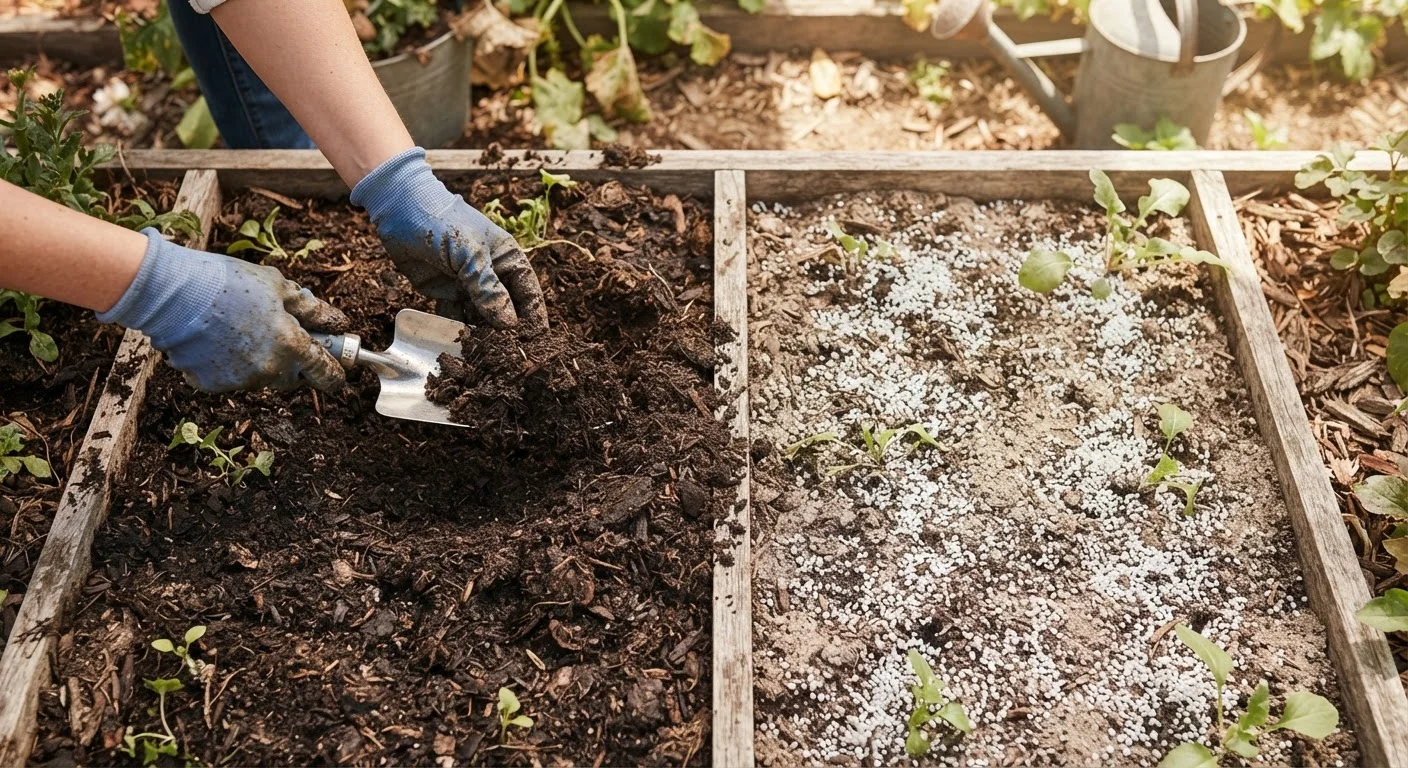
Organic fertilizers come from natural sources - compost, worm castings, bone meal, blood meal, kelp, and fish emulsion are common examples. They don't deliver nutrients directly to plant roots. Instead, soil microbes (bacteria, fungi, and other organisms) break down the organic material first, and then the nutrients become available to plants. This process takes time - usually several weeks - but it has meaningful side effects.
Releases nutrients slowly, reducing burn risk
Because microbes must break down organic material first, nutrient release is gradual and gentler on roots, making over-application far less likely for beginners.
Improves long-term soil health
Organic matter feeds beneficial soil organisms, which over time improve soil structure, drainage, and the overall growing environment.
Lower environmental runoff risk
Slow-release nutrients are less likely to wash out of soil during rain events, reducing the chance of waterway contamination compared to fast-dissolving synthetics.
Builds soil biology with repeated use
Consistent organic applications support a living soil ecosystem that can reduce the need for added nutrients over multiple growing seasons.
Because organic matter feeds microbial life, it gradually improves soil texture, water retention, and aeration. Over a full growing season, soil amended with organics often becomes measurably richer and easier to work with. This is especially relevant if you're gardening in heavy clay or sandy soil, both of which can be challenging for beginners. For more context on how your growing environment affects fertilizer choices, see our article on indoor vs. outdoor gardening.
How Synthetic Fertilizers Work
Synthetic fertilizers are manufactured compounds - often mineral salts - that dissolve in water and deliver nutrients directly to plant roots, bypassing the need for microbial breakdown. A liquid synthetic fertilizer can show visible results in days rather than weeks, which is why many gardeners reach for them when a plant looks pale or stressed.
Results take weeks, not days
If a plant is visibly deficient, organic fertilizers may not correct the problem fast enough to prevent damage during the current growing season.
Higher risk of plant burn from salts
Synthetic fertilizers are concentrated mineral salts, and applying too much - or applying to dry soil - can damage roots and foliage relatively quickly.
Does not improve soil biology
Synthetic formulations feed plants directly but provide nothing for soil microbes, meaning repeated use alone doesn't build long-term soil health.
Nutrient leaching is more likely
Water-soluble synthetic nutrients can wash through soil rapidly, especially in sandy or heavily irrigated beds, which means nutrients may not reach roots and can enter local waterways.
NPK ratios can vary and be hard to predict
Organic sources like compost have inconsistent nutrient concentrations, making it harder to know exactly how much of each nutrient you're applying.
The speed advantage is real, but it comes with trade-offs. Synthetic nutrients don't feed soil organisms, and some formulations can actually reduce microbial diversity with repeated use. There's also a higher risk of fertilizer burn - when concentrated salts damage roots or leaf tissue - if you apply too much or in dry conditions. Always follow label rates precisely and water plants before and after applying granular synthetics.
3-4 weeks
Typical organic fertilizer nutrient release window
Most granular organic fertilizers require several weeks of microbial activity before nutrients become fully available to plant roots.
24-48 hrs
How quickly liquid synthetics can show plant response
Liquid synthetic fertilizers dissolve almost immediately in soil water, which is why visible improvement in plant color can appear within a day or two of application.
Making a Practical Choice as a New Gardener
For most beginners, the simplest approach is to start with a good compost and an all-purpose organic granular fertilizer. Apply both at planting time, follow the label, and observe how your plants respond over several weeks. Avoid the temptation to add more if growth seems slow - over-fertilizing is one of the most common beginner mistakes, and it can cause more harm than doing nothing.
If you notice yellowing leaves, stunted growth, or other specific symptoms mid-season, that's a reasonable moment to consider a targeted synthetic product to correct a deficiency quickly. Think of organics as your foundation and synthetics as an occasional, precise tool - not a regular substitute.
Always Read the Label Before Applying
Every fertilizer - organic or synthetic - comes with specific application rates and timing instructions. Following these exactly is the single most effective way to avoid the most common beginner mistake: over-fertilizing. More fertilizer does not mean faster or better growth, and excess nutrients can stress or kill plants. When in doubt, apply less than the stated maximum rate and observe results before adding more.
Your fertilizer strategy also connects to what you're growing. Plants with different nutrient demands - heavy-feeding vegetables versus drought-tolerant herbs, for instance - may need different approaches. If you're planning a mixed bed, companion planting principles can help you group plants with similar needs. And if you're still deciding how to start your plants in the first place, our guide to seeds vs. seedlings covers the tradeoffs clearly.