

| Number of common warning lights | Roughly 50-80 across most modern vehicles (National Highway Traffic Safety Administration guidance) |
| Color coding standard | Red = urgent, Yellow/Amber = caution, Green/Blue = informational (Industry-wide automotive convention) |
| Check engine light causes | Over 1,000 possible diagnostic trouble codes (SAE OBD-II standard) |
| TPMS federal mandate | Required on all new US passenger vehicles since 2008 (NHTSA FMVSS No. 138) |
| Safe driving distance after oil light | Stop as soon as safely possible - do not continue driving (General manufacturer guidance) |
| DIY code reader cost range | Approximately $20-$100 for a basic OBD-II scanner (General retail market data) |
How to Read the Color Code
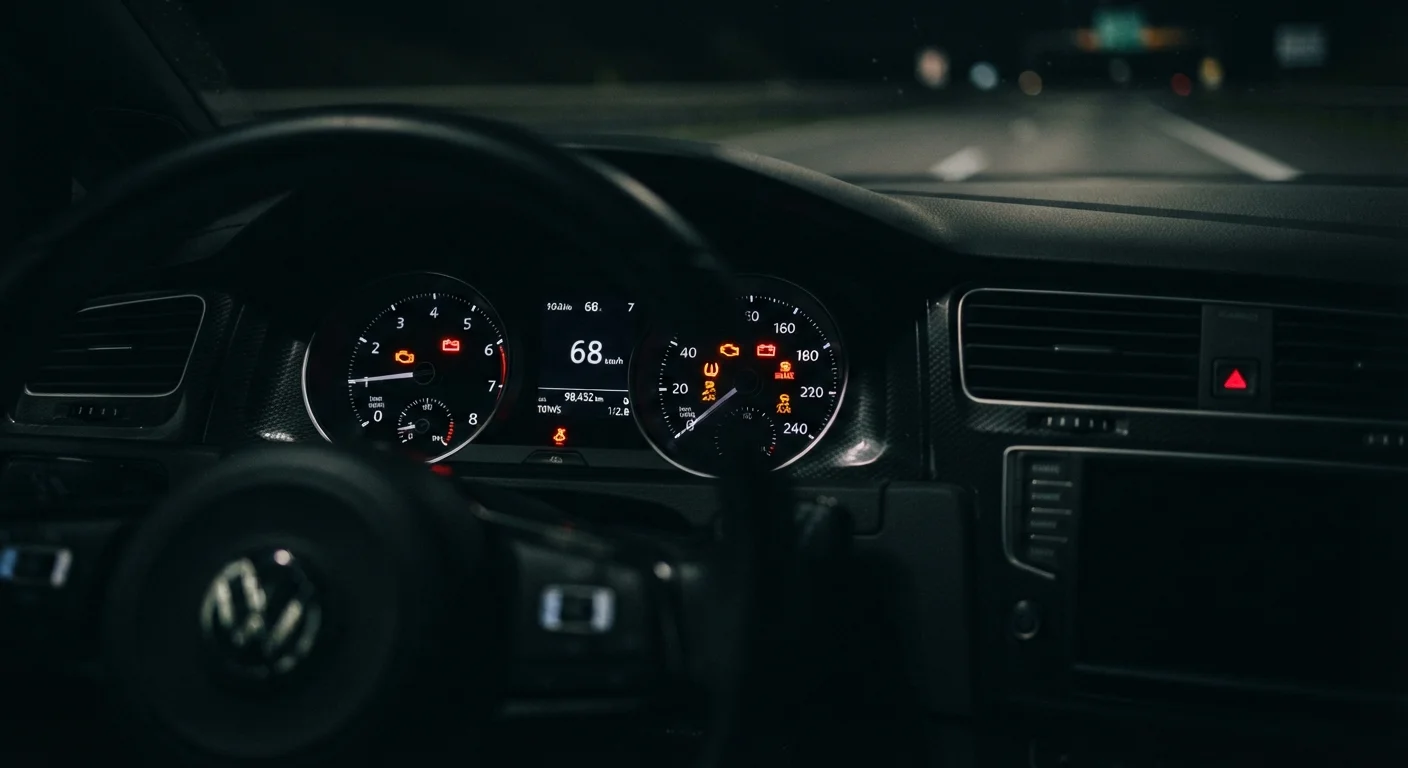
Before diving into individual lights, understand the color system every modern vehicle uses. Red lights demand immediate attention - they indicate a condition that can cause engine damage, brake failure, or a safety risk if you keep driving. Yellow or amber lights signal a caution: something needs attention soon, but you're not usually in immediate danger. Green and blue lights are informational - they simply confirm that a feature (like high beams or cruise control) is active.
When any red light comes on while driving, find a safe place to stop as soon as possible. Don't ignore it and hope it goes away.
| Number of common warning lights | Roughly 50-80 across most modern vehicles (National Highway Traffic Safety Administration guidance) |
| Color coding standard | Red = urgent, Yellow/Amber = caution, Green/Blue = informational (Industry-wide automotive convention) |
| Check engine light causes | Over 1,000 possible diagnostic trouble codes (SAE OBD-II standard) |
| TPMS federal mandate | Required on all new US passenger vehicles since 2008 (NHTSA FMVSS No. 138) |
| Safe driving distance after oil light | Stop as soon as safely possible - do not continue driving (General manufacturer guidance) |
| DIY code reader cost range | Approximately $20-$100 for a basic OBD-II scanner (General retail market data) |
The Lights You're Most Likely to See
Here's a plain-English breakdown of the warning lights that appear most often - and what to do about each one.
Check Engine (MIL)
This amber light can mean anything from a loose gas cap to a misfiring cylinder. A steady check engine light usually means the car is drivable but needs a diagnostic scan soon. A flashing check engine light means the engine is misfiring actively - reduce speed and get to a mechanic promptly to avoid catalytic converter damage. An inexpensive OBD-II scanner can pull the stored code and give you a starting point.
Oil Pressure
This is a red light shaped like an oil can. When it comes on, your engine may not be receiving adequate lubrication. Pull over safely and shut off the engine. Check the oil level; if it's low, adding oil may help - but if the level is fine and the light stays on, a mechanic needs to diagnose the pressure system. Running an engine with low oil pressure causes rapid, expensive damage. See our guide on checking your fluids under the hood to understand oil level checks.
Battery / Charging System
A red battery icon means the alternator may not be charging the battery. Your car is likely running on battery reserve alone. Limit electrical use (radio, AC), head directly to a shop, and avoid turning the engine off - it may not restart. Don't assume a new battery fixes it; the alternator is often the culprit.
Temperature Warning
A red thermometer in liquid signals the engine is overheating. Turn off the AC, turn the heater to full blast (it draws heat away from the engine), and pull over safely. Never open the radiator cap on a hot engine. Continued driving can warp the cylinder head - a very costly repair.
Brake Warning
If this red light appears and your parking brake is fully released, you may have low brake fluid or a brake system fault. This is a safety-critical system - do not ignore it. Our article on brake wear and warning signs explains what to watch for alongside the light.
TPMS (Tire Pressure)
An amber light shaped like a cross-section of a tire with an exclamation mark means at least one tire is significantly underinflated. Check all four tires with a gauge and inflate to the pressure shown on the sticker inside your driver's door - not the number on the tire sidewall. Our tire pressure basics guide walks through the full process. Note that TPMS does not replace regular manual checks.
ABS Warning
An amber ABS light means the anti-lock braking system has detected a fault. Your regular brakes still work, but ABS (which prevents wheel lockup during hard stops) may be disabled. Drive cautiously and have it inspected - especially before winter driving.
Your Owner's Manual Is the Final Word
Warning light symbols and their exact meanings can vary by make and model. The descriptions here reflect common industry conventions, but your owner's manual will show the precise icons for your vehicle and explain manufacturer-specific responses. See our guide on how to actually use your owner's manual if you're not sure where to look.
What to Do When a Light Comes On
Follow this simple decision tree whenever a warning light appears:
- Is it red? Pull over safely and assess. Don't drive on unless you know it's safe.
- Is it flashing? Reduce speed immediately; a flashing light usually signals an active fault, not just a stored code.
- Check the obvious first. Gas cap loose? Parking brake on? These simple fixes clear some lights instantly.
- Consult your owner's manual. Find the exact icon and the recommended action for your specific vehicle.
- Get a diagnostic scan. Many auto parts retailers offer free OBD-II scans. Knowing the code helps you have an informed conversation with a mechanic.
- Don't reset the light without fixing the cause. Clearing a code without addressing the underlying problem just delays the diagnosis.
Staying on top of your regular maintenance schedule is the best way to reduce how often warning lights appear in the first place.