

| Recommended pressure location | Driver's door jamb sticker or owner's manual |
| When to check pressure | Monthly and before long trips, when tires are cold |
| Minimum legal tread depth (most U.S. states) | 2/32 inch |
| Recommended rotation interval | Every 5,000-7,500 miles (verify with your owner's manual) |
| TPMS trigger threshold | Typically 25% below recommended PSI |
| Early replacement threshold | 4/32 inch tread depth, especially in wet/snow climates |
Why Tires Deserve More Attention Than They Usually Get
Your tires are the only part of your car that actually touches the road - four contact patches roughly the size of your hand. Everything that keeps you safe, from steering response to braking distance, runs through those patches. Yet most drivers only think about tires when something goes wrong.
The good news: tire maintenance is simple, takes minutes, and saves real money. Underinflated tires alone can reduce fuel economy noticeably and wear out faster than properly inflated ones. Staying on top of three basics - pressure, tread depth, and rotation - covers most of what you need. See good ownership habits for how this fits into a broader routine.
| Recommended pressure location | Driver's door jamb sticker or owner's manual |
| When to check pressure | Monthly and before long trips, when tires are cold |
| Minimum legal tread depth (most U.S. states) | 2/32 inch |
| Recommended rotation interval | Every 5,000-7,500 miles (verify with your owner's manual) |
| TPMS trigger threshold | Typically 25% below recommended PSI |
| Early replacement threshold | 4/32 inch tread depth, especially in wet/snow climates |
Tire Pressure: The Right Number and How to Find It
The number molded into the side of your tire is not your target pressure - it's the maximum the tire can hold. Your actual target pressure is found on the sticker inside your driver's door jamb, or in your owner's manual. It's typically expressed in PSI and is specific to your vehicle's weight and suspension.
Check pressure when tires are cold - meaning the car hasn't been driven for at least three hours. Driving heats air inside the tire and temporarily raises the reading. A basic digital gauge costs a few dollars and is more reliable than the gauges built into gas station air pumps.
Check monthly and before long trips. If your car has a TPMS light on the dashboard, treat it as a warning - not a substitute for manual checks. The TPMS typically triggers at 25% below recommended pressure, which is already problematic. For more on what dashboard lights mean, see what your dashboard warning lights are telling you.
PSI (Pounds Per Square Inch)
The unit used to measure air pressure inside a tire. Your vehicle's recommended PSI is set by the manufacturer and is found on the door jamb sticker or owner's manual - not on the tire sidewall.
TPMS
Tire Pressure Monitoring System. A sensor-based system that triggers a dashboard warning light when one or more tires drop significantly below recommended pressure. It supplements but does not replace regular manual pressure checks.
Tread Depth
The measurement from the top of a tire's rubber tread to the bottom of its deepest grooves. Adequate depth is critical for channeling water away from the contact patch and maintaining grip, especially in wet conditions.
Tire Rotation
The process of moving tires from one position on the vehicle to another (e.g., front to rear) to even out wear patterns. Regular rotation extends overall tire life and helps maintain balanced handling.
Directional Tire
A tire designed to roll in one specific direction, indicated by an arrow on the sidewall. These tires cannot be swapped side-to-side and have limited rotation patterns compared to non-directional tires.
Alignment
The adjustment of a vehicle's suspension angles so tires meet the road at the correct angle. Poor alignment causes uneven or accelerated tire wear and can affect steering precision.
Tread Depth: Knowing When to Replace
Tread channels water away from the tire's contact patch so rubber grips the road. As tread wears down, wet-weather stopping distance increases substantially - a significant safety concern.
The legal minimum tread depth in most U.S. states is 2/32 of an inch. Many safety experts recommend replacing tires before they reach that point, around 4/32 inches, particularly if you drive in rain or snow.
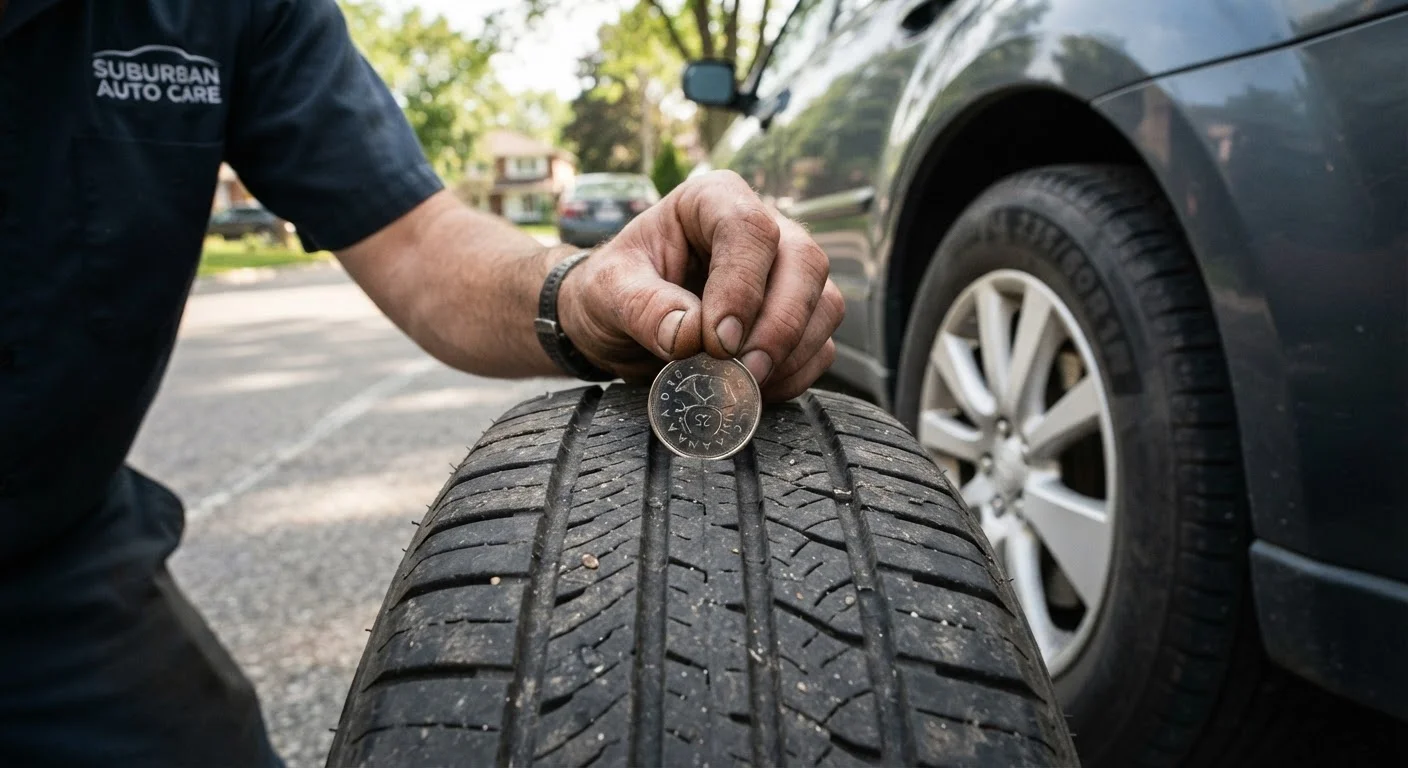
The quick check: insert a U.S. penny into a tread groove with Lincoln's head pointing down. If you can see the top of Lincoln's head, you're at or below 2/32 inches - replacement is overdue. A quarter gives you an earlier warning: if you can see the top of Washington's head, you're near 4/32 inches.
Uneven wear patterns are also worth knowing. Wear in the center suggests chronic overinflation; wear on both outer edges points to underinflation; wear on one side only often indicates an alignment issue. If you're seeing patterns like these, a qualified mechanic should inspect the tires and alignment together. Don't ignore it - uneven wear accelerates the problem and costs more in the long run. Common maintenance myths sometimes lead drivers to delay these checks longer than they should.}
25%
Below recommended PSI when TPMS light activates
The TPMS warning light typically activates at 25% below recommended tire pressure - meaning significant underinflation has already occurred before the alert appears.
2/32"
Legal minimum tread depth in most U.S. states
At this depth, wet-weather braking distance increases significantly; many safety guidelines recommend replacement starting at 4/32 inches.
5,000-7,500 mi
Typical tire rotation interval
Most vehicle manufacturers recommend tire rotation within this range; your owner's manual contains the figure specific to your model.
Tire Rotation: Why Position Matters
Front and rear tires wear at different rates because they handle different jobs. On front-wheel-drive vehicles, the front tires steer and deliver power, so they wear faster. Rotation moves tires to different positions on the vehicle so the wear evens out across all four - extending overall tire life.
Most manufacturers recommend rotating tires every 5,000 to 7,500 miles, often aligned with oil changes. Check your owner's manual for the interval specific to your vehicle. Skipping rotations doesn't save money - it just means replacing all four tires sooner instead of getting more miles from the same set.
Rotation patterns vary depending on whether your car has directional tires (which must spin in one direction only), staggered fitments (different sizes front and rear), or a full-size matching spare that can enter the rotation. A tire shop or mechanic can advise on the right pattern for your setup.
For a full picture of how tire care fits into scheduled maintenance, see understanding your car's maintenance schedule.
This article provides general vehicle maintenance information for educational purposes. For diagnosis of specific tire wear issues or safety concerns, consult a qualified mechanic or tire professional.