

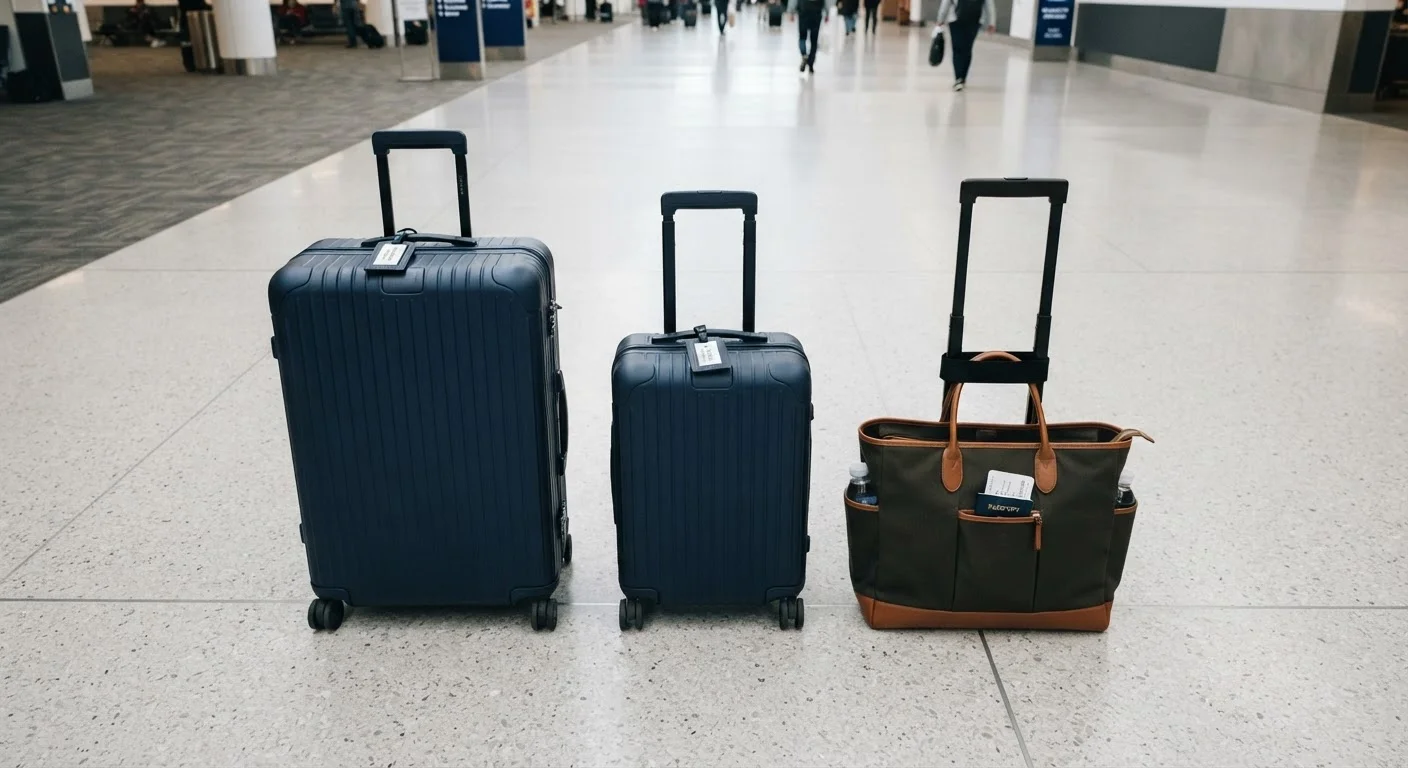
The Three Categories of Airline Luggage
Airlines divide passenger bags into three distinct categories: personal items, carry-on bags, and checked luggage. Understanding where your bag falls - before you arrive at the airport - is one of the most practical things a first-time traveler can do.
A personal item is the smaller bag that goes under the seat in front of you. Think laptop bags, backpacks, small totes, or purses. A carry-on (also called a cabin bag) is the larger bag that fits in the overhead bin. Checked luggage is any bag you hand over at the check-in counter and retrieve at baggage claim.
Most airlines allow one carry-on and one personal item at no extra charge, though this varies significantly by fare class. Budget carriers often charge separately for carry-on overhead bin access - so always read your ticket's fare conditions carefully before assuming what's included.
Carry-On Size Limits: What the Numbers Actually Mean
Carry-on size limits are typically expressed as linear inches - the total of a bag's length, width, and depth added together - or as three separate measurements. A common guideline across many US carriers is roughly 22 x 14 x 9 inches (including handles and wheels), but this is not universal. Some carriers allow slightly larger bags; others are stricter.
Key things to know:
- Measure with wheels and handles extended. Airlines include these in their measurements. A suitcase labeled "22-inch" by a manufacturer may actually exceed airline limits once hardware is factored in.
- Soft bags compress; hard-shell bags don't. A slightly overpacked soft-sided bag may squeeze into the overhead bin where a rigid shell won't flex at all.
- Gate checking happens. If the overhead bins fill up, crew may gate-check your bag at no charge - but this isn't guaranteed, and fragile items or medications should always stay with you.
If you're deciding between bag types, our guide to checked luggage vs. carry-ons walks through the trade-offs in detail.
Personal Item Rules and Weight Limits
Personal item size limits are less standardized than carry-on rules, but a commonly cited range is around 18 x 14 x 8 inches or smaller. Many airlines simply state it must fit under the seat in front of you - which varies by aircraft type. A bag that fits on a wide-body international flight may not fit on a small regional jet.
Linear inches
The sum of a bag's length, width, and depth measurements. Airlines use this to set a single size limit instead of listing three separate numbers. For example, a 45-linear-inch limit means length + width + depth must not exceed 45 inches total.
Personal item
A small bag - such as a purse, laptop bag, or compact backpack - that must fit under the seat in front of you. Most airlines allow one personal item in addition to a carry-on at no extra charge.
Gate check
When airline staff take your carry-on at the boarding gate and place it in the cargo hold because overhead bin space is full. It's usually free but means you collect the bag at baggage claim rather than deplaning with it.
Fare class
The category of ticket you purchased (e.g., basic economy, standard economy, business). Baggage allowances - including whether a carry-on is included - often depend on fare class, not just the airline.
Weight limits apply mainly to checked bags (typically 50 lbs for standard economy on US domestic routes, though international routes and premium cabins differ). Many US carriers don't enforce a weight limit for carry-ons, but some - particularly international and budget airlines - cap carry-on weight at 15 to 22 lbs. If you're flying internationally or on a budget carrier, always verify weight rules in advance.
Before committing to carry-on-only travel, it's worth reading an honest look at carry-on-only travel to understand the real trade-offs.
What to Always Verify Before Your Flight
Luggage rules are not universal - they change by airline, route, fare class, and even aircraft type. Here's a practical checklist for every trip:
- Check the airline's official baggage policy page for the specific route you're flying. Don't rely on what another carrier allowed you to bring.
- Confirm your fare class includes a carry-on. Basic economy fares on some carriers restrict overhead bin access entirely.
- Weigh your bag at home with a luggage scale before you leave. Overweight bag fees can be significant.
- Review what goes inside your carry-on, not just the bag itself. TSA has rules about liquids, gels, and certain items that are separate from size limits. Our article on TSA liquid rules and toiletries covers this clearly.
- For multi-climate trips, packing efficiently matters as much as choosing the right bag size - see packing for different climates in one trip for strategies.
This article provides general travel information only. Airline policies change frequently - always verify current baggage rules directly with your carrier and through official government travel resources before flying.