

Key Takeaways
Why Crate Training Gets a Bad Rap - and Why Trainers Still Recommend It
Many new dog owners hear "crate training" and picture confinement. That reaction is understandable, but it misreads what a crate actually is for a dog. Dogs are denning animals by instinct - in the wild, canids rest and raise young in small, enclosed spaces that feel sheltered and predictable. A properly introduced crate taps into that same instinct, giving your dog a defined space that belongs entirely to it.
Certified professional trainers and veterinary behaviorists widely support crate training because it serves real, practical purposes: it accelerates housebreaking (dogs are reluctant to soil their sleeping area), reduces destructive chewing when you can't supervise, and prepares dogs for crated travel or veterinary stays where they'd otherwise be highly stressed.
If you're bringing a dog home for the first time, introducing a crate in those early weeks is far easier than retrofitting it later. The key is that a crate should never feel like a penalty - it must always be somewhere your dog chooses to go.
What you will need
Choosing the Right Crate and Setting It Up
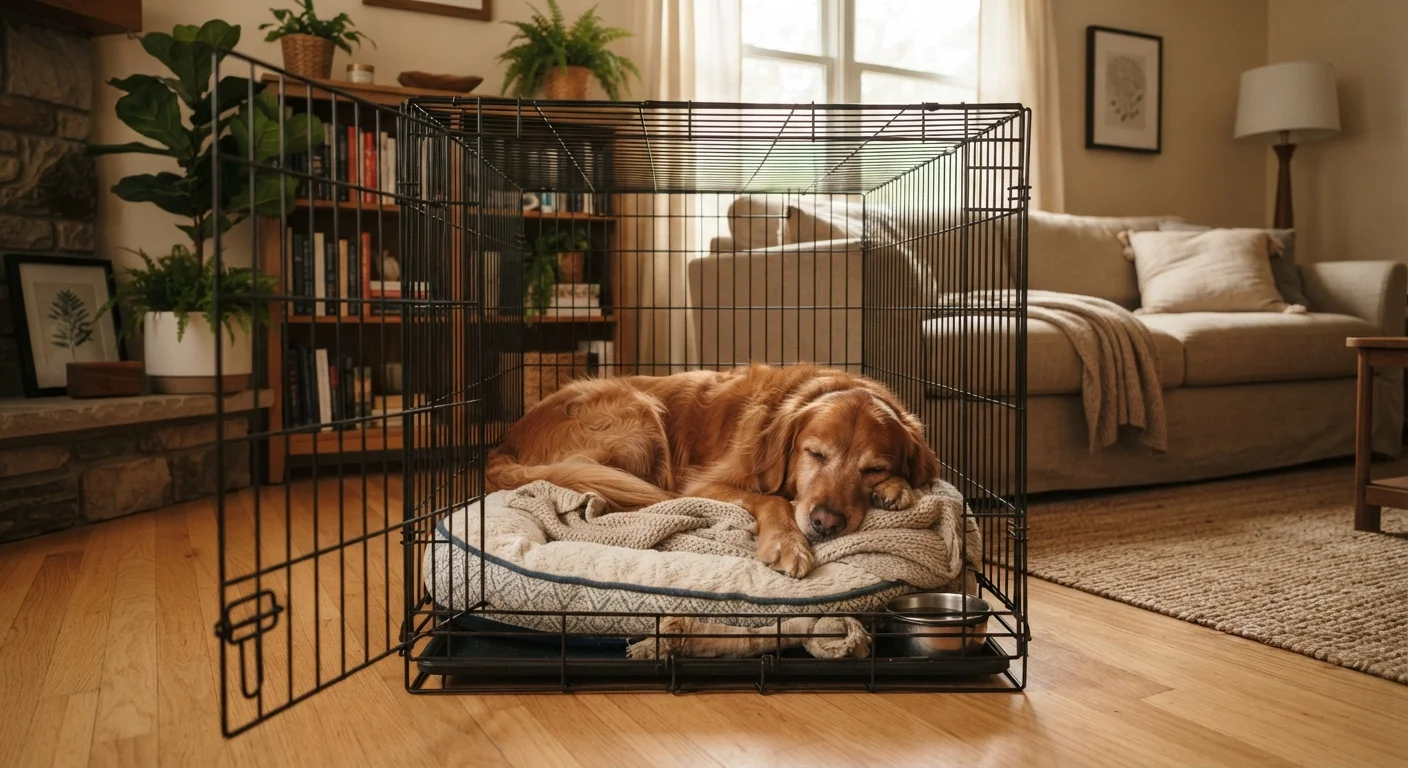
Before any training begins, the crate itself needs to be appropriate. Size matters: your dog should be able to stand up fully, turn around, and lie flat without touching the walls. Too large, though, and a puppy may use one end as a bathroom. If you have a puppy that will grow, consider a crate with a movable divider panel so you can adjust the space as it grows.
Placement is equally important. Put the crate in a room where your family spends time - a corner of the living room or bedroom works well. Dogs are social; isolating the crate in a basement or garage undermines the training entirely. Line the floor with a washable mat or fleece blanket, and tuck in a worn piece of your clothing so the space carries a familiar, calming scent.
Wire crate with divider panel
Provides ventilation and visibility while allowing you to resize the interior as a puppy grows.
Washable crate mat or fleece blanket
Makes the crate floor comfortable and helps the space feel den-like and inviting.
High-value training treats
Used to create positive associations with entering and staying in the crate.
Food-stuffed chew toy
Gives the dog a calming activity during crate time, especially during absences.
Crate cover or lightweight blanket
Draping over three sides can make the crate feel more enclosed and den-like for dogs that prefer lower light.
Step-by-Step: Introducing the Crate Humanely
The process below works for puppies and adult dogs alike. Patience is the most important variable - skip steps only if your dog is genuinely comfortable and not simply shutting down from stress. A dog that freezes, pants, drools excessively, or tries desperately to escape is not ready to move forward.
For dogs showing more intense distress, separation anxiety may be a factor. Our guide on separation anxiety in dogs explains how to distinguish normal adjustment from a deeper behavioral issue that may need professional support.
Let the dog investigate the crate on its own terms
Place the crate in the room with the door open and let your dog sniff, circle, and enter voluntarily. Do not coax, push, or lure it inside yet. Leave a few treats near the entrance and just inside the threshold. Allow this exploration phase to run for at least one full day before moving on.
Begin feeding meals near and then inside the crate
Start placing your dog's food bowl just in front of the crate opening. Over several meal sessions, gradually move the bowl further inside until your dog is eating with all four paws inside the crate. Once it enters readily, begin closing the door briefly while it eats - then open it before your dog shows any signs of distress. Extend door-closed time by a minute or two each session.
Build time in the crate in short increments
Once your dog enters and eats comfortably with the door closed, begin conditioning it to stay in the crate outside of mealtimes. Use a cue word - something simple like "crate" or "place" - toss a treat inside, and click or praise the moment your dog enters. Gradually extend the duration from 30 seconds to a few minutes. Remain in the room during this phase.
Practice with you out of sight
Once your dog is comfortable in the crate for five to ten minutes with you present, begin leaving the room briefly. Start with 30-second absences and build toward 30 minutes over several sessions. This is the phase that takes the most patience - don't jump to full workday durations until your dog is genuinely settled for at least 30 minutes of being alone.
Establish a consistent daily crate routine
Dogs thrive on predictability. Build crate time into your daily schedule - after morning walks, during your work hours, and at night if the crate will serve as a sleeping space. Consistent timing helps your dog anticipate rest periods and reduces resistance over time. Most dogs settle into a reliable crate routine within one to three weeks of consistent training.
Crates Are Not a Substitute for Exercise
A crate does not replace your dog's need for physical activity and social interaction. A dog that is under-exercised and over-crated is likely to develop anxiety, frustration, and behavioral problems regardless of how well the crate training itself went. Make sure daily exercise and enrichment are built into your routine around crate time.
Common Mistakes That Set Training Back
Even well-intentioned owners can slow progress with a few recurring errors:
- Using the crate as punishment. Sending a dog to its crate when it misbehaves attaches a negative association that's very hard to undo.
- Leaving a dog too long, too soon. Young puppies (under six months) should not be crated for more than a few hours at a stretch during the day - their bladder control is simply not there yet. As a rough guideline, a puppy can hold its bladder for about one hour per month of age, up to a maximum of four to five hours.
- Letting the dog out when it whines. If you open the crate the moment your dog vocalizes, you teach it that whining works. Wait for a brief pause in noise before opening the door.
- Covering all progress with one bad experience. An abrupt extended confinement - say, during a long workday before the dog is ready - can reset weeks of positive work. Build up duration gradually.
Crate training pairs naturally with broader routines: the same steady approach applies when building a grooming routine your dog can tolerate without anxiety.
Night-Time Crating Goes Smoother Than You Expect
If you're crate training a puppy at night, placing the crate next to your bed during the first week or two significantly reduces whining. The puppy can sense your presence and settles faster. Once reliable, you can gradually move the crate to its permanent location over several nights.