

Key Takeaways
Option A
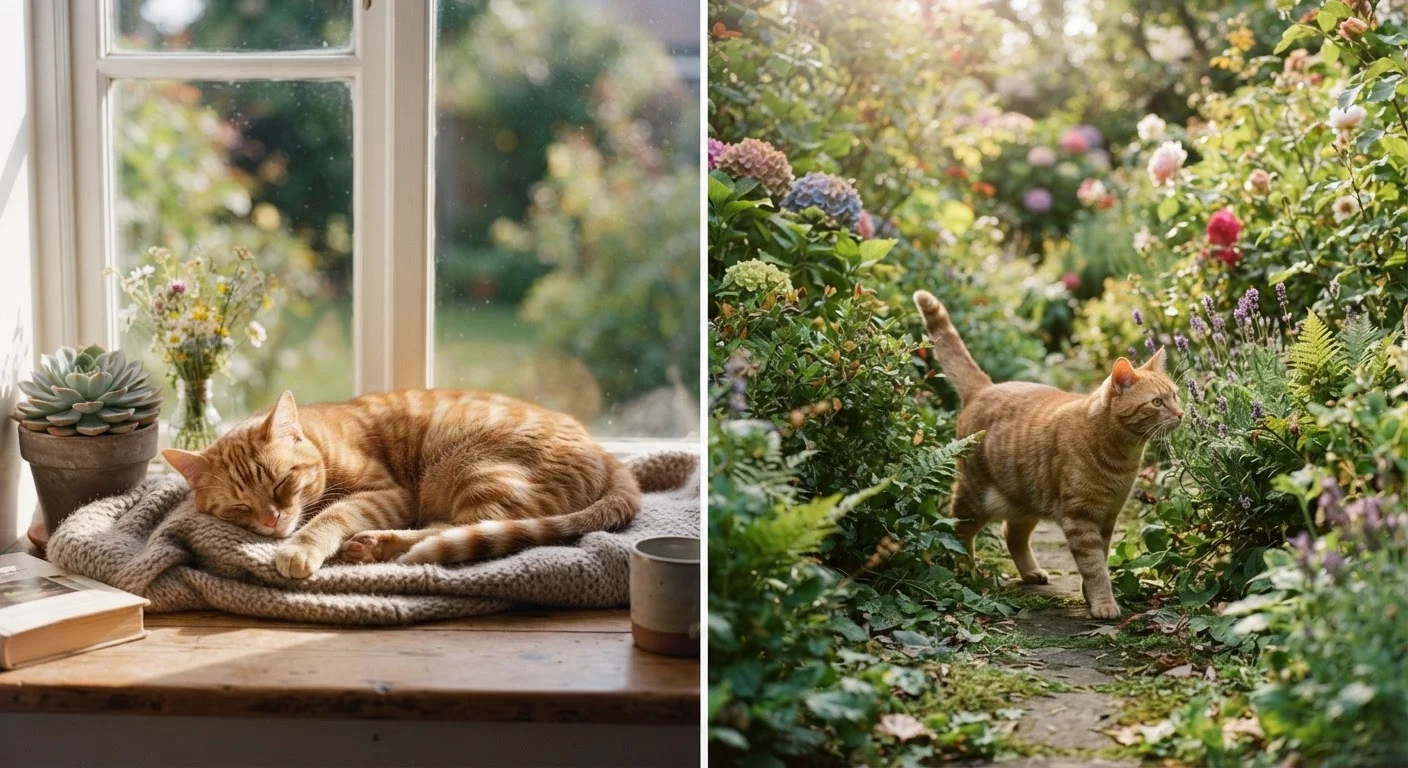
Indoor Cats
The protected, controlled-environment lifestyle.
Best for: Owners who prioritize longevity and safety and can commit to providing mental enrichment at home.
Option B
Outdoor Cats
The free-roaming, stimulation-rich alternative.
Best for: Cats with strong roaming instincts in environments where supervised or managed outdoor access can be provided safely.
If you live near busy roads or in an urban area
Indoor Cats
Traffic is consistently cited as one of the leading causes of injury and death in free-roaming cats. An indoor lifestyle eliminates this risk entirely.
If your cat has strong hunting or roaming drives and you have a safe rural setting
Outdoor Cats
Some cats are highly motivated to roam and may show stress or frustration when fully confined. Managed outdoor access in low-traffic areas can support their wellbeing.
If you want to balance enrichment and safety
Indoor Cats
A well-enriched indoor environment with climbing structures, play sessions, and window access can satisfy most cats' behavioral needs without outdoor hazards.
If you're a new cat owner unsure where to start
Indoor Cats
Starting indoors gives you time to assess your cat's temperament, health status, and local environment before making longer-term decisions about outdoor access.
What the Life Expectancy Data Shows
The gap in lifespan between indoor and outdoor cats is one of the most consistently cited figures in feline veterinary literature. Indoor cats are generally estimated to live between 12 and 18 years, while cats with unrestricted outdoor access are often estimated to live closer to 2 to 5 years on average - though this figure varies considerably based on environment, traffic density, and whether the cat is owned and cared for.
It's worth being clear about what these numbers represent: they are population-level estimates, not guarantees for any individual cat. An outdoor cat in a quiet rural area with regular vet care will have different odds than a stray navigating a busy city. Still, the trend is consistent across veterinary sources - outdoor access introduces risks that measurably shorten average lifespan.
12-18 yrs
Typical indoor cat lifespan
Commonly cited by veterinary organizations including the American Veterinary Medical Association as a general benchmark for indoor cats.
2-5 yrs
Estimated outdoor cat lifespan (average)
This figure varies significantly by environment; it reflects population averages including stray and feral cats, not just owned outdoor cats.
~1 in 3
Indoor cats affected by obesity
Veterinary surveys consistently find obesity to be one of the most common preventable health conditions in indoor cats in the US.
For new owners, this data is a useful starting point, not a verdict. Understanding why the gap exists helps you make a more informed decision than the numbers alone can provide.
Health Risks: Outdoors vs. Indoors
Outdoor cats are exposed to a range of hazards that indoor cats largely avoid. These include:
- Infectious diseases - feline leukemia virus (FeLV), feline immunodeficiency virus (FIV), and upper respiratory infections spread more easily through contact with other cats.
- Parasites - fleas, ticks, intestinal worms, and ear mites are far more common in cats that roam outside.
- Physical trauma - traffic injuries, falls, animal attacks, and territorial fights are among the leading causes of emergency vet visits for outdoor cats.
- Poisoning - outdoor cats may ingest toxic plants, rodent bait, antifreeze, or other environmental hazards.
Indoor cats are not risk-free, however. Without adequate activity and mental stimulation, they are more prone to obesity, diabetes, urinary tract issues, and stress-related behaviors such as over-grooming or aggression. Diet choices also play a meaningful role in managing these risks - particularly for indoor cats prone to weight gain and low water intake.
| Criterion | Indoor Cats | Outdoor Cats |
|---|---|---|
| Average lifespan | 12-18 years (estimated) | 2-5 years (estimated, varies widely) |
| Infectious disease risk | Low | Higher (FeLV, FIV, URI) |
| Parasite exposure | Low | High (fleas, ticks, worms) |
| Trauma risk | Low | High (traffic, predators, fights) |
| Obesity risk | Higher without enrichment | Lower due to activity |
| Behavioral stimulation | Requires intentional enrichment | Naturally high |
| Owner control over environment | High | Low |
This article provides general educational information about cat care and is not a substitute for advice from a licensed veterinarian familiar with your cat's individual health history.
Behavioral Needs and Enrichment
Cats are predatory animals with strong instincts to hunt, climb, explore, and patrol territory. Outdoor access satisfies many of these drives naturally, but that doesn't mean indoor cats are doomed to frustration - it means owners need to be intentional about enrichment.
Signs that an indoor cat may need more stimulation include excessive vocalization, destructive scratching, lethargy, and litter box avoidance. Litter box setup is one often-overlooked factor in a cat's indoor comfort level.
Effective indoor enrichment strategies include:
- Window perches and bird feeders positioned outside windows
- Regular interactive play sessions using wand toys
- Puzzle feeders that make mealtimes mentally engaging
- Cat trees and shelving that allow vertical movement
- Rotating toys to prevent habituation
For owners considering a middle path, supervised outdoor time via a leash or an enclosed catio (a screened outdoor enclosure) can provide sensory stimulation with meaningful safety controls. These options are especially worth considering for cats adopted young who've never known outdoor access - they may adapt more readily to indoor life than a cat that previously roamed freely. If you're deciding on your first cat, age at adoption can also influence how easily a cat adapts to an indoor lifestyle.
Making the Right Call for Your Cat
There's no single correct answer that applies to every cat or every household. What the data does clearly support is this: unrestricted outdoor access carries real, documented risks, and those risks should be weighed deliberately rather than accepted as the default.
Several factors are worth considering before deciding:
- Your local environment
- Traffic volume, predator presence, and disease prevalence in local cat populations all affect outdoor risk levels meaningfully.
- Your cat's temperament and history
- A previously outdoor cat may show distress when suddenly confined. A kitten raised indoors from the start will likely adapt well to that lifestyle.
- Your capacity for enrichment
- An indoor lifestyle is only as good as the environment you create. Time, space, and commitment to play all matter.
Some common beliefs about cats - including assumptions about their independence and resilience - don't always hold up under scrutiny. Our piece on popular cat health myths addresses several of these directly.
What About Indoor-Outdoor Cats?
Many owners allow cats supervised or partial outdoor access - for example, a cat that goes outside during the day but comes in at night. This approach can reduce some risks (such as nocturnal predator encounters or road traffic after dark) while still offering outdoor stimulation. It doesn't eliminate risk, but it represents a practical middle ground for many households. Discuss your specific situation with your veterinarian to understand which preventive measures matter most.
Whatever you decide, regular veterinary checkups, appropriate vaccinations (especially for outdoor cats), and parasite prevention are non-negotiable components of responsible cat ownership in either lifestyle.