

Key Takeaways
Before You Start: What You Actually Need
A budget is just a written plan for your money - nothing more complicated than that. You don't need an app, a course, or a financial background. You need a few pieces of real information and about 30 minutes. If any of the terms in this guide feel unfamiliar, the Common Budget Terms guide has plain-English definitions for everything you'll encounter.
What you will need
Bank or credit card statements (2-3 months)
Provide accurate spending data so your expense categories reflect reality, not estimates.
Recent pay stubs or direct deposit confirmations
Confirm your exact take-home pay amount for the income step.
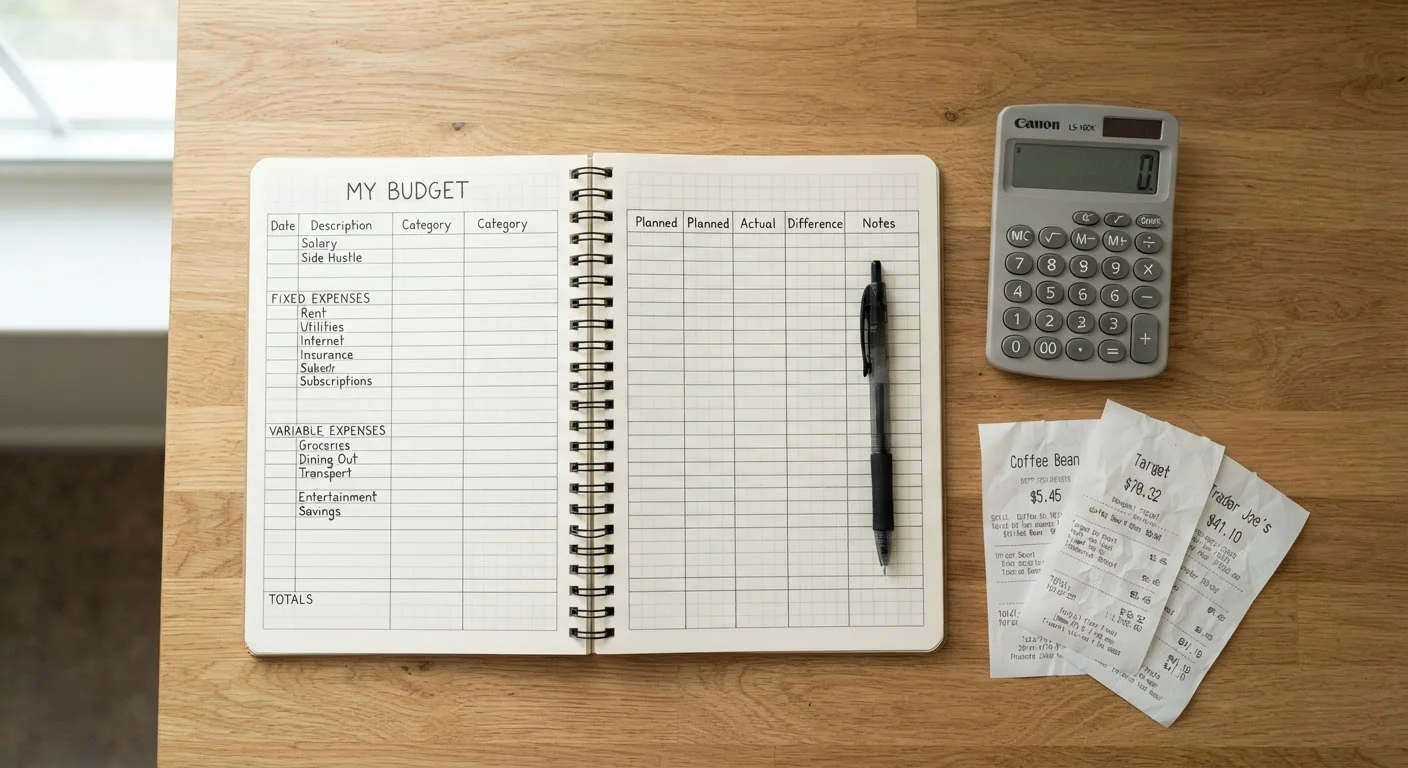
Notebook and pen, or a free spreadsheet
Record your budget categories and numbers in one place you can return to monthly.
A simple calculator
Add up category totals and check that income minus expenses equals zero or a positive number.
The Five Steps
Follow these steps in order. Each one builds on the last. Skipping ahead - especially skipping the expense-listing step - is how first budgets end up unrealistic.
Use Take-Home Pay, Not Gross Income
Gross income is what you earn before taxes and deductions are taken out. Take-home pay - also called net income - is what actually lands in your bank account. Budgeting from gross income is one of the most common first-timer mistakes and will leave you feeling like money is disappearing. Always budget from the number on your paycheck or direct deposit, not the number on your offer letter.
Write Down Your Monthly Take-Home Income
List every reliable source of money coming in each month - your job, a side gig, freelance payments, or any other regular income. Add them together. The total you're working with is your take-home pay, meaning income after taxes and any payroll deductions (health insurance, retirement contributions) have already been removed.
If your income varies month to month, use the lowest amount you reliably earn rather than your best month. Starting conservative protects you from overspending on a slow-income month.
List All Your Monthly Expenses
Go through your statements and write down every expense from the past two to three months. Group them into two buckets:
- Fixed expenses - amounts that stay the same every month, like rent, a car payment, or a loan payment.
- Variable expenses - amounts that change, like groceries, gas, dining out, and entertainment.
For variable expenses, calculate the average across your statement months. Don't round down to make things look tidy - use the real average. Also include irregular expenses like annual subscriptions or car registration by dividing the yearly cost by 12 and treating the result as a monthly line item.
Sort Expenses Into Needs and Wants
Once everything is listed, mark each expense as a need or a want. Needs are things you genuinely cannot do without: housing, basic utilities, transportation to work, groceries, and minimum debt payments. Wants are everything else - restaurant meals, streaming services, clothing beyond basics, hobbies.
This step isn't about judgment. It's about clarity. Knowing which expenses are non-negotiable and which are flexible gives you real choices when your budget is tight. For a more detailed method of categorizing expenses, see sorting your spending into categories.
Assign a Savings Amount as a Budget Line
Before you do any math to see if things balance, decide how much you want to save each month and write it down as its own expense line. Savings should not be what's left over - it should be planned just like rent. Even $25 or $50 a month is a real start.
If you're not sure where that savings is going yet, that's fine. The priority right now is building the habit. Later, you can direct it toward an emergency fund, a specific goal, or something else entirely. For guidance on working emergency savings into the picture from day one, see building an emergency fund into your budget.
Check the Balance and Adjust
Subtract your total expenses (including savings) from your take-home income. You want the result to be zero or a positive number. If it's positive, decide deliberately where that extra money goes - more savings, paying down debt, or a specific goal. If it's negative, you're planning to spend more than you earn, and you need to adjust before the month begins, not after.
Look first at your wants category for places to trim. Then consider whether any fixed costs could be reduced over time. The goal isn't a perfect budget - it's an honest one you can actually follow. Expect to revisit and tweak it each month as your spending patterns become clearer.
Treat Savings Like a Bill You Owe Yourself
Instead of saving whatever is left at the end of the month, assign savings a fixed dollar amount in your budget alongside rent and utilities. Even a small, consistent amount builds the habit. If you want a simple framework for deciding how much, the 50/30/20 rule is a solid starting point.
Don't Guess at Your Expenses
Estimates feel close enough, but they tend to run 20-30% low for most people. Pull up two or three months of actual bank or credit card statements before filling in your expense numbers. Real data, even if it's uncomfortable to look at, gives you a budget that will actually work.
What to Do After Your First Month
Your first budget is a draft, not a final answer. After your first month of using it, compare what you planned to spend against what you actually spent in each category. Most people find two or three categories that were significantly off. That's normal and useful - it tells you exactly where to adjust.
Over two or three months, most people find their budget becomes much more accurate and much less stressful to maintain. If you want to understand what tends to go wrong early on, why most first budgets fall apart after two months walks through the most common patterns and how to avoid them.
Once your budget feels stable, a natural next step is putting more intention behind your savings. The Saving Money hub covers practical habits for making that happen consistently. For a broader look at the full arc of personal budgeting - from your first paycheck to a system that largely runs itself - see the end-to-end budgeting guide.
This article is for general informational purposes only and does not constitute personalized financial advice. Consider speaking with a qualified financial professional about decisions specific to your situation.