

Key Takeaways
What a Budget Actually Is (and Isn't)
A budget is simply a plan for where your money goes each month. That's it. It isn't a punishment, a strict diet for your spending, or proof that you're bad with money. It's a tool - like a map - that shows you where you are and helps you decide where to go.
Many people avoid budgeting because they expect it to feel restrictive. In practice, a good budget does the opposite: it tells you exactly how much you can spend on things you enjoy without guilt, because you've already covered what matters most. Think of it as giving every dollar a job before it has a chance to disappear.
Start Simple, Then Refine
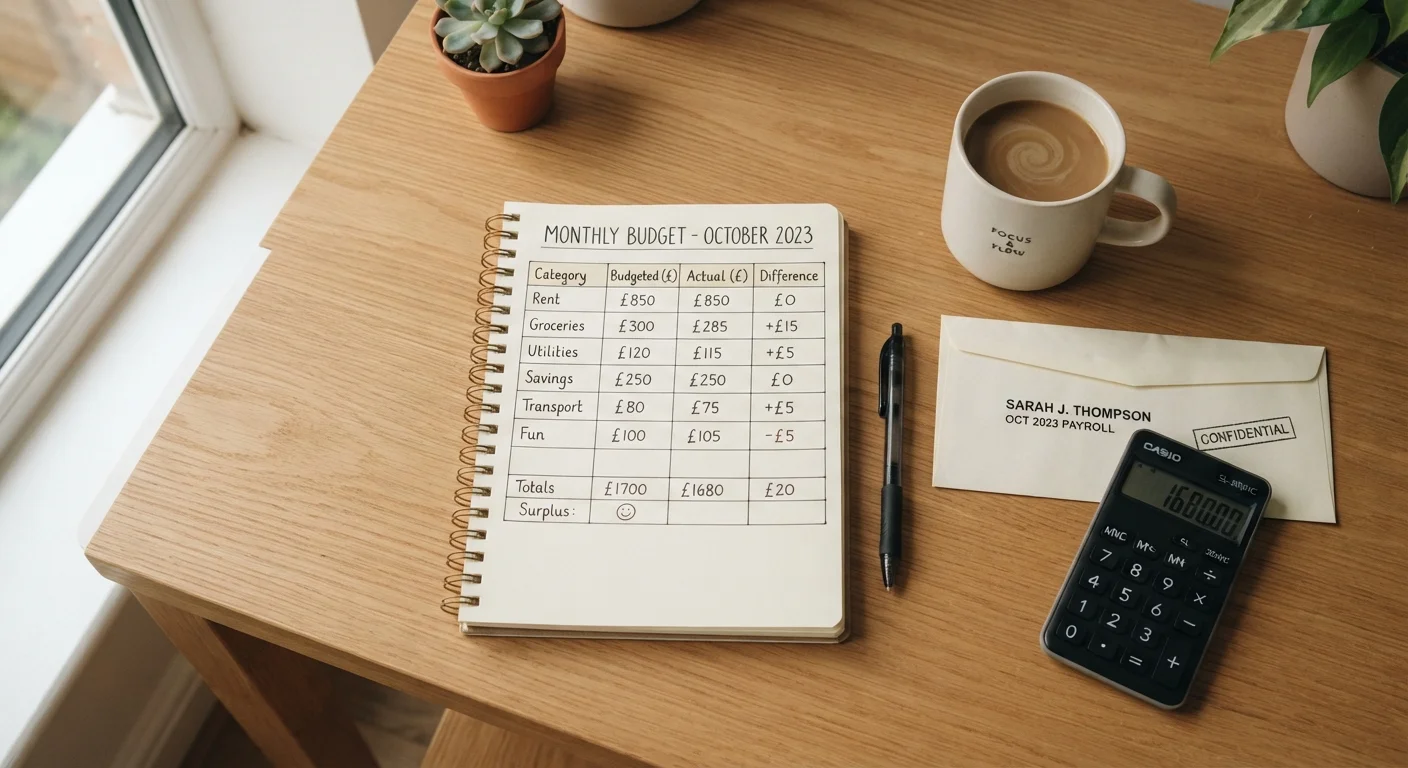
You don't need a spreadsheet or an app on day one. A piece of paper with three columns - income, planned spending, actual spending - is a perfectly functional first budget. Add complexity only when simplicity stops working for you.
Step 1: Know Your Real Take-Home Income
Before you assign a dollar anywhere, you need to know how many dollars you actually have. That means using your take-home pay - the amount that lands in your bank account after taxes, Social Security, and any other deductions are removed - not the bigger number listed on a job offer.
If your income varies month to month (freelance work, hourly shifts, tips), use a conservative estimate: average your last three months of deposits and lean toward the lower end. It's easier to have a little left over than to come up short.
~33%
Americans with a written monthly budget
Surveys conducted by the National Financial Educators Council and similar organizations consistently find that fewer than half of U.S. adults maintain a formal budget.
$400
Many households can't cover an unexpected expense
Federal Reserve surveys have found a significant share of U.S. adults would struggle to cover a $400 emergency expense from savings alone.
Add up all income sources: your main job, any side income, or regular transfers. Write that single number down. Everything else in your budget flows from it.
Step 2: List and Categorize Your Expenses
Pull up your last two months of bank and credit card statements. Write down every expense you see, then sort them into two buckets:
- Fixed expenses - amounts that stay the same each month: rent, car payment, insurance premiums, loan minimums.
- Variable expenses - amounts that change: groceries, gas, dining out, clothing, entertainment.
Fixed expenses are largely non-negotiable in the short term. Variable expenses are where your budget gives you genuine day-to-day choices. Also note non-monthly costs - an annual car registration, a semi-annual insurance premium - and divide them by 12 so you're setting aside a little each month rather than scrambling when the bill arrives.
When reviewing statements, highlight anything that surprised you - those are your best clues about where your budget needs guardrails.
Surprise spending is usually habitual and invisible until you see it on paper; naming it is the first step to managing it.
Give yourself a small, guilt-free "fun money" category from the very first budget. Cutting enjoyment entirely is the fastest route to abandoning the plan.
Behavioral research consistently shows that all-or-nothing approaches to spending restrictions are harder to sustain than plans that include intentional discretionary room.
Once listed, group similar items: all food spending together, all transportation together, and so on. This grouping makes it easy to spot categories where spending is higher than you realized. For broader guidance on growing what's left over, explore the Saving Money hub after you've got a baseline budget in place.
Step 3: Balance the Numbers
Subtract your total monthly expenses from your take-home income. The result tells you everything:
- Positive number: You have room to save, pay down debt, or build a cushion.
- Zero: Every dollar has a job - this is the goal of zero-based budgeting.
- Negative number: Expenses exceed income. Something needs to change before the month starts.
If you're in the red, start with variable expenses - they're easier to adjust. Could any subscriptions be paused? Could grocery spending come down by planning meals? Small reductions in several categories often close the gap faster than one dramatic cut.
Your Budget Must Reflect Reality, Not Aspiration
The most common budgeting mistake is underestimating expenses to make the numbers "work" on paper. If your grocery spending is realistically $400 a month, write down $400 - not $200. A budget built on wishful figures will fail within the first week, while one built on honest numbers will actually help you make decisions.
A widely referenced starting framework is the 50/30/20 guideline: roughly 50% of take-home pay toward needs, 30% toward wants, and 20% toward savings and debt repayment. Treat it as a rough compass, not a rigid rule - your numbers will vary based on where you live and your current obligations. Understanding how debt fits into this picture is worth exploring; the Credit & Debt hub covers loans and credit scores in plain terms.
Handling Surprises Without Blowing the Budget
Unexpected costs aren't really unexpected - car repairs, medical co-pays, and appliance failures happen to everyone. What varies is whether you have a buffer when they do.
A small emergency fund - financial educators commonly suggest starting with $500 to $1,000 - is the single most effective way to prevent one surprise from derailing your entire budget. Even saving $25 a week builds that cushion in under a year.
Build an "irregular expenses" line into your monthly budget as well. If you know you spend around $300 a year on holiday gifts, set aside $25 a month starting in January. When December arrives, the money is already there.
Don't Rely on Credit Cards as a Safety Net
Using a credit card to cover emergencies can feel like a solution in the moment, but interest charges can turn a $300 repair into a much larger debt over time. Building even a modest cash cushion first - before focusing on other financial goals - gives you a true buffer without the cost. For more on managing credit responsibly, see the Credit & Debt hub.
Making Your Budget Run on Autopilot
The best budget is one you barely have to think about after setup. Automation removes willpower from the equation. On payday, schedule automatic transfers to your savings account before you have a chance to spend that money. Pay fixed bills on auto-pay so they're never late and never forgotten.
Set a recurring 15-minute "money check-in" each week - just long enough to glance at your spending and confirm you're tracking close to your plan. Monthly, do a fuller review: compare what you planned against what actually happened, adjust any categories that were consistently off, and carry forward anything you learned.
“A budget is telling your money where to go instead of wondering where it went.”
— Dave Ramsey, Personal finance author and radio host
Budgeting is a skill, and like any skill it gets easier with repetition. Your first budget won't be perfect - and it doesn't need to be. The goal is to finish the month knowing where your money went and feeling more in control than you did before. For ideas on stretching your dollars further, the Saving Money hub offers practical habits you can layer on once your budget foundation is solid.
This article is for general informational and educational purposes only and does not constitute personalized financial advice. Consider consulting a qualified financial professional for guidance specific to your situation.