

Key Takeaways
Why Mental Stimulation Matters for Cats
Cats are often portrayed as low-maintenance pets, but their brains are wired for problem-solving, hunting, and exploration. Without enough mental engagement, indoor cats can become bored - and boredom in cats rarely looks passive. It tends to show up as destructive scratching, excessive vocalization, attention-seeking behaviors, or even compulsive over-grooming.
If you've ever wondered why your cat knocks things off counters or paces restlessly at night, those behaviors often signal an unmet need for stimulation. Understanding what drives them is the first step - see our guide to decoding feline behaviors for a closer look at what your cat is communicating.
The good news: enrichment doesn't have to be complicated or expensive. Below are the most effective ways to keep your cat mentally engaged every day.
Structured interactive play sessions
A wand toy, a laser pointer, or even a crinkled piece of foil can trigger your cat's full hunting sequence - stalking, chasing, pouncing, and catching. This sequence matters because it satisfies an instinct that your cat can't fully exercise in a static environment.
Aim for two sessions of 10-15 minutes daily, ideally once in the morning and once in the evening when cats are naturally more active. Always end with a toy your cat can physically "catch" - this gives closure to the hunt and helps prevent frustrated, hyperactive behavior after play.
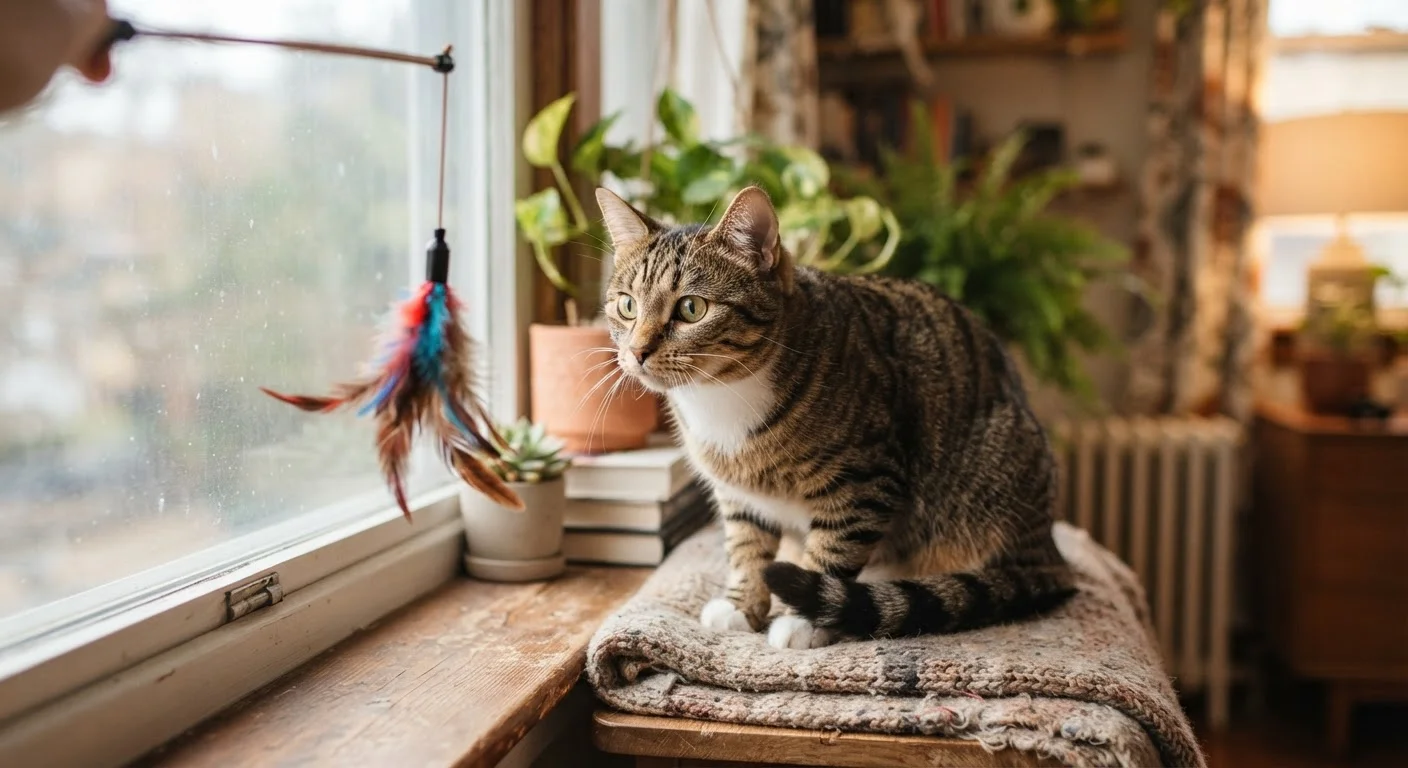
Completing the full hunting sequence - stalk, chase, pounce, catch - is key to satisfying play.
Puzzle feeders and food-dispensing toys
In the wild, cats spend a significant portion of their waking hours working for food. Serving meals in a bowl eliminates that work entirely, which can leave cats mentally under-stimulated even when physically full.
Puzzle feeders - containers that require pawing, batting, or tilting to release kibble - reintroduce a small problem-solving challenge at mealtime. You can also hide small portions of dry food around a room for your cat to "hunt." This is sometimes called scatter feeding, and it's one of the simplest enrichment techniques available.
Scatter feeding turns mealtime into a hunt, adding mental work without extra cost.
Vertical space and window access
Cats are vertical animals. They feel safer, more confident, and more engaged when they can survey their environment from above. Cat trees, wall-mounted shelves, or even a cleared bookshelf give your cat territory to claim and navigate.
Positioning a perch near a window adds a powerful layer of stimulation: birds, squirrels, passing pedestrians, and changing light all function as live entertainment for a cat. A window with a bird feeder placed just outside is sometimes called "cat TV" - and veterinary behaviorists frequently recommend it as a low-effort, high-reward enrichment tool.
A window perch near a bird feeder is one of the easiest enrichment upgrades you can make.
Rotation of toys to maintain novelty
Cats habituate quickly - a toy that was fascinating on Monday may be completely ignored by Friday. Rather than buying more toys, try rotating what's available. Keep a small selection out at a time and swap in "new" ones from a box every few days.
Introducing a toy with a different texture, sound, or movement pattern also resets interest. Crinkle toys, toys with feathers, mylar balls, and soft stuffed mice all engage slightly different instincts and keep your cat from tuning out their environment.
Rotating toys every few days restores novelty without needing to constantly buy new ones.
Scent enrichment and environmental variety
Cats experience the world heavily through smell. Introducing safe, novel scents - dried catnip, silver vine, or even a paper bag that's been outside - can trigger curiosity and exploratory behavior that exercises the brain.
Cardboard boxes, paper bags (handles removed for safety), and tunnels also create new terrain for your cat to investigate. These don't need to be elaborate setups. A fresh cardboard box left on the floor often provides 20 minutes of engaged exploration on its own.
A simple cardboard box can deliver more genuine engagement than many purpose-built cat toys.
Training and trick work
Many cat owners don't realize that cats can be trained using the same positive reinforcement methods used for dogs. Teaching a cat to sit, touch a target stick, or come when called builds cognitive engagement and strengthens the bond between cat and owner.
Short sessions of two to three minutes work best. Use a high-value treat - a small piece of cooked chicken or a lick of wet food - and keep sessions upbeat. Cats learn best when they're choosing to participate, so if your cat walks away, the session is over. This kind of mental work is genuinely tiring for cats in the best way.
Two-minute training sessions can mentally tire a cat more effectively than an hour of passive play.
Building Enrichment Into Your Daily Routine
Consistency matters more than variety alone. A cat who gets two short, focused play sessions each day - even just ten minutes each - is likely better off mentally than one who gets an occasional burst of attention. Think of enrichment less as an event and more as an ongoing part of how you care for your cat.
Start Small and Build Gradually
If your cat is currently under-stimulated, don't try to introduce every enrichment idea at once - that can overwhelm rather than engage. Pick one change, such as adding a window perch or starting daily play sessions, and stick with it for a week before layering in more. Cats respond well to gradual, predictable change.
Indoor cats in particular benefit from deliberate enrichment planning. If you're weighing the pros and cons of keeping your cat strictly indoors, our article on indoor vs. outdoor cat health walks through the tradeoffs clearly.
Start with one or two ideas from the list above, observe how your cat responds, and build from there. Every cat has a different threshold for stimulation - some thrive with constant novelty, while others prefer a predictable routine with a few high-quality interactions. Paying attention to your individual cat's reactions will guide you better than any single formula.