

Key Takeaways
Cat Food Label
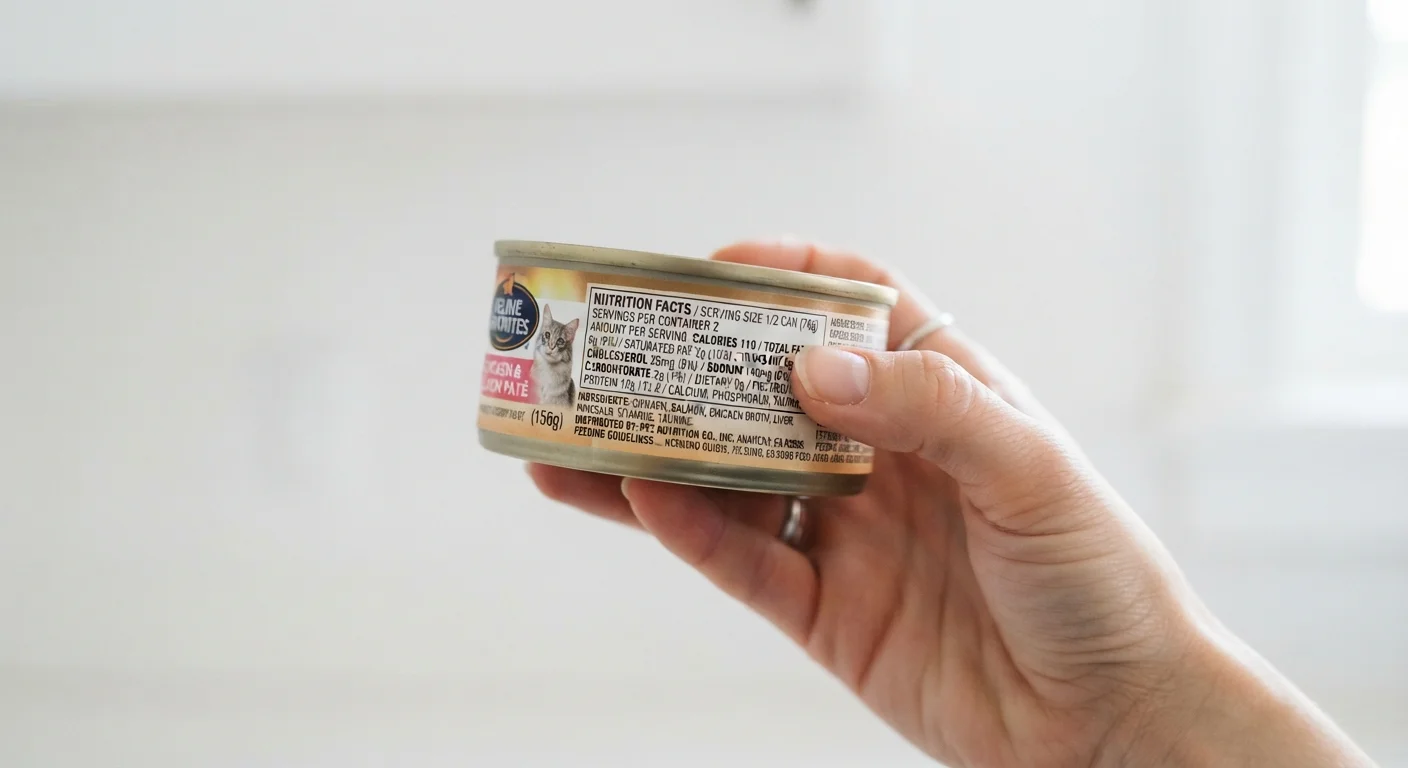
A cat food label is the printed information panel on any bag, can, or pouch of commercial cat food. It includes the product name, ingredient list, guaranteed analysis, feeding guidelines, and a regulatory statement. Together, these sections tell you what the food contains, whether it meets nutritional standards, and how much to feed your cat.
In the US, cat food labels are regulated by the Association of American Feed Control Officials (AAFCO), which sets the nutritional standards that manufacturers must meet or reference on the label.
The Product Name: More Regulated Than It Looks
The name on the front of a cat food package isn't just marketing - AAFCO rules determine exactly how ingredient names can appear. Understanding these rules gives you a quick first clue about what's inside.
- The 95% rule: If the label says "Chicken Cat Food," at least 95% of the product (excluding water) must be chicken. That's a high bar.
- The 25% ("dinner") rule: Words like "dinner," "platter," "entrée," or "formula" signal that the named ingredient makes up 25-95% of the food.
- The 3% ("with") rule: "Cat Food with Salmon" only requires 3% salmon. The protein is present but not dominant.
- The "flavor" rule: "Chicken Flavor" requires no minimum percentage of chicken - only enough to be detectable.
These distinctions matter because a food named "Tuna Dinner" and one named "Tuna Cat Food" contain very different amounts of tuna, even if they look similar on the shelf.
The Ingredient List: Reading Between the Lines
Ingredients are listed in descending order by weight before processing. Because meat contains a lot of water, a named meat like "chicken" may rank first but shrink considerably after cooking. This is normal - it doesn't mean the food is low in protein.
Watch for Ingredient Splitting
When a manufacturer lists multiple forms of the same ingredient separately - such as 'ground corn,' 'corn gluten meal,' and 'corn flour' - each appears lower on the list individually. Combined, they might outweigh the named protein. Scanning for repeated base ingredients helps you spot this pattern.
Watch for ingredient splitting: a manufacturer might list "ground corn," "corn gluten meal," and "corn flour" separately, each in a lower position, when combined they would outweigh the named meat protein. It's a legal practice worth knowing about.
Some ingredients to recognize:
- Named meat meals (e.g., "chicken meal"): Already have moisture removed, so they're actually a concentrated protein source.
- Unnamed meats (e.g., "meat meal" or "animal digest"): Less transparent about the source.
- Preservatives: Natural options include mixed tocopherols (vitamin E) and rosemary extract. Synthetic options like BHA and BHT are approved for use but some owners prefer to avoid them - consult your vet if you have concerns.
For more on how feeding choices connect to ingredient quality, see our guide on common feeding misunderstandings for new cat owners.
The Guaranteed Analysis: Nutrients at a Glance
The guaranteed analysis panel lists four nutrients by regulation:
| Nutrient | Listed As |
|---|---|
| Crude Protein | Minimum % |
| Crude Fat | Minimum % |
| Crude Fiber | Maximum % |
| Moisture | Maximum % |
"Crude" refers to the laboratory method used to measure these nutrients, not their quality. The minimums for protein and fat mean the actual amount could be higher; the maximum for fiber means it could be lower.
Comparing Wet and Dry Food Fairly
Because moisture content differs dramatically between wet and dry cat food, label percentages aren't directly comparable. To calculate nutrients on a dry matter basis, subtract the moisture percentage from 100, then divide the nutrient percentage by that result and multiply by 100. For example, a wet food with 78% moisture and 10% protein: 10 ÷ (100 − 78) × 100 = roughly 45% protein on a dry matter basis.
Comparing a wet food (78% moisture) to a dry food (10% moisture) using label percentages alone is misleading. To compare them fairly, calculate on a dry matter basis: subtract the moisture percentage from 100 to get the dry matter percentage, then divide the nutrient percentage by that number. This levels the playing field between formats. Our article on wet food vs. dry kibble for cats walks through the tradeoffs in more detail.
The AAFCO Statement: The Most Important Line on the Label
The nutritional adequacy statement - sometimes called the AAFCO statement - tells you whether the food is nutritionally complete for your cat. It's usually a small block of text, but it carries the most weight of anything on the label.
95%
Minimum named ingredient for simple-name foods
AAFCO's '95% rule' applies when a single protein (e.g., 'Chicken Cat Food') appears as the product name without qualifiers like 'dinner' or 'formula.'
3%
Minimum required for 'with' ingredient claims
A label that says 'Cat Food with Salmon' only requires 3% salmon content under AAFCO naming guidelines.
75-82%
Typical moisture content in canned cat food
This high water content is why nutrient percentages in wet foods appear lower than dry kibble and must be adjusted before comparing the two.
There are two forms this statement can take:
- Formulated to meet AAFCO nutrient profiles: The recipe was designed on paper to hit established nutrient levels. This is the most common approach.
- Substantiated by feeding trials: The food was actually fed to cats in a controlled study that met AAFCO protocols. This is a higher bar of evidence.
The statement also names a life stage: "growth and reproduction" (kittens, pregnant/nursing cats), "adult maintenance," or "all life stages." Feeding a kitten food labeled only for adult maintenance - or vice versa - means the nutritional balance isn't optimized for your cat's current needs.
If the label says the food is intended for "intermittent or supplemental feeding," it is not complete and balanced. It's a treat or topper, not a sole diet.
“The nutritional adequacy statement is the single most important piece of information on a pet food label. It tells you whether the food was designed to meet your pet's complete nutritional needs - or not.”
— Lisa Freeman, Board-certified veterinary nutritionist and pet food labeling researcher
Feeding Guidelines and What They Actually Mean
Feeding guidelines give you a starting range based on body weight and life stage. They're calculated conservatively - often on the higher end - because manufacturers want to ensure cats don't go underfed. Your individual cat's needs may be lower, particularly if they're spayed or neutered, less active, or prone to weight gain.
Use the label's guidelines as a starting point, then adjust based on your cat's body condition over several weeks. A healthy cat at an ideal weight should have a visible waist when viewed from above and ribs that are easy to feel but not prominently visible. Your veterinarian can help you assess body condition and fine-tune portions.
This article provides general educational information about cat food labels and is not a substitute for veterinary nutritional advice. Always consult your veterinarian for guidance specific to your cat's health and dietary needs.