

Key Takeaways
Option A
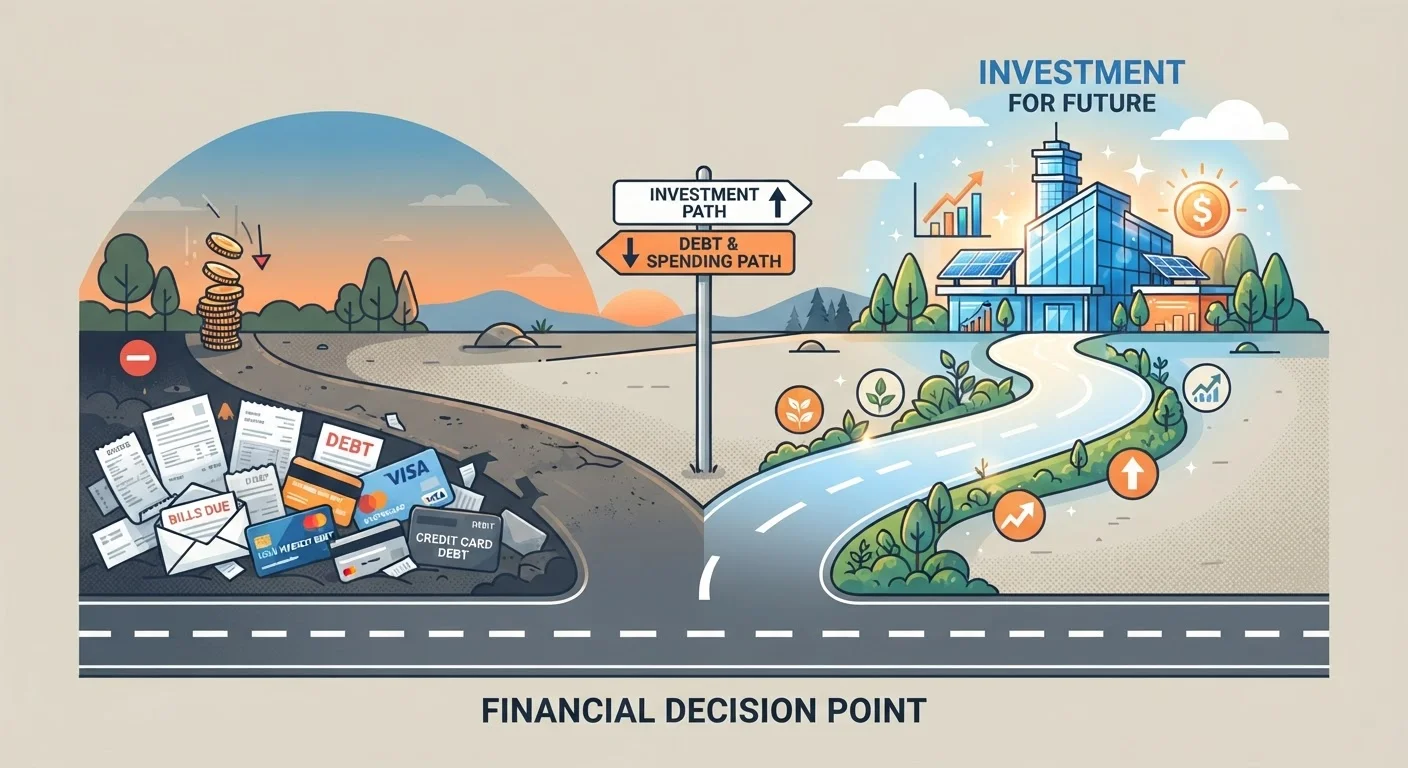
Good Debt
Borrowing that builds something of lasting value.
Best for: Financing assets or opportunities that are likely to increase your net worth or earning potential over time.
Option B
Bad Debt
High-cost borrowing that drains without building.
Best for: Understood as what to avoid - short-term consumption purchases funded by high-interest credit that erodes financial stability.
If you're considering a mortgage to purchase a home
Good Debt
A mortgage typically carries a lower interest rate and builds equity over time, making it one of the more manageable forms of borrowing for most households.
If you're tempted to carry a balance on a high-interest credit card for everyday spending
Bad Debt
Carrying a balance on a high-APR credit card compounds quickly and funds purchases that depreciate immediately - it's the clearest example of debt working against you.
If you're evaluating student loans for a degree with strong earning potential
Good Debt
Federal student loans at modest interest rates can be a reasonable investment in future income, though the amount borrowed should be proportional to realistic salary expectations.
If you're looking at payday loans or cash advances to cover a shortfall
Bad Debt
These products typically carry extremely high effective rates and can trap borrowers in a cycle of repeated borrowing that compounds financial stress.
What Makes Debt 'Good' or 'Bad'?
The good-debt-versus-bad-debt framework comes down to two questions: what is the money being used for, and what does borrowing cost you? Debt used to acquire something that may grow in value or increase your earning capacity - a home, a college degree, a small business - is generally classified as good debt. Debt used to fund consumption that disappears quickly, at a steep interest rate, falls into the bad category.
That said, these are not rigid buckets. Even a mortgage becomes a problem if the monthly payment is unmanageable. Even credit card debt occasionally makes sense in a genuine emergency. Think of the categories as a useful starting framework, not a permission slip.
Before borrowing anything, it's worth understanding the basic vocabulary. Terms like APR (annual percentage rate), principal, and credit utilization directly affect how much debt costs you over time. See our plain-language glossary of borrowing terms for a quick grounding in those concepts.
| Criterion | Good Debt | Bad Debt |
|---|---|---|
| Typical interest rate | Lower (e.g., 3-8%) | Higher (e.g., 20%+) |
| Common examples | Mortgage, federal student loans | Credit card balances, payday loans |
| What the money buys | Assets or income potential | Consumed goods or services |
| Long-term net worth impact | Potentially positive | Generally negative |
| Risk level | Moderate, manageable if sized right | High, especially if balance grows |
| Repayment terms | Longer, often structured | Shorter or revolving, often variable |
Common Examples - and the Nuances That Matter
Mortgages are the most commonly cited example of good debt. Interest rates are generally lower than other loan types, and real estate has historically appreciated over long periods - though home values can fall, and a home should not be treated as a guaranteed investment.
Student loans occupy complicated middle ground. Federal student loans often carry fixed, moderate rates and income-driven repayment options. But borrowing far more than your expected starting salary can turn an education investment into a long-term burden. The debt's quality depends heavily on the amount borrowed relative to realistic post-graduation income.
Credit card balances are the clearest example of bad debt. The average credit card APR in the US has exceeded 20% in recent years, according to Federal Reserve data. Carrying a balance at that rate means you're paying a significant premium on purchases that have already been consumed.
Payday loans and cash advances sit at the worst end of the spectrum. Their effective annual rates can reach triple digits, and their short repayment windows make it easy to fall into a cycle of reborrowing.
20%+
Average US credit card APR
According to Federal Reserve consumer credit data, average credit card interest rates have exceeded 20% in recent years - a historically high level.
~43M
Americans with federal student loan debt
The US Department of Education reports roughly 43 million borrowers hold federal student loan debt, making it one of the most common forms of 'good debt.'
36%
Common total debt-to-income guideline
Many financial guidance sources cite keeping total monthly debt payments below 36% of gross income as a general benchmark for manageable borrowing.
It also matters whether debt is secured or unsecured. Secured debt - like a mortgage or auto loan - is backed by an asset the lender can reclaim if you default. Unsecured debt - like most credit cards - carries higher rates because the lender takes on more risk. Our guide to secured vs. unsecured credit explains how that distinction shapes your obligations and risks.
Managing Both Types Responsibly
If you carry what most people would call good debt, the goal is still to manage it deliberately. Keep your total debt payments - mortgage, student loans, car payment, and other obligations combined - to a share of monthly income you can sustain without cutting essentials. A common guideline is keeping total debt service below 36% of gross monthly income, though your own situation may call for a more conservative target.
If you carry high-interest debt, prioritizing payoff is usually the most impactful financial move available. Paying down a 22% APR credit card balance is the equivalent of earning a guaranteed 22% return - something almost no investment can reliably offer. Two common approaches are the avalanche method (paying off the highest-rate debt first to minimize total interest) and the snowball method (paying off the smallest balances first for psychological momentum). Neither is universally better; the one you'll stick with is the right one.
For a broader look at how credit, debt, and borrowing fit together as you build your financial foundation, the complete guide to credit and debt for beginners covers each piece in depth. And if you're weighing a specific borrowing decision, our comparison of personal loans vs. credit cards can help you pick the right tool.
The 'Good Debt' Label Has Limits
Calling a mortgage or student loan 'good debt' doesn't mean borrowing more is always better. The amount matters as much as the type. A student loan that exceeds your expected first-year salary, or a mortgage with a payment that strains your monthly budget, can become a serious problem regardless of category. Always evaluate what you can realistically repay, not just whether the debt type sounds favorable.
This article is for general informational and educational purposes only and does not constitute personalized financial or legal advice. Consult a qualified financial professional before making decisions about your own borrowing or debt management.