

Key Takeaways
Monthly Budget
A monthly budget is a written plan that maps out how much money you expect to receive and how you intend to spend or save it over one calendar month. It's not a restriction - it's a record of your intentions before the month begins. Think of it as giving every dollar a job so your money goes where you actually want it to go.
In personal finance, a budget is distinct from a spending log: a budget is forward-looking (a plan), while a spending log is backward-looking (a record of what already happened).
The Simple Truth About What a Budget Is
A monthly budget is a plan - nothing more. You write down what money you expect to come in during the month, then decide in advance where it should go: rent, groceries, savings, and everything else. That's it.
The plan doesn't have to be precise to the cent. It doesn't have to live in a spreadsheet. It just needs to give you a clear picture of your money before you start spending it, so you're making choices instead of guessing.
If you want to understand the vocabulary that comes with budgeting - terms like net income, discretionary spending, and cash flow - the common budgeting terms guide is a good plain-English reference to keep nearby.
Start With What You Know
If you're making your first budget, don't try to estimate every possible expense from memory. Pull up your last two or three bank statements and use your actual spending as the starting point. Real numbers are more useful than guesses, and they'll save you from setting targets you can't realistically hit.
What a Budget Is Not
A lot of people avoid budgets because they picture something punishing - a list of things they're no longer allowed to buy. That's a common misunderstanding, and it keeps a lot of people stuck.
A budget is not a restriction on your freedom. It's a record of your priorities. If eating out matters to you, your budget can reflect that. If you're saving for a trip, your budget helps you make that happen without accidentally spending the money on something else first.
A budget is also not a one-time document. You revise it at the start of each month based on what's actually happening in your life. Income changes, unexpected bills arrive, and plans shift - a budget shifts with them. The monthly budget reset checklist walks through exactly how to do that review at the start of each month.
Budgets and Spending Logs Work Together
A budget tells you what you plan to spend; a spending log tells you what you actually spent. Comparing the two at the end of the month is where the real learning happens. You don't need a separate app - a simple notebook column works just as well.
How a Monthly Budget Actually Works
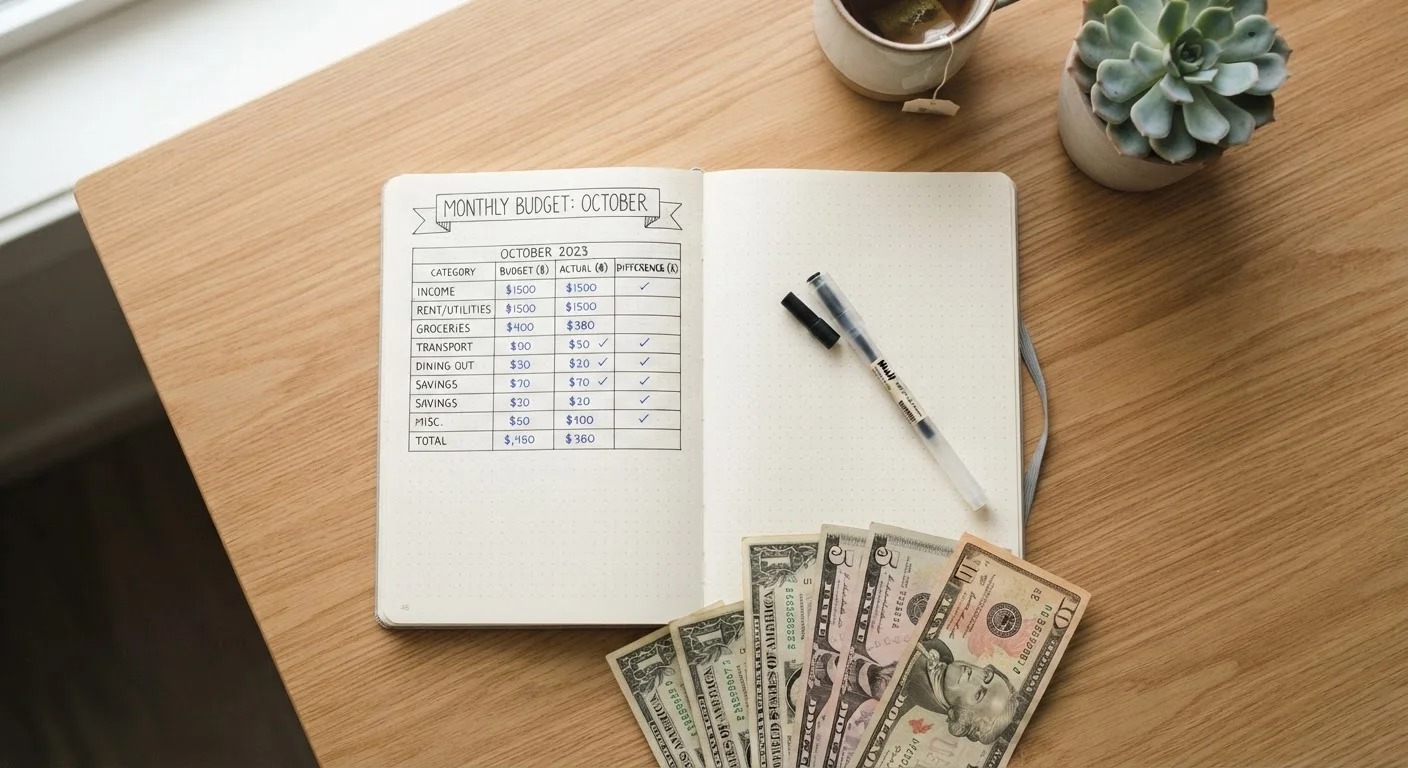
The mechanics are straightforward. You start with your take-home pay - the amount that actually lands in your bank account after taxes. Then you list every category of spending you expect that month and assign a dollar amount to each one.
At the end of that exercise, your income minus your planned spending should equal zero - meaning every dollar has a destination, including savings. If you spend less than planned in a category, you move that leftover money somewhere intentional rather than letting it disappear.
One of the most useful skills in budgeting is learning to separate costs that stay fixed every month from costs that change. Rent is the same each month. Groceries vary. Understanding that split makes your estimates far more accurate. The article on fixed vs. variable expenses explains the difference and why it matters.
~33%
Americans who follow a detailed monthly budget
Surveys by Gallup and similar pollsters consistently find that fewer than one in three Americans maintains a detailed household budget, despite widespread agreement that budgeting is beneficial.
$1,000
Common emergency savings benchmark for beginners
Many financial educators suggest a $1,000 starter emergency fund as an early budgeting milestone - a goal a written budget can help you reach systematically.
Choosing a Budgeting Approach That Fits You
There's no single correct way to budget. Some people track every category in detail; others prefer a broader method that just splits income into a few buckets. What matters is that the system is simple enough to actually maintain.
Two widely used frameworks are zero-based budgeting - where you assign every dollar a specific job - and percentage-based methods, where you split income into rough thirds for needs, wants, and savings. Neither is objectively better; they suit different ways of thinking about money. The comparison of zero-based vs. percentage budgeting breaks down both clearly so you can choose the one that feels manageable.
For beginners, the most important thing is to start with something realistic - a budget built around your actual life, not an idealized version of it. A plan you'll follow imperfectly is worth far more than a perfect plan you abandon after two weeks.
This article is for general informational and educational purposes only and does not constitute personalized financial advice. For guidance specific to your financial situation, consider speaking with a qualified financial professional.