

Key Takeaways
The 50/30/20 Rule
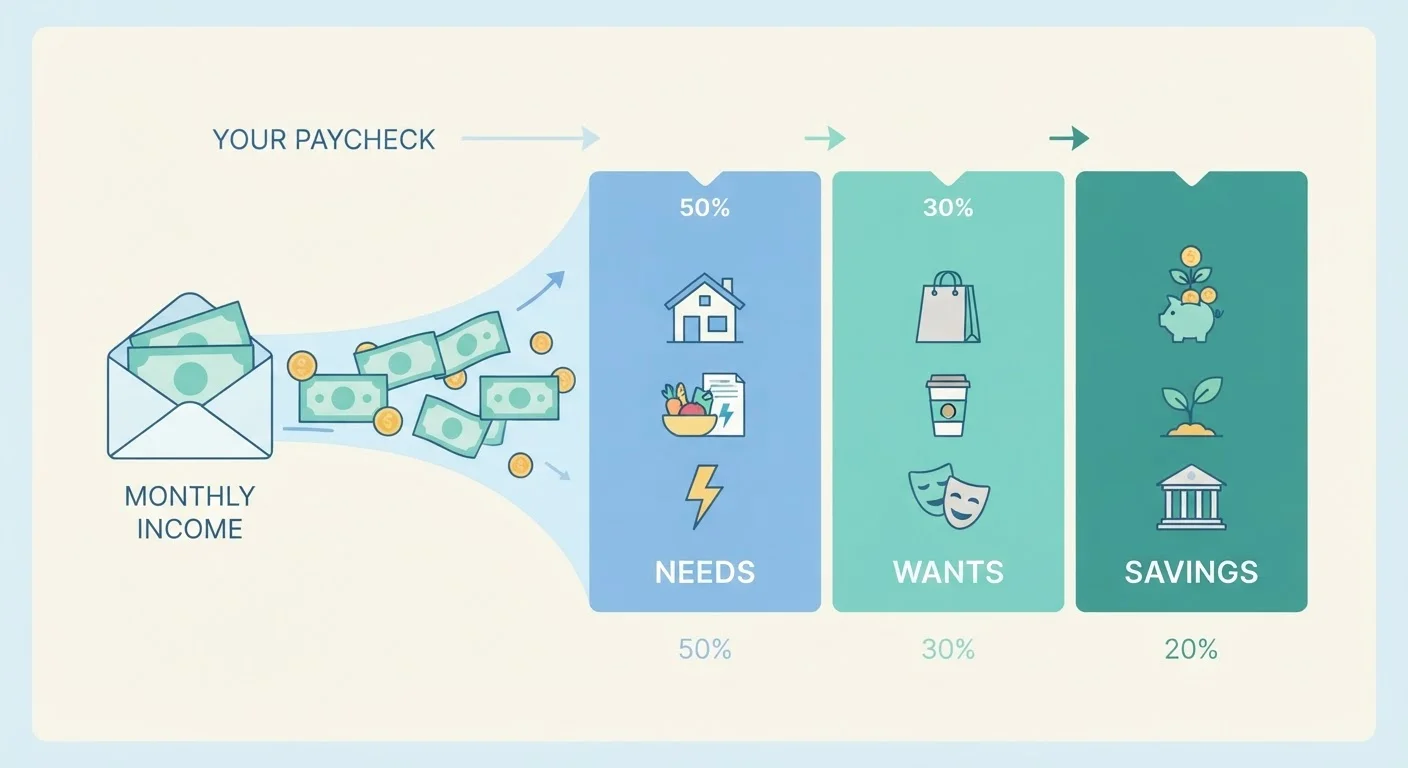
The 50/30/20 rule is a budgeting guideline that suggests dividing your after-tax income into three categories: 50% toward needs, 30% toward wants, and 20% toward savings and debt repayment. It's designed to give you a simple, percentage-based starting point rather than tracking every single dollar. The idea is that a few clear buckets are easier to follow than a detailed line-item budget.
The framework is commonly attributed to Senator Elizabeth Warren and her daughter Amelia Warren Tyagi, who described it in their 2005 book 'All Your Worth.' It applies to net (after-tax) income, not gross pay.
How the Three Categories Work
The 50/30/20 rule breaks your monthly take-home pay into three buckets. Here's what goes where:
- 50% - Needs: Rent or mortgage, utilities, groceries, minimum loan payments, health insurance, and basic transportation. These are non-negotiable expenses that keep your life running.
- 30% - Wants: Dining out, streaming subscriptions, gym memberships, vacations, hobbies, and anything else you choose to spend on but could live without.
- 20% - Savings and debt payoff: Emergency fund contributions, retirement savings, and any extra payments on credit cards or loans beyond the minimum.
The math is straightforward. If your monthly take-home pay is $3,500, you'd aim for roughly $1,750 on needs, $1,050 on wants, and $700 toward savings or paying down debt faster.
Start With What You Actually Earn
Always base your 50/30/20 calculations on your net (after-tax) take-home pay, not your salary. Using gross income will make your budget look more comfortable than it really is, and you'll end up short. Check your pay stub or bank deposit for the real number.
This is a starting point, not a law. Most financial educators treat these percentages as a useful default - something you calibrate to your own situation over time. See our step-by-step guide to building your first budget if you want a full walkthrough using your actual numbers.
Where the Rule Works Well - and Where It Struggles
The 50/30/20 rule is genuinely useful for people who are new to budgeting and feel overwhelmed by the idea of tracking dozens of line items. Three categories are manageable. You can glance at your spending each month and get a quick read on whether things are roughly on track.
That said, it has real limitations:
- High housing costs: In many US cities, rent alone can eat up 40-50% of take-home pay for moderate earners. That leaves almost nothing for other needs before you even get to wants or savings.
- Lower incomes: When income is tight, essentials can crowd out the savings bucket entirely. The rule assumes a cushion that not everyone has.
- Irregular income: Freelancers, gig workers, or anyone with variable monthly pay may find percentage-based budgeting harder to apply month to month.
~35%
Average share of income spent on housing in the US
According to the US Bureau of Labor Statistics Consumer Expenditure Survey, housing typically accounts for around a third of spending for many American households, making the 50% needs target challenging in high-cost areas.
57%
Americans unable to cover a $1,000 emergency
A Bankrate survey found that more than half of US adults could not pay for an unexpected $1,000 expense from savings alone, underscoring why the 20% savings allocation matters.
If the 50% needs target feels impossible, the most practical adjustment is to compress the wants category rather than skip savings altogether. Even setting aside 5-10% of income consistently is a habit worth building. For a closer look at a more hands-on alternative, compare the tradeoffs of budgeting every dollar.
Putting It Into Practice
Getting started with the 50/30/20 rule takes three steps:
- Find your actual take-home pay. Look at your most recent pay stub and use the net amount - after taxes and any deductions like health insurance premiums.
- Add up what you currently spend in each category. A month of bank and credit card statements is usually enough. Don't estimate - use real numbers, even if they're uncomfortable.
- Compare your actual split to the 50/30/20 targets. Most people find their wants category is larger than expected, and their savings rate is lower than they'd like.
Once you see where your money is actually going, small adjustments become easier to make. Canceling one subscription or cooking at home a few more nights a month can shift dollars from the wants column into savings without feeling like a dramatic lifestyle change.
The 20% Bucket Can Do Double Duty
You don't have to choose between saving and paying off debt - the 20% category can cover both. A common approach is to build a small emergency fund first (even $500-$1,000 to start), then direct extra money toward higher-interest debt. Once the debt is cleared, that same allocation shifts fully into savings and investing. The Credit & Debt hub covers how to prioritize which debts to tackle first.
The 20% savings bucket can serve more than one purpose. A portion can go toward building an emergency fund (three to six months of essential expenses is a widely cited target), while another portion goes toward longer-term goals like retirement or paying off higher-interest debt. Explore more strategies on the Saving Money hub.
This article is for general informational and educational purposes only and does not constitute personalized financial advice. For guidance specific to your situation, consider speaking with a qualified financial professional.