

Key Takeaways
Option A
Saturated Fat
The solid, stable fat found mainly in animal foods.
Best for: Understanding which foods to enjoy in moderation as part of a balanced diet.
Option B
Unsaturated Fat
The liquid, heart-friendly fat found mainly in plants and fish.
Best for: Readers looking to identify which fats to prioritize for general cardiovascular wellness.
If you want to support heart health through diet
Unsaturated Fat
Research broadly supports swapping saturated fats for unsaturated fats as one way to help maintain healthy cholesterol levels. Foods like olive oil, avocado, and fatty fish are solid starting points.
If you're simply trying to understand everyday food labels
Saturated Fat
Learning to spot saturated fat on a nutrition label is one of the most practical first steps in reading food packaging, since it's listed separately and has a clear daily reference value.
If you follow a plant-forward or Mediterranean-style diet
Unsaturated Fat
Plant-based oils, nuts, and seeds are naturally rich in unsaturated fats and align well with eating patterns consistently linked to positive long-term health outcomes in research.
What Dietary Fat Actually Is
Fat is one of three macronutrients - meaning nutrients the body needs in relatively large amounts. The other two are carbohydrates and protein. Fat isn't a foe; it helps the body absorb certain vitamins (A, D, E, and K), cushions organs, and provides a concentrated source of energy.
The word "fat" covers a wide family of molecules called fatty acids. The key difference between saturated and unsaturated fat comes down to chemistry: how many hydrogen atoms are attached to the carbon chain that makes up the fatty acid. That chemical difference changes how the fat behaves - in food and in the body. You don't need to memorize the chemistry, but it does explain the practical differences described below.
For a broader look at common misconceptions around nutrients, see our guide to nutrition myths that refuse to die.
Saturated vs. Unsaturated: The Core Differences
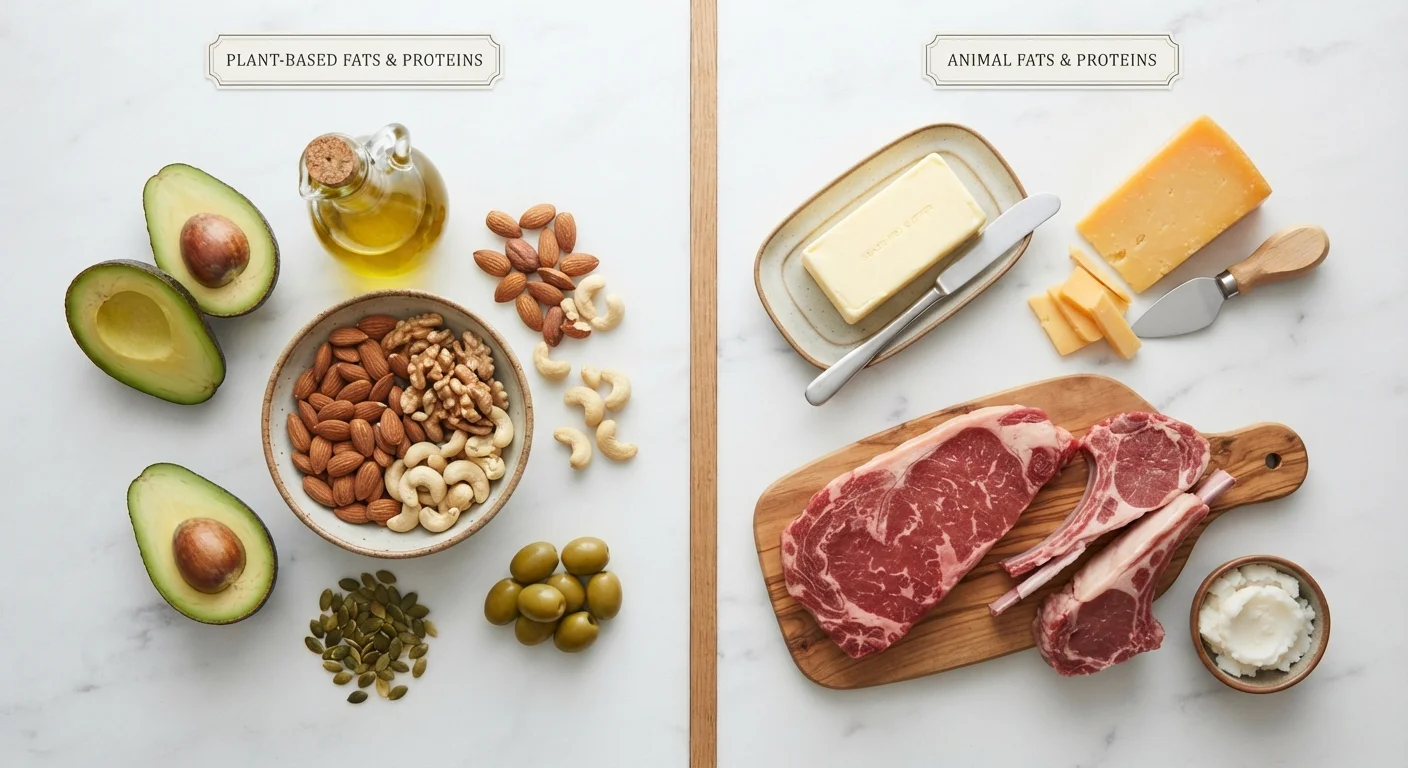
The simplest real-world clue is texture at room temperature. Saturated fats tend to be solid - think butter or the white fat on a piece of steak. Unsaturated fats tend to be liquid - like olive oil or sunflower oil. That's the same molecular difference playing out visibly in your kitchen.
| Criterion | Saturated Fat | Unsaturated Fat |
|---|---|---|
| State at room temperature | Solid | Liquid |
| Main food sources | Butter, red meat, cheese, coconut oil | Olive oil, avocado, nuts, fatty fish |
| Carbon chain structure | No double bonds (fully saturated) | One or more double bonds |
| Effect on LDL cholesterol | May raise LDL in excess | Generally neutral or may lower LDL |
| Dietary guidance | Limit; consume in moderation | Favor as replacement for saturated fat |
| Common sub-types | Stearic acid, palmitic acid | Monounsaturated, polyunsaturated (omega-3, omega-6) |
Unsaturated fats break down further into two sub-types: monounsaturated fats (one "gap" in the carbon chain - found in olive oil, avocados, and many nuts) and polyunsaturated fats (multiple gaps - found in fatty fish, walnuts, flaxseed, and sunflower oil). Both sub-types are broadly considered beneficial in the context of an overall healthy diet.
There is also a third category worth knowing: trans fats. These are artificially produced unsaturated fats that behave more like saturated fats and are associated with negative health outcomes. Artificial trans fats have largely been phased out of the US food supply following regulatory action, but they can still appear in small amounts in some processed and fried foods.
What Current Evidence Says About Health
Years of nutrition research have shaped a fairly consistent picture. Major health organizations - including the American Heart Association - generally recommend that saturated fat make up no more than about 5-6% of total daily calories for people managing cardiovascular risk. That's a guideline for the general population, not a personal prescription; individual needs vary.
5-6%
Recommended saturated fat limit (of daily calories)
The American Heart Association suggests this range for people focused on cardiovascular health, though individual needs vary.
2x/week
Recommended fish intake for omega-3 benefits
The Dietary Guidelines for Americans recommend eating seafood at least twice per week as part of a healthy eating pattern.
~34%
Share of US adults with high LDL cholesterol
According to CDC data, elevated LDL - partly influenced by diet - affects roughly one in three American adults.
The relationship isn't simply "saturated fat is harmful"; it's more nuanced. Research suggests that what you replace saturated fat with matters. Swapping saturated fat for refined carbohydrates, for example, does not appear to produce the same benefit as swapping it for unsaturated fats. Whole dietary patterns - like the Mediterranean diet - that are naturally high in unsaturated fats show consistently favorable associations in research.
Coconut Oil: A Common Point of Confusion
Coconut oil is plant-derived but is unusually high in saturated fat - around 80-90% by composition. Some popular claims suggest it behaves differently from other saturated fats in the body, but current mainstream nutritional guidance still treats it as a source of saturated fat to be used in moderation. Research in this area is ongoing and not yet settled. If you have questions about coconut oil in your specific diet, a registered dietitian can help.
Understanding where these fats show up in real foods is also useful. Our guide on whole foods vs. processed foods puts this in practical context.
Practical Ways to Shift the Balance
Small, consistent swaps tend to be more sustainable than dramatic overhauls. Here are some approaches consistent with general dietary guidance:
- Use liquid oils for cooking when possible - olive oil or canola oil in place of butter or coconut oil.
- Choose fish twice a week - salmon, sardines, or trout are rich in omega-3 polyunsaturated fats.
- Snack on nuts and seeds rather than processed snacks high in saturated or trans fats.
- Read nutrition labels - both saturated fat and trans fat are listed separately, making comparison straightforward.
- Don't aim for zero fat - very low-fat diets can make it harder to absorb fat-soluble vitamins. The goal is balance, not elimination.
Remember, these are general educational suggestions. If you have a specific health condition - including heart disease, high cholesterol, or diabetes - please speak with a qualified healthcare provider or a registered dietitian before making significant dietary changes.
This article is for general informational and educational purposes only and does not constitute medical or dietary advice. Always consult a qualified healthcare professional for guidance specific to your health situation.