

Key Takeaways
Zero commute means fewer barriers to starting
Removing travel time is one of the most effective ways to lower the threshold for actually exercising. Studies on habit formation consistently show that reducing friction is key to building consistency.
No membership cost required
Home workouts can be done with little to no equipment, making them accessible regardless of budget. Even a modest set of resistance bands represents a one-time cost.
Full schedule flexibility
You can work out at 6 a.m. or 10 p.m. without worrying about gym hours or peak-time crowds. This makes it far easier to fit movement around irregular schedules.
Private environment reduces self-consciousness
Many beginners feel uncomfortable exercising in public before they've built any baseline fitness. At home, there's no audience - which can make it much easier to focus and experiment.
Limited equipment can slow progress over time
Bodyweight training is highly effective early on, but without added resistance, progression eventually plateaus. Purchasing equipment helps, but costs and space requirements add up.
Home distractions can derail sessions
Family members, household chores, or the pull of a nearby couch can interrupt or shorten workouts. Creating a dedicated space helps, but it isn't always possible.
No built-in guidance for beginners
Without a trainer or fitness community nearby, it's easy to develop poor form habits that go uncorrected. This can reduce effectiveness or, in some cases, increase the risk of strain.
Harder to maintain accountability
When no one is expecting you to show up, it's easy to skip a session. External accountability - from a class, a trainer, or a workout partner - is a well-documented driver of exercise adherence.
Our Verdict
Home workouts and gym workouts each offer genuine advantages that suit different people and different seasons of life. If cost, convenience, or social anxiety are real obstacles, starting at home is a smart, sustainable choice. If you thrive with structure, variety, or external motivation, a gym can accelerate your early progress. Most beginners benefit from trying one approach for at least four to six weeks before deciding - consistency over any given period is a far stronger predictor of progress than the location itself.
Home workouts are ideal for budget-conscious beginners or those with busy schedules, while the gym suits people who need structured environments or access to specialized equipment.
Why This Decision Feels Harder Than It Should
If you're brand new to exercise, the home-versus-gym question can feel like a significant fork in the road. It doesn't have to be. Both environments can support real, lasting fitness - and neither is a magic solution. What actually drives progress is showing up repeatedly over time, not the postcode of your workout.
That said, your environment does shape your habits. Understanding the practical trade-offs helps you pick a starting point that fits your real life - not an idealized version of it. If you're also sorting out fitness terminology along the way, our plain-language guide to aerobic and anaerobic exercise is a helpful companion read.
The Case for Working Out at Home
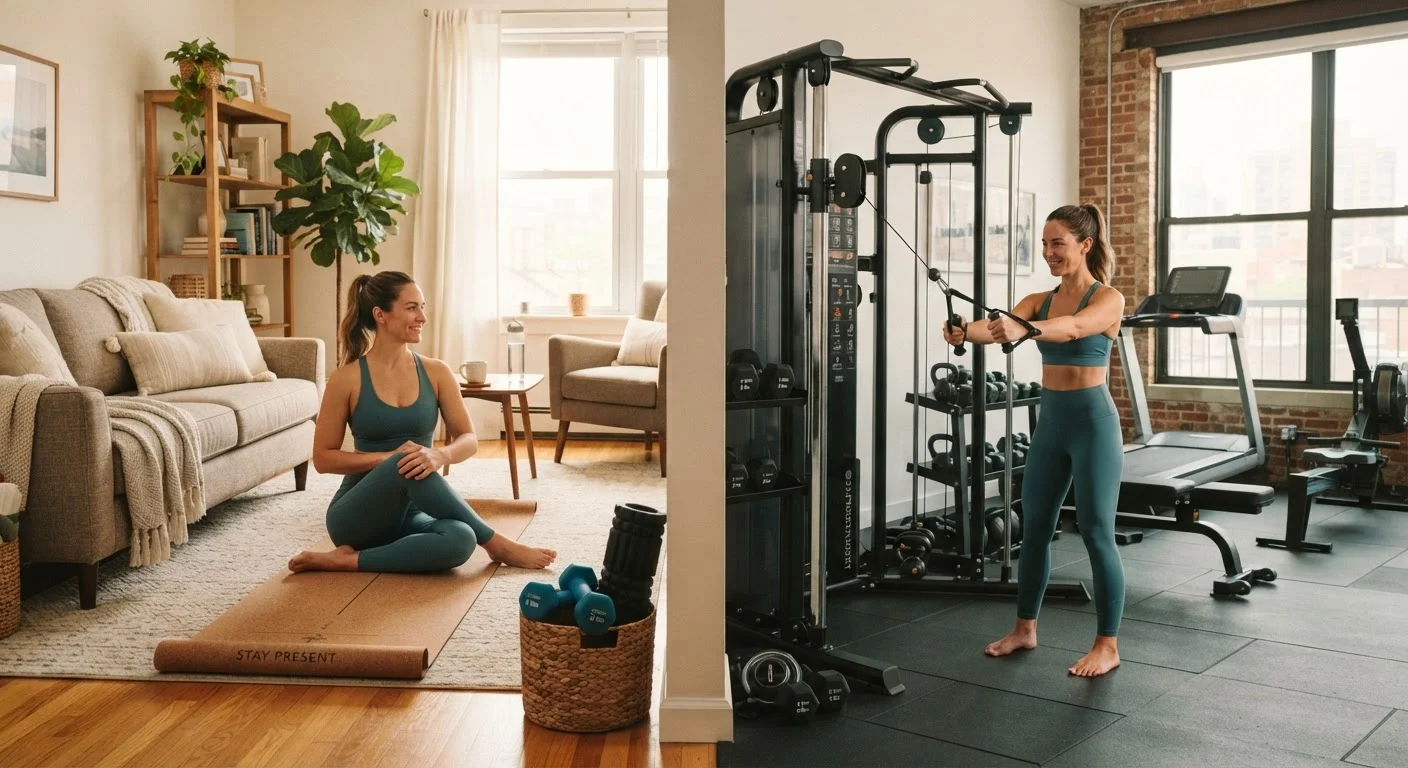
Home workouts have become far more practical in recent years. A clear floor, a mat, and your own bodyweight are genuinely enough to build strength and cardiovascular fitness as a beginner.
Zero commute means fewer barriers to starting
Removing travel time is one of the most effective ways to lower the threshold for actually exercising. Studies on habit formation consistently show that reducing friction is key to building consistency.
No membership cost required
Home workouts can be done with little to no equipment, making them accessible regardless of budget. Even a modest set of resistance bands represents a one-time cost.
Full schedule flexibility
You can work out at 6 a.m. or 10 p.m. without worrying about gym hours or peak-time crowds. This makes it far easier to fit movement around irregular schedules.
Private environment reduces self-consciousness
Many beginners feel uncomfortable exercising in public before they've built any baseline fitness. At home, there's no audience - which can make it much easier to focus and experiment.
The biggest advantage is friction reduction. When the gym is your living room, there are fewer excuses not to start. This matters enormously in the early weeks, when the habit is still fragile. For a deep dive into what's possible without any equipment, see our complete beginner's guide to bodyweight training.
Where Home Workouts Fall Short
Working out at home isn't without its challenges, and being honest about them helps you plan around them.
Limited equipment can slow progress over time
Bodyweight training is highly effective early on, but without added resistance, progression eventually plateaus. Purchasing equipment helps, but costs and space requirements add up.
Home distractions can derail sessions
Family members, household chores, or the pull of a nearby couch can interrupt or shorten workouts. Creating a dedicated space helps, but it isn't always possible.
No built-in guidance for beginners
Without a trainer or fitness community nearby, it's easy to develop poor form habits that go uncorrected. This can reduce effectiveness or, in some cases, increase the risk of strain.
Harder to maintain accountability
When no one is expecting you to show up, it's easy to skip a session. External accountability - from a class, a trainer, or a workout partner - is a well-documented driver of exercise adherence.
One of the most common issues is the mental separation - or lack of it - between your workout space and your relaxation space. Without a clear boundary, it's easy to get distracted or cut sessions short. External accountability, which a gym naturally provides, can be genuinely powerful for beginners. Our article on common fitness myths that keep beginners stuck explores why motivation alone is rarely enough to sustain a new habit.
What the Gym Gets Right
A gym environment offers things that are genuinely hard to replicate at home, especially once you've moved past the complete beginner stage.
~80%
Adults not meeting activity guidelines
According to the CDC, roughly 80% of American adults do not meet federal guidelines for both aerobic and muscle-strengthening activity - indicating that access to a gym alone doesn't guarantee consistent exercise.
Top reason
Why people skip the gym: lack of time
Research consistently identifies time constraints as the most commonly cited barrier to gym attendance, reinforcing why convenience of location plays a significant role in adherence.
Equipment variety is the obvious draw - cable machines, barbells, and cardio equipment open up training options that bodyweight alone can't fully replicate. There's also a social dimension: being around other people exercising can provide a quiet but real motivational lift. If you're weighing up strength work against cardio, our piece on whether you need to choose between strength training and cardio is worth a read.
You Don't Have to Pick Just One
Many people find a hybrid approach works well: home workouts on busy weekdays and a gym visit on weekends, for example. There's no rule that says you must commit exclusively to one setting. As your fitness improves, your needs will evolve too - and so can your approach.
Making a Practical Choice - and Sticking With It
The honest answer is that the right environment is the one you'll actually use. A few questions worth asking yourself: Do I have a reasonably quiet space at home? Does commuting to a gym feel like a genuine obstacle, or am I using it as an excuse? Do I tend to stay focused when alone, or do I need external structure?
Whichever you choose, give it a real trial - at least a month. Progress from any kind of movement takes time, and it's worth reading about how long it typically takes before exercise starts feeling easier so you set expectations accordingly. Don't forget that rest is part of the equation too - understanding why rest days matter for recovery will help you build a plan that's sustainable rather than exhausting.
This article is for general informational purposes only and is not a substitute for professional medical or fitness advice. If you have an existing health condition or injury, please consult a qualified healthcare provider before starting a new exercise routine.