

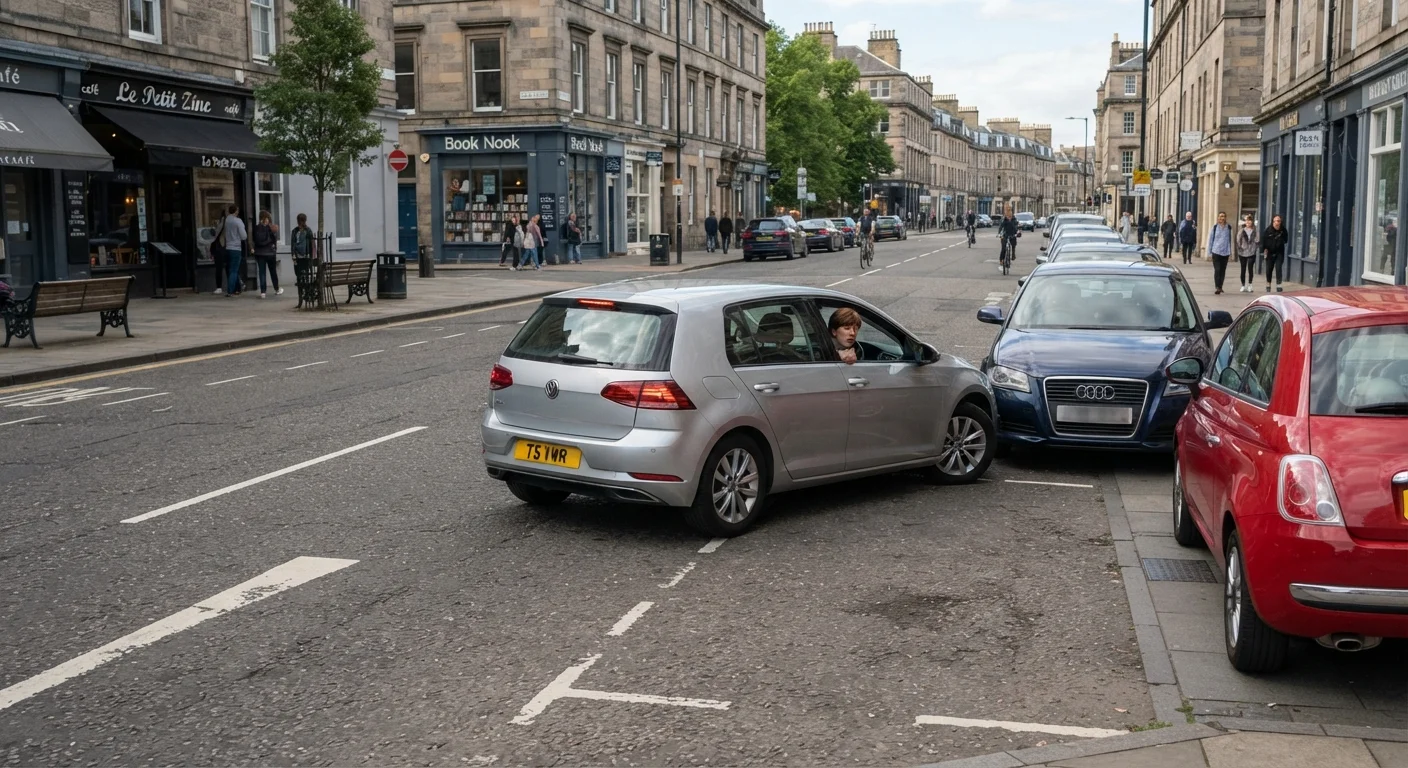
Key Takeaways
Why Parallel Parking Feels So Hard
Parallel parking trips up new drivers for one main reason: you're steering backward into a gap that's barely larger than your car, while traffic may be waiting behind you. That pressure, combined with unfamiliar spatial judgment, is what causes panic. The good news is that the maneuver follows a fixed geometric pattern. Once you internalize the reference points, the process becomes predictable - not instinctive guesswork.
Good road scanning habits are the foundation here: spotting an open space early, reading traffic behind you, and setting up properly before you stop all happen before the actual parking sequence begins. Rushing any of those steps is where most mistakes start.
What you will need
What You Need Before You Start
Parallel parking isn't just a physical skill - your equipment and environment matter. Make sure all mirrors are properly adjusted before driving in any urban area. Review the steps below, then use an empty parking lot or quiet residential street to practice before tackling a busy downtown block. Building the muscle memory in a low-stakes setting is the most efficient path to confidence.
For a broader foundation of safe driving habits, see our complete overview of driving skills.
Properly adjusted mirrors (side and rearview)
Provide the visibility needed to judge the gap, track the curb, and monitor nearby vehicles throughout the maneuver.
Turn signals
Alert other drivers that you're slowing to park, reducing the risk of a rear-end collision while you set up.
Parking sensors or a backup camera (if equipped)
Provide additional distance feedback, particularly helpful for judging proximity to front and rear vehicles.
Empty parking lot or quiet street
A low-pressure practice environment allows you to repeat the sequence until the reference points feel natural.
Step-by-Step: How to Parallel Park
Work through each step slowly. There is no minimum speed requirement - moving at a walking pace or slower is perfectly appropriate during the maneuver.
Identify a Usable Space
Look for a gap that is at least 1.5 times the length of your vehicle - roughly 20-25 feet for a standard sedan. Anything shorter makes the maneuver significantly harder and raises the risk of contact. Scan ahead so you have time to slow down smoothly rather than braking sharply in front of waiting traffic.
Signal and Pull Alongside the Leading Car
Activate your right turn signal to indicate your intent. Pull forward so your car is parallel to the vehicle in front of the open space. Align your rear bumper roughly even with the leading car's rear bumper, and position your vehicle about 2-3 feet away from it laterally (side to side). Come to a complete stop.
Begin Reversing and Steer Toward the Curb
Shift into reverse. Begin rolling backward slowly - no faster than a walking pace. Once the car is moving, turn the steering wheel sharply toward the curb (right, in most US parking scenarios). Continue reversing until your car is at roughly a 45-degree angle to the curb. A useful reference point: stop turning when you can see the rear car's full front end in your driver-side mirror.
Straighten the Wheel and Continue Reversing
When you've reached the 45-degree angle, turn the steering wheel back to center (straight). Continue reversing slowly. Watch your passenger-side mirror - you're aiming to bring the rear of your car close to but not touching the curb. Stop when your front bumper has cleared the rear of the leading car.
Steer Away From the Curb to Swing the Front In
Still in reverse and still moving slowly, now turn the steering wheel away from the curb (left). This pivots the front of the car into the space. Continue reversing until your car is roughly parallel to the curb. Stop before getting closer than about a foot to the vehicle behind you.
Straighten Up and Center in the Space
Shift into drive. Pull forward slightly to center your car in the space, leaving roughly equal gaps between your front and rear bumpers and the neighboring vehicles. Straighten your wheels. Apply the parking brake, shift into park, and turn off the engine. Aim to end up no more than 12 inches from the curb - many jurisdictions specify this distance in their parking regulations.
Practice the Geometry in a Lot First
Set up two traffic cones or cardboard boxes to simulate the front and rear vehicles, then run through the sequence repeatedly until each steering input feels automatic. Muscle memory developed off-street transfers directly to real parking situations. Ten focused repetitions in a quiet lot can replace months of anxious street-parking attempts.
Common Mistakes and How to Avoid Them
Even when the geometry is understood, a few habits consistently cause problems for new parallel parkers:
- Starting too far from the target space. If you're more than three feet from the parked car beside you when you begin reversing, you'll run out of angle before you're in the space. Set up at roughly arm's-length (2-3 feet) from the leading car.
- Turning the wheel before the car moves. Steering input only changes your direction when the wheels are rolling. Start moving first, then steer.
- Stopping mid-maneuver to look at the phone or recalculate. Keep your eyes scanning continuously - rear window, driver-side mirror, passenger-side mirror, and back again.
- Skipping the final straighten. After the rear is in, many drivers forget to steer back toward the curb. The car ends up at an angle, wasting space and making exit harder.
Don't Force a Space That's Too Small
If the gap genuinely isn't long enough for your vehicle, move on and find another space. Attempting to fit into an undersized spot greatly increases the chance of contact with another vehicle. Minor parking lot collisions are among the most common - and most preventable - types of vehicle damage. Circling the block takes less time than exchanging insurance information.
If you're building overall confidence behind the wheel, our guide to highway driving for new drivers covers the next major skill milestone.