

Key Takeaways
Our Verdict
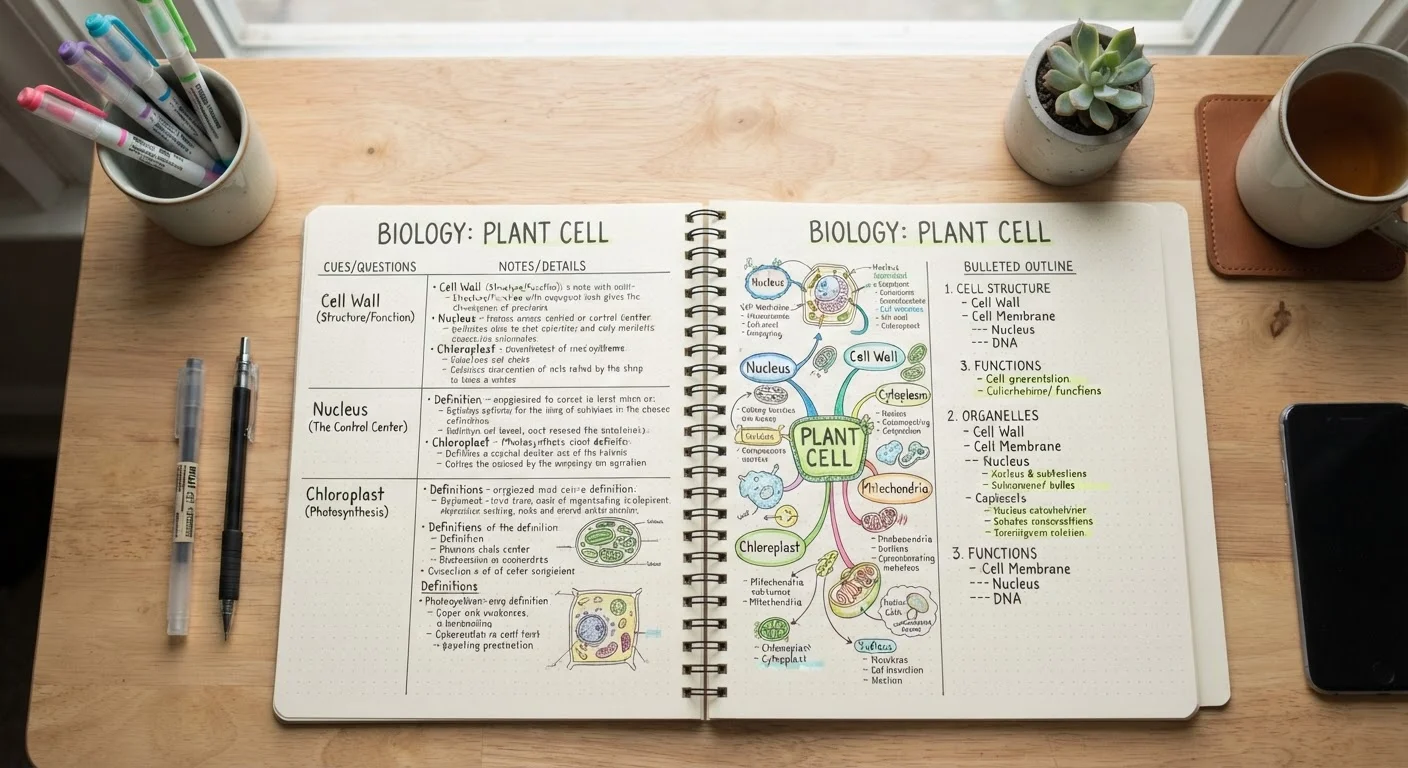
Each of these three note-taking formats solves a different problem. The Cornell method builds in self-testing and is well suited to dense academic content. Mind mapping externalizes relationships between ideas and works best when creativity and big-picture thinking matter. Outline format prioritizes speed and clarity in structured settings. Your best choice depends on the subject, your learning style, and how you plan to review.
| Best for | Recommended |
|---|---|
| Students who want built-in review and self-testing | Cornell Method |
| Visual thinkers exploring connected or creative topics | Mind Mapping |
| Beginners or fast-paced lectures needing quick structure | Outline Format |
| Learners covering multiple subject types across a week | A mix of all three |
Why Your Note-Taking Format Actually Matters
Most beginners treat note-taking as simple transcription - writing down what they hear or read as quickly as possible. The format, though, shapes whether those notes become a genuine learning tool or a document you never look at again.
Research in cognitive science consistently distinguishes between encoding (getting information in) and retrieval (getting it back out). A well-chosen note-taking structure supports both. It also reduces cognitive overload in the moment by giving your brain a predictable template to follow. Before choosing a method, it helps to prepare your study session deliberately so you enter with a clear goal and the right format already decided.
Three formats dominate practical note-taking guidance: the Cornell method, mind mapping, and the outline format. Each has a distinct logic, a distinct use case, and a distinct weakness.
The Cornell Method: Built-In Review in Every Session
Developed at Cornell University in the 1950s, this method divides each page into three zones:
- Notes column (right, ~70% of page width): Your main notes taken during a lecture or reading.
- Cue column (left, ~30%): Keywords, questions, or prompts you add after the session while reviewing.
- Summary box (bottom): A two-to-three sentence synthesis of the page's main idea, written in your own words.
The power is in the cue column. By covering your notes and using only your cues to self-quiz, you transform passive pages into an active retrieval tool - which aligns with how memory consolidation actually works. This is especially valuable for content-heavy subjects like biology, history, or economics.
The drawback: the Cornell method requires extra time after each session to complete the cue column and summary. Skipping that step defeats much of the purpose. It also works less well for non-linear content where ideas branch in multiple directions. If you're curious why passive re-reading feels effective even when it isn't, this explanation of the fluency illusion is worth reading alongside your review habits.
Mind Mapping: Seeing the Shape of an Idea
Mind mapping places a central concept in the middle of a blank page, then branches outward with related ideas, subtopics, and connections - often using color, symbols, or images. The format reflects how many people naturally associate ideas, rather than forcing them into a hierarchy.
It works particularly well when:
- You're brainstorming or exploring a new topic before structure emerges.
- The subject matter involves many interrelated concepts (e.g., ecosystems, marketing strategy, character relationships in literature).
- You're a visual or spatial thinker who remembers images and layouts more readily than written lines.
The limitation is equally clear: mind maps become hard to read and expand during fast-paced lectures. They're better suited to pre-reading, revision, or planning sessions where you control the pace. Digital tools can help manage complexity, but paper maps often feel more intuitive for first-time users.
| Cornell Method | Mind Mapping | Outline Format | |
|---|---|---|---|
| Best learning style | Analytical, self-testers | Visual, associative thinkers | Sequential, systematic learners |
| Speed to learn the format | Moderate (setup required) | Low (freeform start) | High (intuitive from the start) |
| Works for fast lectures | Moderately well | Poorly | Very well |
| Built-in review mechanism | Yes - cue column and summary | Partial - visual layout aids recall | No - must add separately |
| Best subject types | Science, history, economics | Creative, interconnected topics | Any structured lecture or text |
| Works well digitally | Yes, with templates | Yes, with mapping tools | Yes, natively in any editor |
Outline Format: Simple, Fast, and Universally Understood
The outline is the format most people default to without realizing it - a numbered or bulleted hierarchy where main topics sit at the top level and details indent beneath them. Its strength is speed and universality: almost no instruction is needed, and it mirrors the structure of most textbooks and slide decks.
Outlines are particularly effective when:
- A lecture or reading source follows a clear, sequential structure.
- You need to capture information quickly without pausing to organize spatially.
- You plan to type your notes, since software naturally supports indented hierarchies.
The weakness is rigidity. If a speaker jumps between topics or an idea belongs to multiple categories simultaneously, outlines can feel cramped or misleading. They also don't inherently prompt review - a finished outline can look complete while hiding significant gaps in understanding.
Choosing among these formats is similar to choosing among planning systems for daily productivity. Just as time blocking, to-do lists, and calendars each suit different work styles, note-taking formats suit different learning contexts. The goal is to match the tool to the task.
Try All Three Before Committing
Spend one week using each format in a real study session before deciding which feels most natural. What feels awkward on day one often clicks by day three once the template becomes automatic. Mixing formats across subjects - rather than picking just one - tends to produce better recall across different types of content.
Choosing - and Combining - the Right Approach
There is no universal winner. A practical approach for beginners is to match the method to the context:
- Use outlines during a fast-moving lecture where structure is clear.
- Switch to Cornell format when studying dense material you need to retain and recall for tests.
- Use mind maps during pre-reading or revision sessions when your goal is understanding relationships.
You can also layer methods: take rough outline notes during a session, then redraw key sections as a mind map during review, and add Cornell-style cues in the margins. The act of reformatting is itself a powerful retrieval practice.
Whichever format you choose, the note-taking session is only half the work. Reviewing, testing yourself, and revising your notes within 24 hours dramatically increases what you retain - regardless of which format you used to capture the material.