

Key Takeaways
Option A
Active Recall
The effortful, retrieval-based approach to lasting memory.
Best for: Learners who want information to stick through exams, real-world application, or long-term retention.
Option B
Passive Review
The familiar, low-effort review strategy most people default to.
Best for: Getting a quick first-pass familiarity with new material before moving to more demanding study methods.
If you want to remember material weeks or months later
Active Recall
Retrieval practice strengthens memory traces each time you successfully reconstruct information, making it far more durable than repeated reading.
If you are encountering a topic for the very first time
Passive Review
A single read-through builds the basic familiarity needed before active recall can work effectively - you can't retrieve what you've never seen.
If you are preparing for a high-stakes test or certification
Active Recall
Practice tests, flashcards, and self-quizzing mirror exam conditions and expose gaps that re-reading conceals.
If your study time is very limited before a session
Active Recall
Even brief self-quizzing produces greater memory benefit per minute than the same time spent re-reading notes.
What Each Method Actually Involves
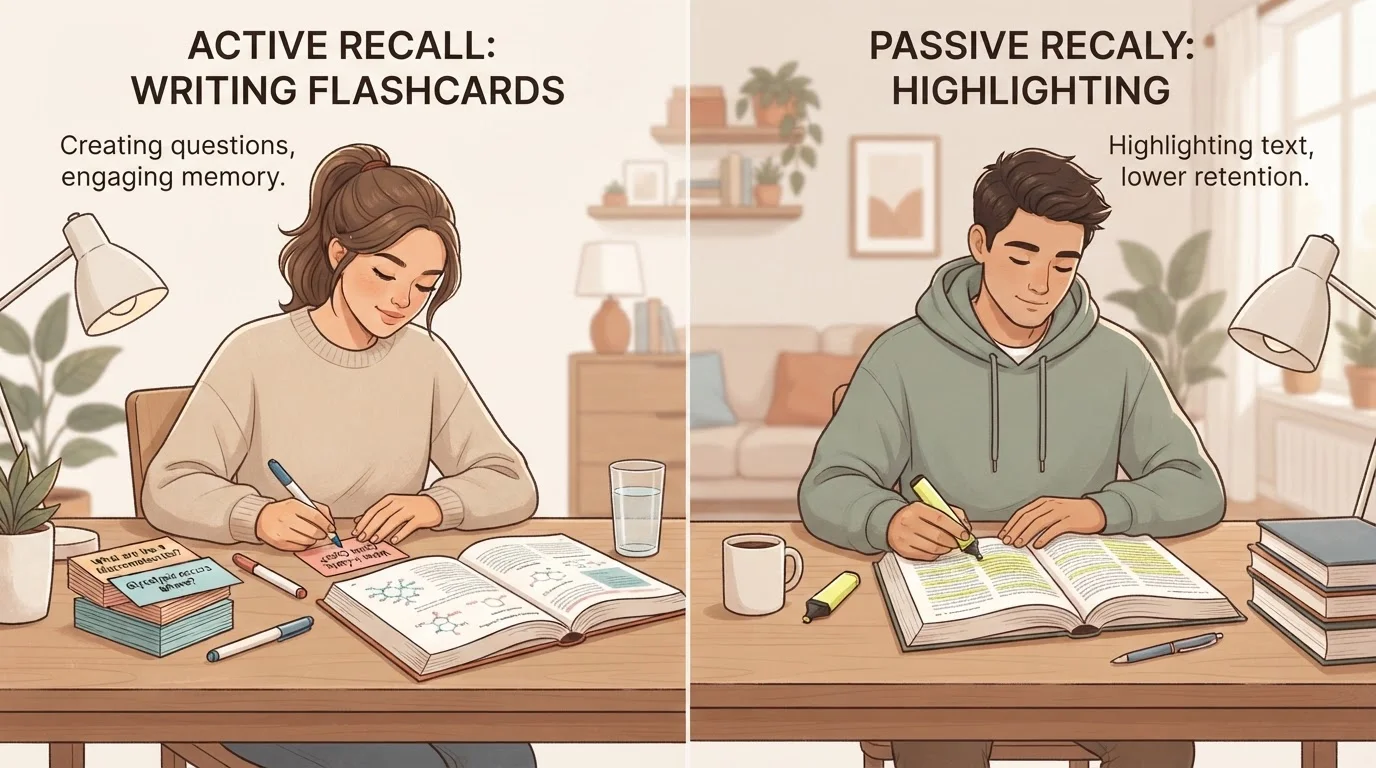
Active recall means closing your notes and trying to retrieve information from memory - before you look it up. Common techniques include answering practice questions, writing a brain dump of everything you remember on a topic, explaining a concept aloud without prompting, or working through flashcards answer-side first. The defining feature is effort: your brain must search, reconstruct, and produce the information.
Passive review, by contrast, keeps the information in front of you the whole time. Re-reading a chapter, highlighting text, watching a lecture video again, and reviewing annotated notes all fall into this category. The material is available; your brain simply processes it as input rather than generating it as output.
Understanding how your brain stores new information explains why this distinction matters so much. Retrieval is not just a test of memory - it actively rebuilds and reinforces the memory itself.
The Research Gap: Why Active Recall Wins
Cognitive scientists call the memory benefit gained from retrieval practice the testing effect. Studies in educational psychology have consistently found that students who quiz themselves on material - even without feedback - retain significantly more over time than students who re-read the same content for an equivalent period.
The reason comes down to how memory consolidation works. Each time you successfully retrieve a piece of information, the neural pathway associated with it becomes stronger and more accessible. Struggling slightly to find an answer - what researchers sometimes call desirable difficulty - appears to produce deeper encoding than effortless re-reading.
Passive review, meanwhile, generates fluency illusions: because the material feels familiar after re-reading, learners often overestimate how well they actually know it. Why re-reading feels productive but often isn't explores this deceptive comfort in detail.
| Criterion | Active Recall | Passive Review |
|---|---|---|
| Core mechanism | Retrieving information from memory | Re-reading or re-watching material |
| Cognitive effort | High - deliberate and effortful | Low - comfortable and automatic |
| Long-term retention | Significantly stronger | Fades quickly without reinforcement |
| Fluency illusion risk | Low - gaps are immediately exposed | High - familiarity mimics mastery |
| Best stage of learning | After initial exposure, repeatedly | First contact with new material |
| Example techniques | Flashcards, practice tests, brain dumps | Highlighting, re-reading, re-watching |
| Time efficiency | High return per minute invested | Diminishing returns with repetition |
When Passive Review Still Has a Place
Passive review is not without value - it simply has a narrower role than most learners assign it. When you encounter a subject for the first time, reading through an overview or watching an introductory video is entirely appropriate. You cannot retrieve information you have never been exposed to, so passive first contact is a necessary starting point.
It can also be useful for re-orienting yourself to a topic after a long break, or for quickly scanning material to decide what deserves focused study. The problem arises when passive review becomes the primary or repeated strategy - at that point, it delivers diminishing returns while feeling deceptively productive.
Passive Review as a Starting Point
Educators generally agree that some form of initial reading or listening is necessary before active recall can work. Think of passive review as laying the foundation and active recall as building on it. The mistake most learners make is spending the majority of their study time on the foundation alone, never advancing to construction.
For a practical before-session framework, this pre-session readiness checklist helps you decide which approach fits each study block.
Putting Active Recall Into Practice
Starting with active recall does not require special tools. Here are four entry-level techniques:
- Flashcards (answer hidden): Write a question on one side, the answer on the other - and always attempt the answer before flipping.
- Brain dumps: After reading a section, close the book and write down everything you can remember. Then check for gaps.
- The Feynman method: Explain a concept in plain language as if teaching it to someone unfamiliar with the topic. Gaps in your explanation reveal gaps in your understanding.
- Practice questions: Work through end-of-chapter questions or past exam papers before reviewing answers.
Active recall becomes even more powerful when paired with spaced repetition - revisiting material at increasing intervals. Spaced repetition is the scheduling technique that fights forgetting, and combining it with self-quizzing is one of the most evidence-backed study approaches available.
For learners ready to go beyond basic flashcards, retrieval practice techniques that go beyond flashcards covers brain dumps, question generation, and more structured approaches.
~50%
More material retained with retrieval practice
A meta-analysis published in Psychological Science in the Public Interest found retrieval practice produced substantially better long-term retention compared to re-studying across a range of educational settings.
~70%
Information forgotten within 24 hours without review
Hermann Ebbinghaus's foundational research on the forgetting curve showed that without active reinforcement, much of newly learned material is lost within a day.