

| Document type | Policy summary sheet |
| Typical length | 1-2 pages |
| When updated | Each renewal or mid-term change |
| Minimum liability required | Varies by state (Check your state DMV for current minimums) |
| Common policy term | 6 or 12 months |
What Is a Declarations Page?
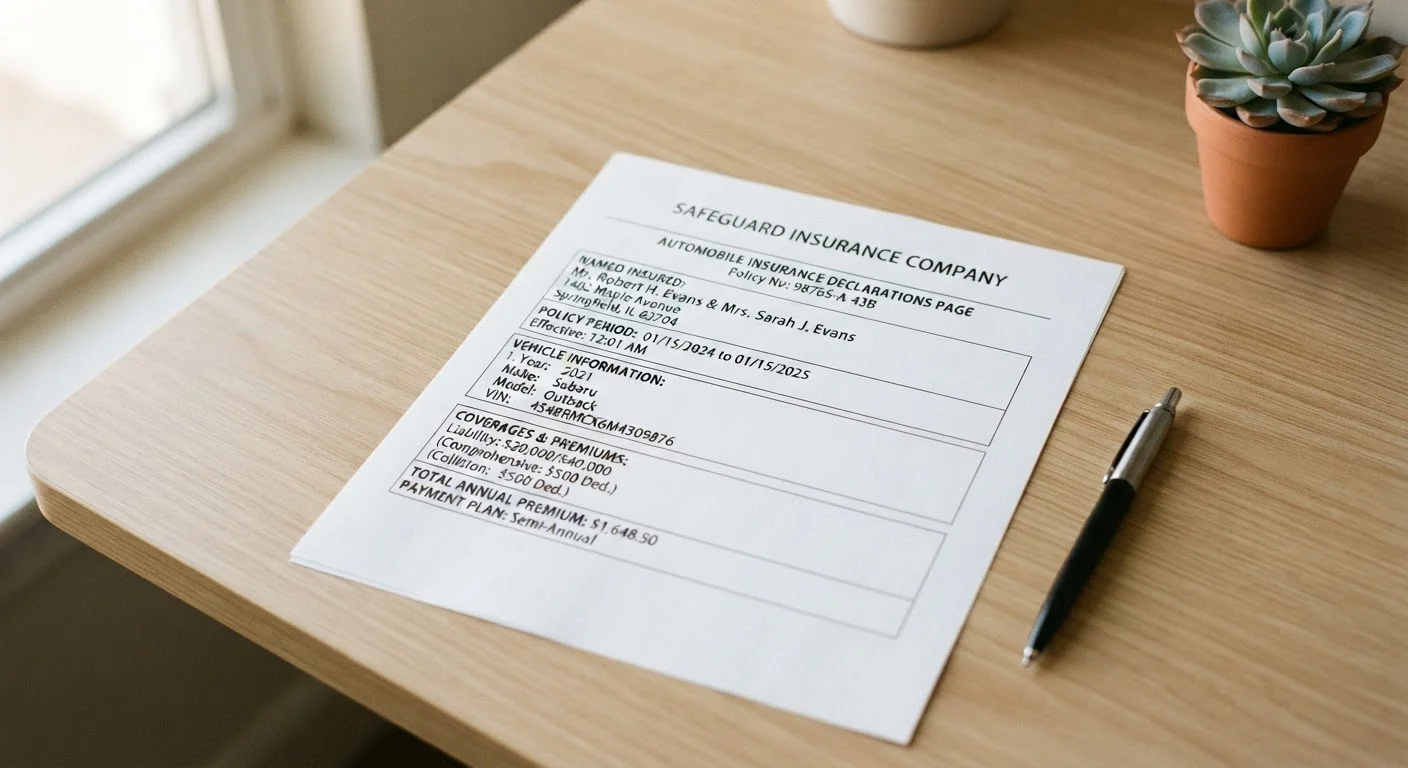
Your auto insurance declarations page - often called a "dec page" - is the summary sheet that sits at the front of your policy packet. Think of it as the cover sheet that distills a lengthy legal document into one or two readable pages. It lists who is covered, what vehicles are covered, what types of coverage you purchased, and how much those coverages will pay out.
Insurers are required to send you an updated dec page every time your policy renews or changes. If you've never looked at yours, now is the time - it tells you far more than your monthly premium amount.
| Document type | Policy summary sheet |
| Typical length | 1-2 pages |
| When updated | Each renewal or mid-term change |
| Minimum liability required | Varies by state (Check your state DMV for current minimums) |
| Common policy term | 6 or 12 months |
Key Sections and What They Mean
Here's what you'll typically find on a standard declarations page and what each section is actually telling you:
Named Insured and Drivers
This section lists the policyholder - the person whose name is on the contract - and any additional drivers explicitly covered under the policy. If a household member who regularly drives your car isn't listed here, your insurer may dispute a claim involving them. Review this list any time someone new starts driving your vehicle.
Vehicle Information
Your vehicle's year, make, model, and VIN (Vehicle Identification Number) appear here. Double-check this. A typo in the VIN can create complications during a claim, especially if your car is totaled.
Policy Period
This shows your coverage start and end dates - typically a six- or twelve-month window. Your coverage does not automatically renew without action from either you or your insurer, so note when the period ends.
Coverage Types and Limits
This is the most critical section. Each coverage type is listed alongside two numbers: a per-person or per-occurrence limit, and a per-accident limit. Common coverages include:
- Bodily Injury Liability: Pays for injuries you cause to other people in an accident.
- Property Damage Liability: Covers damage you cause to someone else's vehicle or property.
- Collision: Pays to repair or replace your own car after a collision, regardless of fault.
- Comprehensive: Covers non-collision damage - theft, fire, hail, animal strikes.
- Uninsured/Underinsured Motorist: Protects you if the at-fault driver has no insurance or not enough of it.
- Medical Payments (MedPay) or Personal Injury Protection (PIP): Covers medical costs for you and your passengers regardless of fault.
Those numbers next to each coverage matter enormously. A limit of 25/50/25 means $25,000 per injured person, $50,000 per accident for bodily injury, and $25,000 for property damage. If a serious accident exceeds those limits, you're personally responsible for the remainder. For a deeper look at where new owners commonly fall short, see why new car owners often underinsure.
Declarations Page
A one- to two-page summary document at the front of your auto insurance policy. It lists your coverage types, limits, deductibles, and insured vehicles in plain form.
Coverage Limit
The maximum dollar amount your insurer will pay for a covered claim. You are responsible for costs that exceed this limit.
Deductible
The amount you pay out of pocket on a collision or comprehensive claim before your insurance coverage applies. Choosing a higher deductible typically lowers your premium.
Liability Coverage
Insurance that pays for injuries or property damage you cause to other people in an accident. It does not pay for your own injuries or vehicle damage.
Uninsured Motorist Coverage
A coverage type that pays for your injuries or damages when the at-fault driver carries no insurance or insufficient insurance to cover your losses.
VIN
Vehicle Identification Number - a unique 17-character code assigned to every vehicle. It appears on your dec page and is used to confirm exactly which car is insured.
Deductibles
Your deductible is the amount you pay out of pocket before insurance kicks in on a collision or comprehensive claim. A $500 deductible means you cover the first $500 of repairs; your insurer covers the rest up to your policy limit. Higher deductibles generally mean lower premiums.
Discounts Applied
Many dec pages include a list of discounts your insurer has already applied - safe driver, multi-car, anti-theft device, and others. It's worth confirming these are still accurate when you renew.
How to Use This Document
Your dec page is not just a filing formality. Keep a digital copy on your phone and a printed copy in your glove compartment. When you're involved in an accident, you'll need to provide your insurer name, policy number, and coverage confirmation quickly.
Read it carefully at each renewal. Premiums rise and coverage limits can quietly shift - especially if your insurer auto-adjusts something without a direct conversation. If a line item looks unfamiliar or a coverage you expected appears missing, call your agent before assuming you're protected.
State Minimums Are Not Always Enough
Purchasing only the state-required minimum coverage keeps you legal, but it may leave significant financial exposure in a serious accident. Medical and repair costs in a multi-vehicle crash can easily exceed minimum limits. Talk to a licensed insurance agent about whether your current limits match your actual risk.
This article is for general informational purposes only and is not legal or insurance advice. Coverage requirements vary by state. Consult a licensed insurance professional for guidance specific to your situation.